Colaboración
ARTE
BELLEZA Y BIENESTAR
ARTESANÍA
CULTURA E HISTORIA
ENTRETENIMIENTO
MEDIO AMBIENTE
COMIDA Y BEBIDAS
INGENIERÍA INVERSA
CIENCIAS
DEPORTES
TECNOLOGÍA
TECNOLOGÍA VESTIBLE
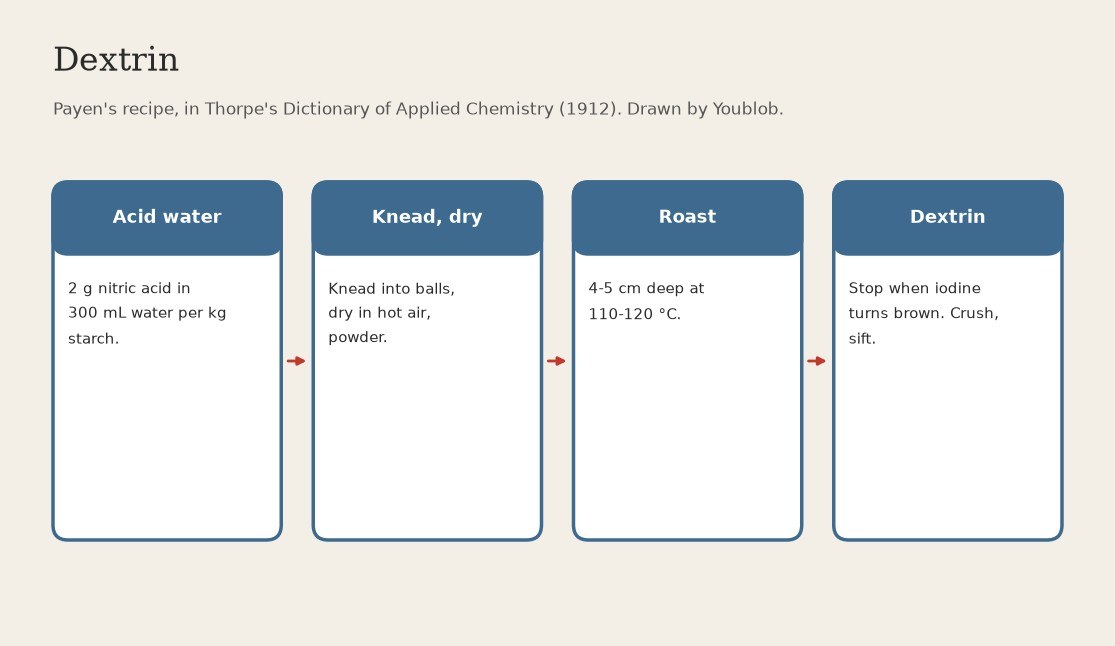


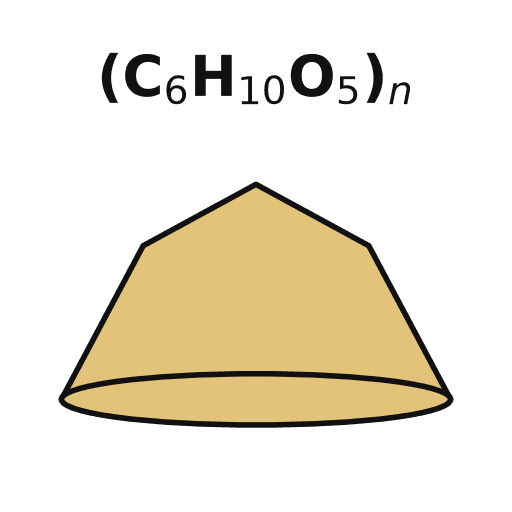
Dextrin: Starch Moistened with Dilute Nitric Acid and Heated at 110-120 °C (Payen, in Thorpe 1912)
Dextrin, also called British gum, is starch broken down by heat into a powder that dissolves in water to a sticky gum. A trace of nitric acid lets it form at a lower heat, 110 to 120 °C, so it comes out paler. The lower the heat and the drier the starch, the whiter the dextrin.
Source: Thorpe, Dictionary of Applied Chemistry, vol. 2 (1912), Dextrins, giving Payen's recipe. Ours: potato starch (Payen names no starch) and the scaling to 1 kg. Not given: how long to dry and to heat. Picture drawn by Youblob.
Principiante
2 days
Instrucciones
1
1
Mix 2 g nitric acid into 300 mL water
Mix 2 g nitric acid into 300 mL water
Payen: 30 gallons of water holding 2 lb nitric acid (sp. gr. 1.38) for 1000 lb starch. Ours, scaled to 1 kg of starch: weigh 2 g of the acid into about 300 mL water. Add acid to water, not water to acid. Goggles and gloves for the strong acid.
Materiales para este paso:
 Ácido nítrico2 g
 Agua300 ml
Herramientas necesarias:
 Balanza de platillos
 Jarra medidora
 Gafas de protección química
 Guantes de nitrilo
2
2
Knead 1 kg starch with the acid water into balls
Knead 1 kg starch with the acid water into balls
Moisten 1 kg of starch with the acid water, knead it well and make it up into balls. Payen names no starch; ours: potato starch.
Materiales para este paso:
 Fécula de patata1 kg
Herramientas necesarias:
 Cuenco de vidrioGuantes de nitrilo
3
3
Dry the balls in hot air, then powder them
Dry the balls in hot air, then powder them
Dry the balls in a hot-air chamber, then powder them. Time and heat for this drying are not given. Ours: a drying oven, and a mortar to powder.
Herramientas necesarias:
 Horno de secado
 Mortero y mano de mortero
4
4
Heat 4-5 cm deep on trays at 110-120 °C
Heat 4-5 cm deep on trays at 110-120 °C
Spread the powder 1 1/2 to 2 inches (4 to 5 cm) deep on trays (Payen: brass trays) and heat in a hot-air oven at 110 to 120 °C. Time not given.
Herramientas necesarias:
 Bandeja plana de secadoHorno de secado
 Termómetro de horno
5
5
Stop as soon as iodine turns a sample brown
Stop as soon as iodine turns a sample brown
Test small samples with iodine. Starch turns iodine blue; commercial dextrin, mostly erythrodextrin, gives a brown colour. When the change is complete, stop the heating at once. Ours: a few iodine crystals shaken in water as the test liquid.
Herramientas necesarias:
 Cristales de yodoAguaHorno de secado
6
6
Crush, sift and store dry
Crush, sift and store dry
Crush the roasted dextrin and sift it (in works: crushing pans or rollers, then a rotating silk screen as in flour mills). Ours: mortar and a fine sieve. Keep it dry in a closed jar.
Herramientas necesarias:
Mortero y mano de mortero Tamiz de malla metálica fina
 Tarro de vidrio
Materiales
3- Marcador de posición
- 300 mlMarcador de posición
- 1 kgMarcador de posición
Herramientas requeridas
13- Marcador de posición
- Marcador de posición
- Marcador de posición
- Marcador de posición
- Marcador de posición
- Marcador de posición
- Marcador de posición
- Marcador de posición
- Marcador de posición
- Marcador de posición
- Marcador de posición
- Marcador de posición
- Marcador de posición
Este plano hace
Blueprints relacionados
Estos blueprints comparten conocimiento — técnicas, materiales o principios

CC0 Dominio público
Este Blueprint se publica bajo CC0. Eres libre de copiar, modificar, distribuir y usar este trabajo para cualquier propósito, sin pedir permiso.
Apoya al Maker comprando productos a través de su Blueprint, donde gana una Comisión del Maker establecida por los vendedores, o crea una nueva iteración de este Blueprint e inclúyela como conexión en tu propio Blueprint para compartir ingresos.