ARTE
BELLEZA Y BIENESTAR
ARTESANÍA
CULTURA E HISTORIA
ENTRETENIMIENTO
MEDIO AMBIENTE
COMIDA Y BEBIDAS
INGENIERÍA INVERSA
CIENCIAS
DEPORTES
TECNOLOGÍA
TECNOLOGÍA VESTIBLE
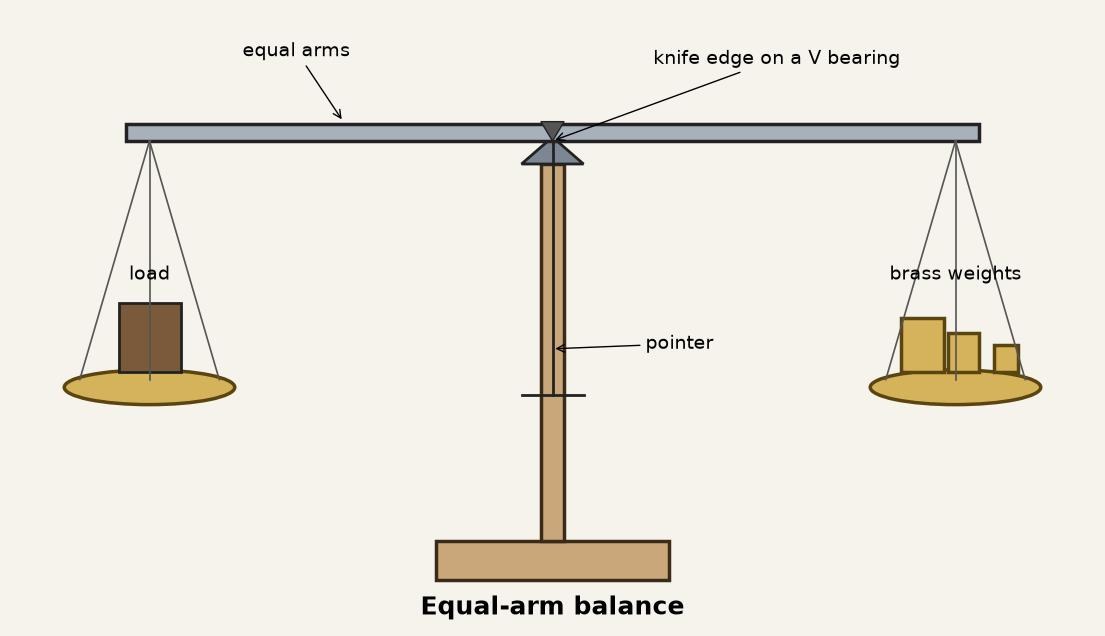


Equal-Arm Balance on a Knife Edge, with a Set of Brass Weights
The oldest weighing machine is a beam with equal arms balanced on a pivot, a pan hanging from each end: put the load in one pan and known weights in the other until the beam lies level. Balances go back to the Fourth Dynasty of Egypt. A hardened knife edge makes it sensitive and a long pointer shows the smallest tilt; the weights are cast in brass and adjusted against each other.
The picture: our diagram of the balance, its knife edge, pointer, pans and weights.
Intermedio
Two to three days
Instrucciones
1
1
Beam and knife edge
Beam and knife edge
File a straight beam from flat tool steel with a hole exactly in the middle and one near each end, the two end holes equally far from the centre. Forge and file a short steel knife edge, harden and temper it, and fit it through the centre hole, edge down. File a long pointer onto the beam.
Materiales para este paso:
 Barra plana de acero para herramientas1 pieza
Herramientas necesarias:
 Lima para metal
 Taladro de mano
 Calibre digital de 6 pulgadas
 Fragua de herrero
 Cubo de temple
 Gafas de seguridad
2
2
Stand and bearing
Stand and bearing
Make an upright stand of hardwood with a hardened steel V-block on top, shallower than the knife edge, so the beam rocks freely. Mark a zero line behind the pointer.
Materiales para este paso:
 Listón de madera dura2 piezas
 Redondo de acero dulce0.3 m
Herramientas necesarias:
Lima para metalFragua de herreroCubo de temple3
3
Pans
Pans
Cut two equal brass discs, dish them slightly, drill three holes in each rim and hang each from an end hole on three equal cords.
Materiales para este paso:
 Lámina de latón1 pieza
 Hilo de lino encerado3 m
Herramientas necesarias:
 Tijeras de chapaTaladro de manoLima para metal
4
4
Trim to level
Trim to level
With both pans empty, file the heavier side until the pointer rests on zero. Swap the pans and check again: if the pointer moves, the arms are unequal and the end holes need moving.
Herramientas necesarias:
Lima para metal5
5
Cast the weights
Cast the weights
Melt brass and cast a row of plain cylinders a little heavy in green sand.
Materiales para este paso:
 Lingote de latón2 kg
 Carbón vegetal1 as required
 Arena de moldeo5 kg
Herramientas necesarias:
Fragua de herrero Crisol de arcilla refractaria
 Tenazas para crisol
 Caja de moldeo (tapa y base)
 Guantes de soldador
6
6
Adjust the weights
Adjust the weights
Balance the largest weight against a litre of water measured in the cylinder (one kilogram, our reference), filing it down until the beam is level. Make the smaller ones by balancing pairs against a larger one and against each other, filing each to level.
Materiales para este paso:
 Agua1 litro
Herramientas necesarias:
 Probeta graduadaLima para metal
7
7
A binary set of weights
A binary set of weights
Cargando el cuaderno de Jupyter…
8
8
Limits
Limits
The balance's form and use are as Wikipedia describes; the sizes and the water reference are ours. Water's density changes a little with temperature, so the reference is good to a few parts in a thousand.
Materiales
9- Marcador de posición
- 2 piezasMarcador de posición
- Marcador de posición
- 1 piezaMarcador de posición
- Marcador de posición
- 2 kgMarcador de posición
- 1 as requiredMarcador de posición
- 5 kgMarcador de posición
- 1 litroMarcador de posición
Herramientas requeridas
12- Marcador de posición
- Marcador de posición
- Marcador de posición
- Marcador de posición
- Marcador de posición
- Marcador de posición
- Marcador de posición
- Marcador de posición
- Marcador de posición
- Marcador de posición
- Marcador de posición
- Marcador de posición
Este plano hace
Blueprints relacionados
Estos blueprints comparten conocimiento — técnicas, materiales o principios

CC0 Dominio público
Este Blueprint se publica bajo CC0. Eres libre de copiar, modificar, distribuir y usar este trabajo para cualquier propósito, sin pedir permiso.
Apoya al Maker comprando productos a través de su Blueprint, donde gana una Comisión del Maker establecida por los vendedores, o crea una nueva iteración de este Blueprint e inclúyela como conexión en tu propio Blueprint para compartir ingresos.