Colaboración
ARTE
BELLEZA Y BIENESTAR
ARTESANÍA
CULTURA E HISTORIA
ENTRETENIMIENTO
MEDIO AMBIENTE
COMIDA Y BEBIDAS
INGENIERÍA INVERSA
CIENCIAS
DEPORTES
TECNOLOGÍA
TECNOLOGÍA VESTIBLE
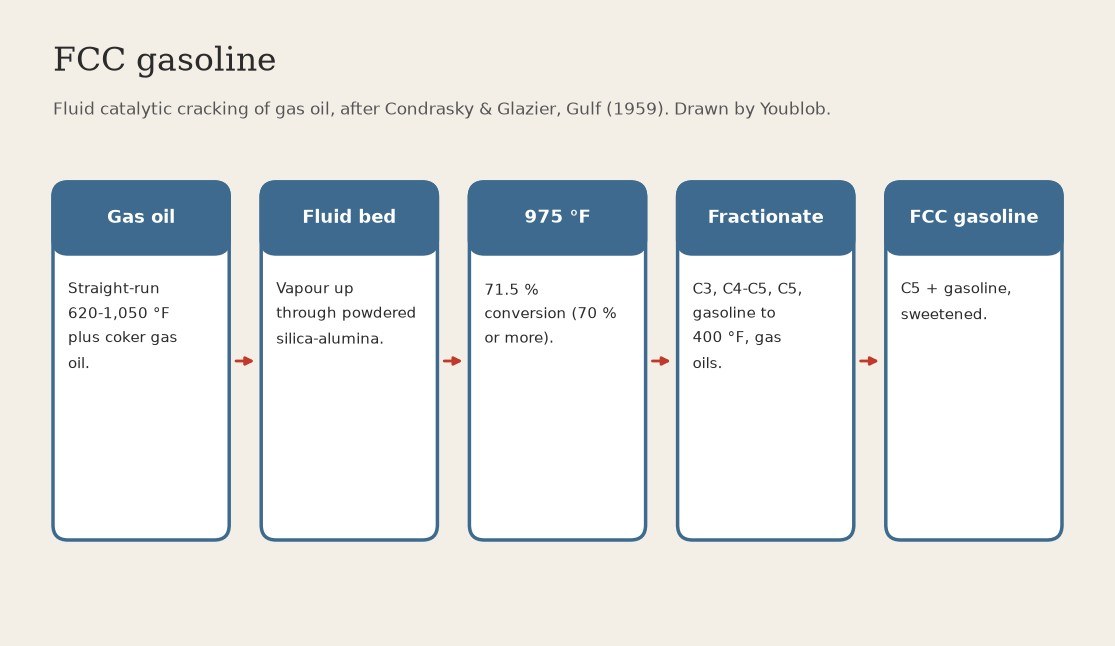

FCC Gasoline: Gas Oil Cracked over Fluidised Silica-Alumina at 975 °F, 71.5 % Conversion (Gulf, US 3,071,535)
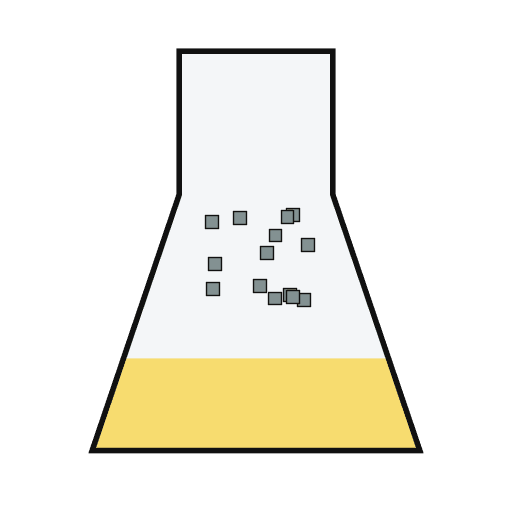
In a fluid catalytic cracker, gas oil vapour streams up through a bed of fine silica-alumina powder kept floating by the gas, and breaks into gasoline and lighter products. Gulf ran theirs hotter than usual, at 975 °F, to make more butylenes for alkylation.
Result (Gulf's example, barrels per day): from 44,840 of gas oil, 15,052 of gasoline boiling to 400 °F plus 4,393 of pentane fraction, with 7,547 of C4-C5, 4,230 of C3, 10,555 of light gas oil and fuel gas. Conversion 71.5 %.
Source: Condrasky & Glazier, US 3,071,535 (Gulf, filed 1959). The heavy gas oil and coker gas oil come from Gulf's own crude unit and coker. Not given: catalyst regeneration, space velocity, how the gasoline is sweetened. Hot oil vapour: fire risk. Picture drawn by Youblob.
Experto
1 day
Instrucciones
1
1
Charge the gas oils
Charge the gas oils
The fresh charge is heavy straight-run gas oil boiling from 620 to 1,050 °F, 36,950 barrels per day in Gulf's example, plus 7,890 of coker gas oil boiling above 400 °F.
Materiales para este paso:
 Gasóleo pesado36950 parts by volume
 Gasóleo de coquización7890 parts by volume
Herramientas necesarias:
 Tanque de petróleo
 Bomba de trasiego
2
2
Crack over a suspended bed of silica-alumina powder
Crack over a suspended bed of silica-alumina powder
Vaporise the charge and pass it upward through a suspended bed of powdered silica-alumina catalyst, as in a conventional fluid catalytic cracker.
Herramientas necesarias:
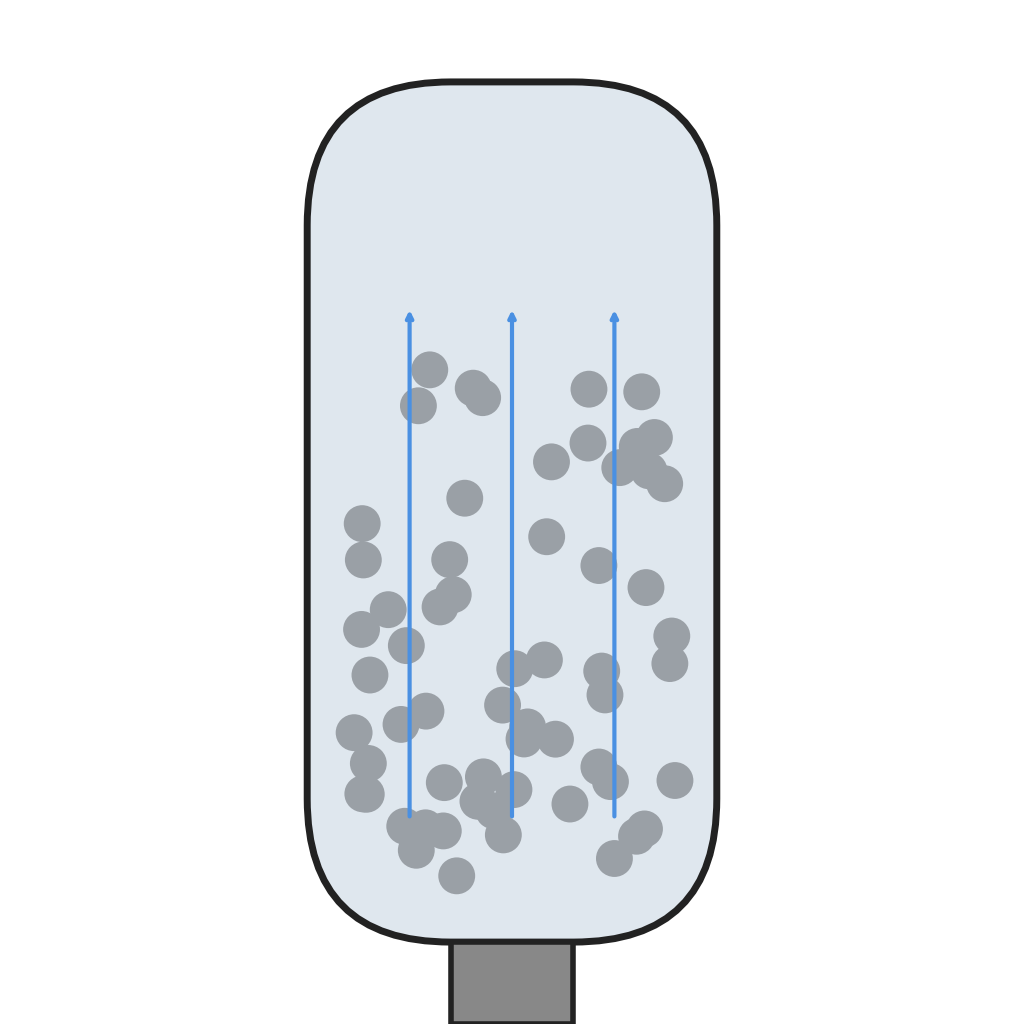 Reactor de lecho fluidizado
 Catalizador de gel de sílice-alúmina
3
3
Run at 975 °F or hotter, to 70 % conversion or more
Run at 975 °F or hotter, to 70 % conversion or more
Hold the cracking temperature at 975 °F or more, preferably 975 to 1,050 °F, and set the space velocity to convert at least 70 % by volume of the fresh charge. Gulf's example: 975 °F, 71.5 %.
Herramientas necesarias:
Reactor de lecho fluidizado Pirómetro
4
4
Fractionate the products
Fractionate the products
Split the cracked products: fuel gas, a C3 fraction (4,230), a C4-C5 fraction (7,547), a C5 fraction (4,393), gasoline boiling from C6 to 400 °F (15,052), light gas oil (10,555) and heavy oils. The C3 fraction and the light gas oil are kept for polymerisation and hydrotreating. Gulf does not describe the fractionator. Ours: a fractionating still.
Herramientas necesarias:
 Alambique de fraccionamiento
5
5
Sweeten the C5 fraction and the gasoline
Sweeten the C5 fraction and the gasoline
The C5 fraction and the gasoline are preferably sweetened in a conventional unit that turns mercaptans into less objectionable sulphur compounds. Gulf does not give the method. This is the FCC gasoline; its part boiling up to 200 °F is the light FCC of the premium blend.
Herramientas necesarias:
Tanque de petróleoMateriales
2- 36950 parts by volumeMarcador de posición
- 7890 parts by volumeMarcador de posición
Herramientas requeridas
6- Marcador de posición
- Marcador de posición
- Marcador de posición
- Marcador de posición
- Marcador de posición
- Marcador de posición
Este plano hace
Blueprints relacionados
Estos blueprints comparten conocimiento — técnicas, materiales o principios
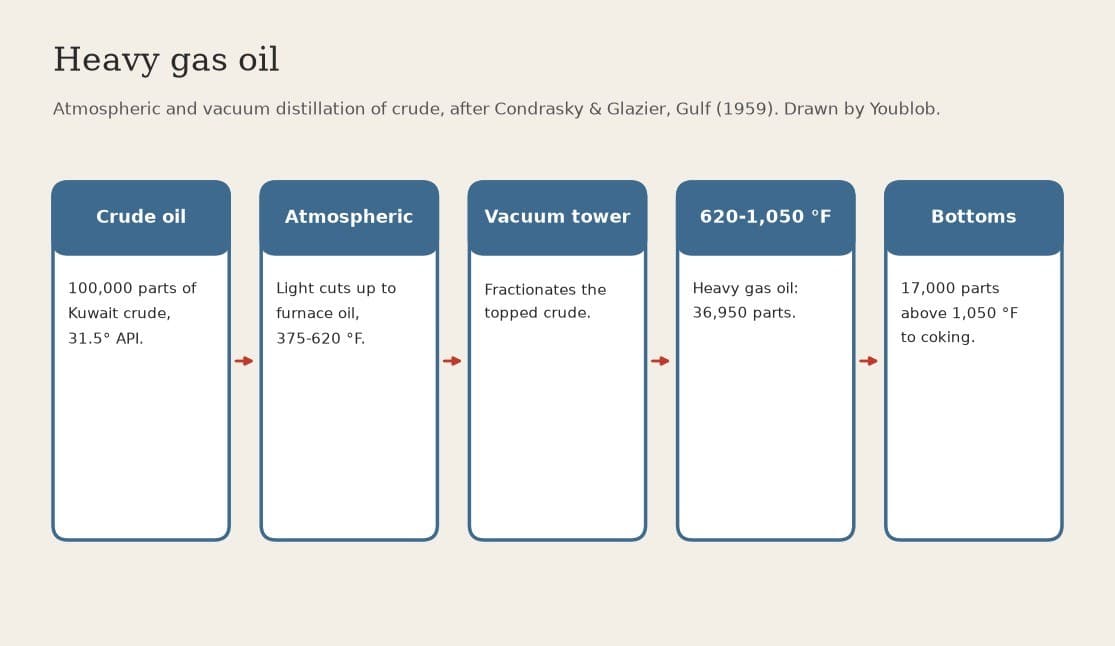
Heavy Gas Oil: the 620-1,050 °F Cut from Atmospheric and Vacuum Distillation of Crude Oil (Gulf, US 3,071,535)
por Charlie
Industrial
8
0
0
0
0
0
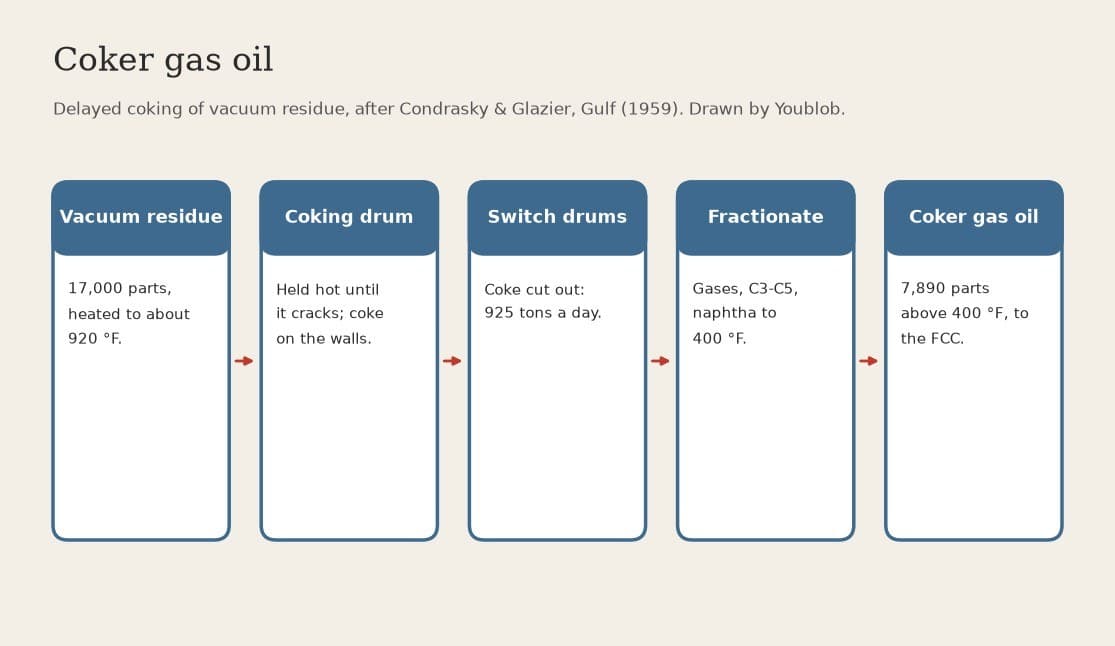
Coker Gas Oil and Petroleum Coke: Vacuum Residue Delayed-Coked at about 920 °F (Gulf, US 3,071,535)
por Charlie
Industrial
5
0
0
0
0
0
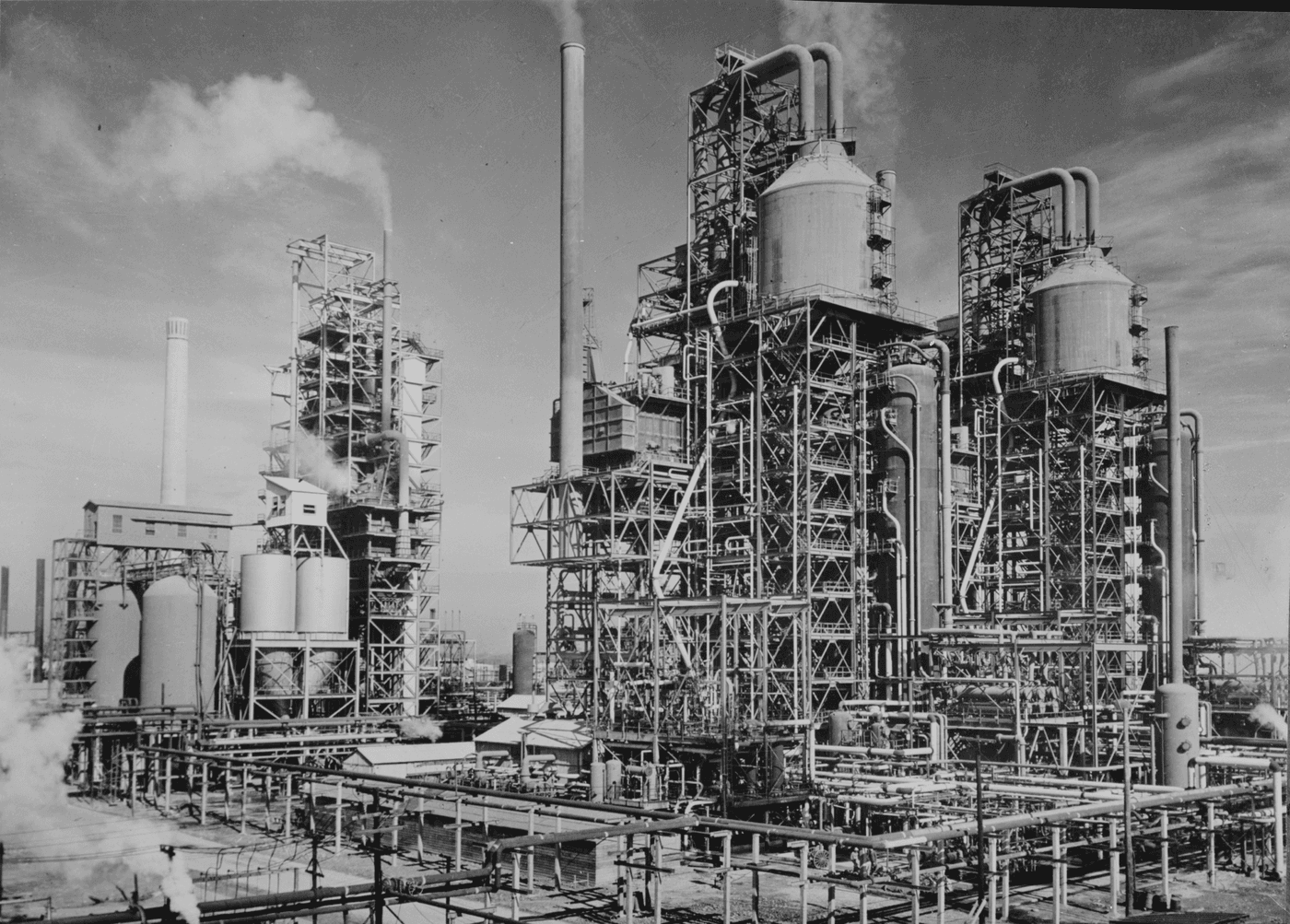
Aviation Gasoline by Catalytic Cracking over Silica-Alumina Gel at 750 °F (Voorhies, US 2,230,552)
por Charlie
Industrial
8
0
0
0
0
0
CC0 Dominio público
Este Blueprint se publica bajo CC0. Eres libre de copiar, modificar, distribuir y usar este trabajo para cualquier propósito, sin pedir permiso.
Apoya al Maker comprando productos a través de su Blueprint, donde gana una Comisión del Maker establecida por los vendedores, o crea una nueva iteración de este Blueprint e inclúyela como conexión en tu propio Blueprint para compartir ingresos.