
ARTE
BELLEZA Y BIENESTAR
ARTESANÍA
CULTURA E HISTORIA
ENTRETENIMIENTO
MEDIO AMBIENTE
COMIDA Y BEBIDAS
INGENIERÍA INVERSA
CIENCIAS
DEPORTES
TECNOLOGÍA
TECNOLOGÍA VESTIBLE
Horse Knee-Cap: Cupped Leather Block, Cloth Shield and Flock-Stuffed Chamois Roll (Hasluck, Saddlery, 1904)
Tex

Creado por

Tex

13. noviembre 2026FO
7
0
0
0
0

Horse Knee-Cap: Cupped Leather Block, Cloth Shield and Flock-Stuffed Chamois Roll (Hasluck, Saddlery, 1904)

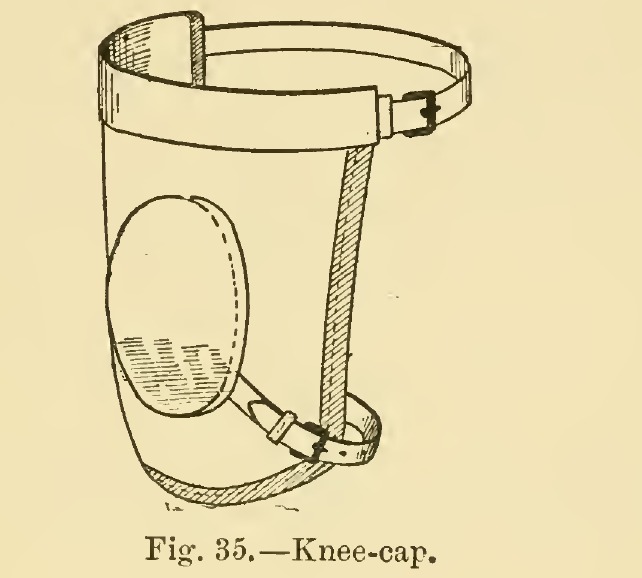
A knee-cap protects a horse's knee from knocks and falls. This one is from Paul N. Hasluck's Saddlery (1904): a leather block beaten into a cup, set on a cloth or leather shield, a flock-stuffed chamois roll along the top strap, and a strap below the knee. Every size is his. He notes it is often better to buy the pads, but shows how to make them.
Intermedio
About 1 day

Instrucciones

1

Cutting list

Cargando el cuaderno de Jupyter…
2

Read Saddlery, ch. X

"Knee-caps are of felt, fawn rugging, kersey cloth, union, buff leather, black rubber, etc."
3

Beat the knee block

With no press, damp some half-curried leather and beat it, as a shoemaker beats boot soles, until it takes a hollow cup shape. Let it dry, then cut it to a wide oval about 5 in by 4 in.

Materiales para este paso:

Cuero curtido al vegetalCuero curtido al vegetal1 pieza
Agua dulceAgua dulce1 pieza

Herramientas necesarias:

MartilloMartillo
Hierro de regazoHierro de regazo
Cuchilla para cueroCuchilla para cuero
4

Cut and bind the shield

Make the cloth, kersey or leather about 8 in at the top and 9 in deep, and round the bottom. Bind all of it except the straight top with patent binding or cloth; buff leather need not be bound.

Materiales para este paso:

Plancha de fieltro de lanaPlancha de fieltro de lana1 pieza
Tira de ribeteTira de ribete1 pieza
Hilo de linoHilo de lino1 pieza
Cera de abejaCera de abeja1 pieza

Herramientas necesarias:

TijerasTijeras
Cinta métricaCinta métrica
Punzón (lezna)Punzón (lezna)
Dos agujas de guarnicioneroDos agujas de guarnicionero
5

Fit the block

Put the leather block on the centre with a piece of shaped cardboard under it, paste the two together and press the cloth down into the hollow. Stitch the block to the cloth about 1-1/4 in from the top and 1-1/2 in from the bottom.

Materiales para este paso:

Cartón encoladoCartón encolado1 pieza
Engrudo de trigoEngrudo de trigo1 pieza
Hilo de linoHilo de lino1 pieza
Cera de abejaCera de abeja1 pieza

Herramientas necesarias:

Cuchilla para cueroCuchilla para cuero
Punzón (lezna)Punzón (lezna)
Dos agujas de guarnicioneroDos agujas de guarnicionero
6

Make the top strap

Cut a piece of leather 1-1/8 in wide and 1 in longer at each end than the cloth at the top. Make a hole at each end 1 in from the point for a 5/8 in strap. Put a chape, buckle and loop in the hole at one end and a 5/8 in strap 9 in long in the other, and stitch both firmly.

Materiales para este paso:

Cuero para arnesesCuero para arneses1 pieza
Hebilla de latón con clavilloHebilla de latón con clavillo1 pieza
Hilo de linoHilo de lino1 pieza
Cera de abejaCera de abeja1 pieza

Herramientas necesarias:

Cuchilla para cueroCuchilla para cuero
Sacabocados para cueroSacabocados para cuero
Punzón (lezna)Punzón (lezna)
Dos agujas de guarnicioneroDos agujas de guarnicionero
7

Make the padded roll

Cut chamois the same length and width as the strap. With it hanging down in front of the knee-cap and the three edges together, stitch it all along through the top leather and the cloth. Turn the chamois over the top towards the bottom and stitch it along the bottom side of the top strap, rather slack. Make two rows of stitches across the centre, leaving an opening of about 1-1/2 in exactly in the centre. Stuff both parts of the roll from each end with flock, then close the ends by stitching chamois and top leather together.

Materiales para este paso:

GamuzaGamuza1 pieza
Borra de lanaBorra de lana1 pieza
Hilo de linoHilo de lino1 pieza
Cera de abejaCera de abeja1 pieza

Herramientas necesarias:

TijerasTijeras
Punzón (lezna)Punzón (lezna)
Dos agujas de guarnicioneroDos agujas de guarnicionero
8

Fit the bottom strap

Put a 5/8 in chape buckle and loop at the bottom of the block pad, slanting slightly downwards, with a strap 10 in long on the opposite side. For a pair, reverse the buckles so each is on the outside.

Materiales para este paso:

Cuero para arnesesCuero para arneses1 pieza
Hebilla de latón con clavilloHebilla de latón con clavillo1 pieza
Hilo de linoHilo de lino1 pieza
Cera de abejaCera de abeja1 pieza

Herramientas necesarias:

Cuchilla para cueroCuchilla para cuero
Punzón (lezna)Punzón (lezna)
Dos agujas de guarnicioneroDos agujas de guarnicionero
9

Troubleshooting

Knee-cap troubleshooting.

Flow

Loading...
10

History and honest limits

From **Saddlery**, edited by Paul N. Hasluck, David McKay, 1904 (archive.org saddlery00hasl), chapter X, "Knee-caps and Miscellaneous Articles", pp. 81-84, Figs. 33-35; every fraction was read on the scan. He also suggests a better block cut with a tongue up under the top strap, and a fastening with two squares and a 5/8 in rubber ring; those are not shown here. The thread, the tools and the metric figures are ours.

Materiales

12

Herramientas requeridas

8

CC0 Dominio público

Este Blueprint se publica bajo CC0. Eres libre de copiar, modificar, distribuir y usar este trabajo para cualquier propósito, sin pedir permiso.

Apoya al Maker comprando productos a través de su Blueprint, donde gana una Comisión del Maker establecida por los vendedores, o crea una nueva iteración de este Blueprint e inclúyela como conexión en tu propio Blueprint para compartir ingresos.

Discusión

(0)

Iniciar sesión para unirte a la discusión

Cargando comentarios...