

Panning for Gold — Finding Native Metal
Instrucciones
The Physics of Gold Panning
The Physics of Gold Panning
Why Gold Sinks
Gold panning is a gravity separation technique. It works because gold is absurdly dense:
| Material | Density (g/cm³) |
|---|---|
| Sand (quartz) | 2.65 |
| Iron pyrite ("fool's gold") | 5.01 |
| Black sand (magnetite) | 5.18 |
| Lead | 11.34 |
| Gold | 19.30 |
Gold is 7.3× denser than sand. When you agitate a pan of mixed sediment in water, gravity pulls gold to the bottom while lighter materials wash over the rim. No chemistry needed — pure physics.
Where Gold Accumulates
Water transports gold downstream from its source (veins in quartz rock). Gold settles where water slows:
- Inside bends of rivers (slower water = deposition)
- Behind large boulders (eddy zones)
- Bedrock cracks (gold drops into crevices and stays)
- Below waterfalls (plunge pools concentrate heavy material)
Materiales para este paso:
 Grava1 kit
 Oro1 referencia
Herramientas necesarias:
 Tamiz clasificador
 Frasco aspirador y pinzas
 Vial de vidrio (pequeño, para muestras)
 Batea
BateaCollecting and Classifying Material
Collecting and Classifying Material
Sampling
- Dig material from bedrock level — gold works its way down through gravel over time. Surface gravel is mostly barren.
- Fill your classifier (sieve) with the excavated material and place it over your pan.
- Pour water through the classifier — fine material falls into the pan, large rocks stay in the classifier.
- Check the large rocks for visible gold before discarding. Gold sometimes lodges in rock crevices.
Quantity
Fill the pan ¾ full with classified material. Too full and you'll lose gold over the rim. Too little wastes time.
Materiales para este paso:
Oro1 referenciaGrava1 kitHerramientas necesarias:
BateaThe Panning Technique
The Panning Technique
Step-by-Step Panning
- Submerge: Hold the pan underwater and break up any clay lumps with your fingers. Gold trapped in clay won't separate.
- Shake: While submerged, shake the pan vigorously side-to-side (NOT circular). This stratifies the material — heavy gold sinks, light sand rises.
- Tilt and wash: Tilt the pan slightly away from you. Gently swirl water across the surface, washing the lightest sand over the rim.
- Re-shake: Every 3-4 washes, level the pan and shake again to re-stratify.
- Reduce: Continue the wash-shake cycle until only heavy concentrates remain — black sand (magnetite) and hopefully gold.
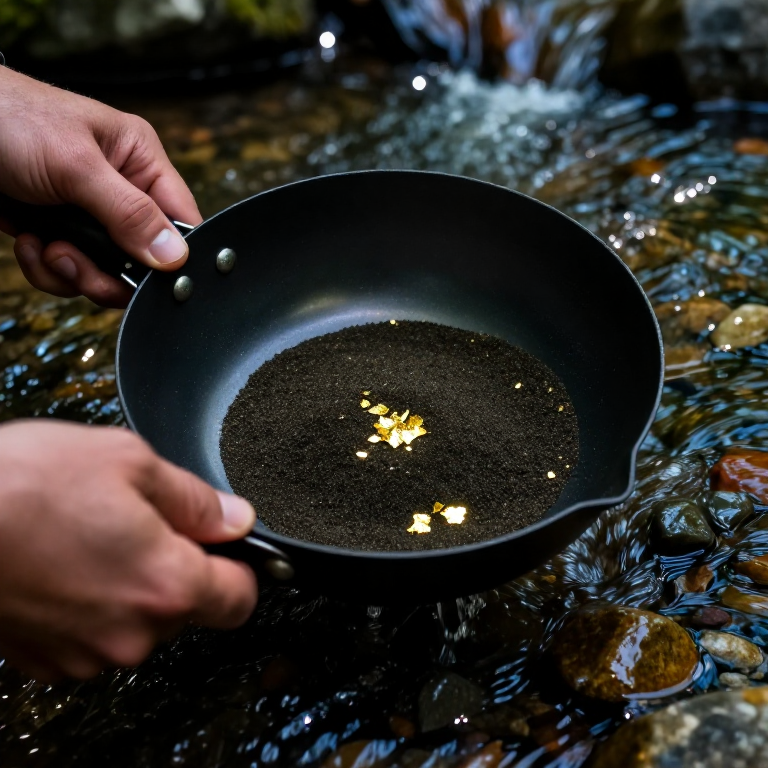
- Final check: Swirl a thin film of water across the remaining black sand. Gold appears as bright yellow flakes or specks against the dark background.
Common Mistakes
- Circular motion: Creates a vortex that lifts gold OUT of the pan. Always shake side-to-side.
- Rushing: Patience is everything. A proper pan takes 10-15 minutes.
- Shallow water: Always work with the pan submerged. Surface panning loses fine gold.
Materiales para este paso:
Grava1 kitOro1 referenciaHerramientas necesarias:
BateaRecovery and Assessment
Recovery and Assessment
Identifying Real Gold
| Test | Gold | Fool's Gold (Pyrite) |
|---|---|---|
| Color | Bright yellow, same in shade/sun | Brassy, sparkling only in direct light |
| Shape | Rounded, flattened flakes (water-worn) | Angular, cubic crystals |
| Hardness | Soft — bends with fingernail | Hard — scratches metal |
| Streak | Yellow streak on ceramic | Black/green streak |
| Density | Stays at bottom through heavy agitation | Washes away with sand |
Recovery
Use a snuffer bottle (squeeze, touch to gold flake, release — suction picks it up) or wet tweezers. Transfer to a glass vial with a small amount of water.
Innovation Connection
Gold panning shows that native metals exist — metals that occur pure in nature. This discovery (probably accidental) planted the seed: "if this shiny stuff comes from rocks, what else is hiding in rocks?" The answer required fire — and that leads to Blueprint: Smelting Copper from Malachite.
Materiales para este paso:
Grava1 kitOro1 referenciaHerramientas necesarias:
BateaCC0 Dominio público
Este Blueprint se publica bajo CC0. Eres libre de copiar, modificar, distribuir y usar este trabajo para cualquier propósito, sin pedir permiso.
Apoya al Maker comprando productos a través de su Blueprint, donde gana una Comisión del Maker establecida por los vendedores, o crea una nueva iteración de este Blueprint e inclúyela como conexión en tu propio Blueprint para compartir ingresos.