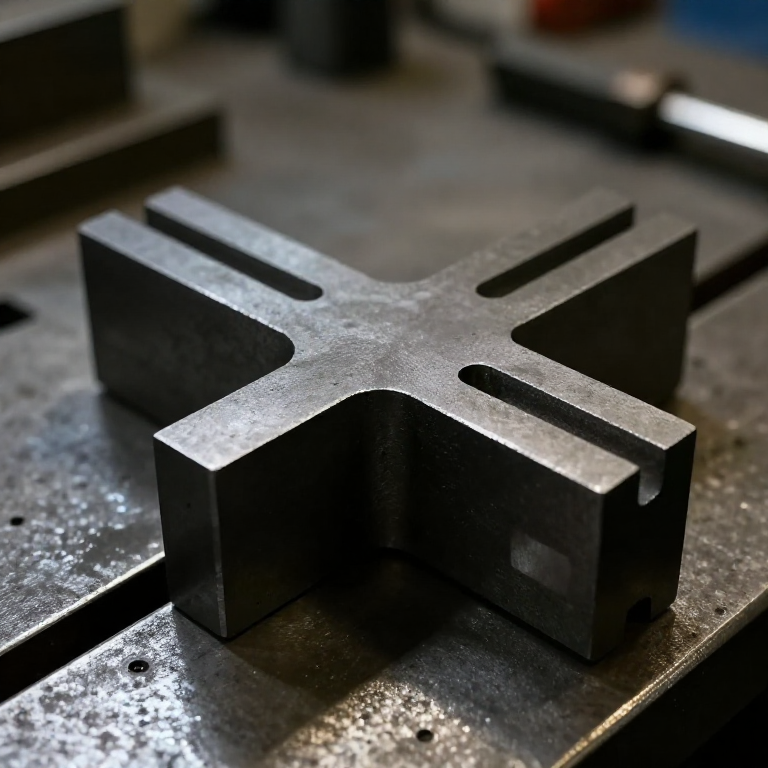


Machinist's Angle Plate
Instrucciones
Build the L
Build the L
Two plates and a rigid joint between them.
- Cut a base 150 × 100 mm and an upright 150 × 120 mm from 18 mm Baltic birch plywood.
- Face the working side of each with 6 mm aluminium flat bar, fixed with M4 × 20 flat head machine screws × 6 and M4 hex nuts × 6, all countersunk below the surface.
- Join the two at a corner using a length of aluminium angle inside the joint.
- Fix the angle with M5 × 25 socket head cap screws × 6, M5 flat washers × 12 and M5 hex nuts × 6, left slightly loose for now.
Leave the joint adjustable at this stage. Squareness is set in step 3 by measurement, not by hoping the parts were cut square. Tightening everything now removes the one chance to correct it.
Countersunk faces again, for the same reason as the V-block: any fastener standing proud of a reference face becomes the reference.Materiales para este paso:
 Contrachapado de abedul báltico1 hoja
 Pletina de aluminio2 piezas
 Angular de aluminio1 pieza
 Tornillo de cabeza plana6 piezas
 Tuerca hexagonal6 piezas
 Arandela plana12 piezasTuerca hexagonal6 piezas
Herramientas necesarias:
 Sierra de calar
 Taladro inalámbrico
 Juego de brocas
 Juego de brocas avellanadoras
 Juego de llaves Allen
Cut the mounting slots
Cut the mounting slots
Slots rather than holes, so the work can be positioned rather than merely attached.
- Mark two slots on the upright, 12 mm wide, running 70 mm vertically, spaced 60 mm apart.
- Mark two more on the base, running front to back.
- Drill a 12 mm hole at each slot end and join with the coping saw.
- File the slot edges straight and deburr both faces.
Modern build spec (derived). 12 mm slots clear M6 hardware with room to slide, which is the size most hobby machine tables are tapped for. Commercial angle plates are cast iron with machined slots and are stress-relieved before final machining, because casting stresses released later will pull a finished plate out of square.
Slot width is a clearance dimension, so it does not need precision — but the slot must not break out into the plate edge. Leave at least 15 mm of material outside each slot.Herramientas necesarias:
 Segueta (sierra de marquetería)Taladro inalámbricoJuego de brocas
 Juego de limas
 Escuadra combinada
 Calibre digital de 6 pulgadas
Set squareness by REVERSAL, not by a square
Set squareness by REVERSAL, not by a square
The clever part: find the error without owning anything known to be square.
- Stand the plate on a flat surface against a scribed line and mark along the upright's face.
- Flip the plate over left-to-right and stand it against the same line.
- Mark along the upright again.
- If the two marks coincide, the plate is square. If they diverge, the angle between them is TWICE the error.
- Adjust the loose joint by half that gap and re-test.
Herramientas necesarias:
Escuadra combinadaCalibre digital de 6 pulgadasJuego de llaves AllenJuego de limasLock it and use it
Lock it and use it
Tighten in a sequence that does not disturb what you just set.
- With squareness set, tighten the joint's six M5 screws in a cross pattern, a little at a time.
- Re-run the reversal test after tightening — clamping loads move things.
- Bolt a test piece to the upright with M6 × 40 hex bolts × 2, M6 flat washers × 4 and M6 hex nuts × 2 through the slots.
- Check the piece's free face is perpendicular to the base.
Materiales para este paso:
Arandela plana4 piezasHerramientas necesarias:
Juego de llaves AllenEscuadra combinadaCalibre digital de 6 pulgadasWhy squareness has to be built, and history
Why squareness has to be built, and history
Angle plates are old and unglamorous — they appear in machine shops from the earliest days of the industrial machine tool and have barely changed. The cast iron web-and-rib form exists for one reason: stiffness per unit weight, so the plate does not deflect under clamping loads. A plate that bends under its own clamps is worse than useless, because it appears rigid and is not.
The interesting part is where 90 degrees comes from in the first place. There is no natural right angle to copy. Reversal, used in step 3, is how the first accurate squares were made: compare a thing with its own mirror image and the error doubles while the reference cancels. The same self-referencing logic makes a flat plane from three plates rubbed together, which is the three-plate method elsewhere in this catalogue.
What it does among its siblings: the V-block removes the freedoms of a round bar; the angle plate presents a flat face perpendicular to another; a vise grips but guarantees no geometry at all; a sine bar sets angles that are NOT 90 degrees. Workholding is a family of freedom-removal devices, and choosing between them starts with asking which freedoms the job actually has.
Honest limits of this build: plywood and aluminium will not hold accuracy under heavy clamping the way ground cast iron does, and wood moves with humidity. Re-run the reversal check periodically rather than assuming it stays true — which is, in fairness, good practice with a real angle plate too.
Materiales
7- Marcador de posición
- 2 piezasMarcador de posición
- 1 piezaMarcador de posición
- 6 piezasMarcador de posición
- 6 piezasMarcador de posición
- 16 piezasMarcador de posición
- 6 piezasMarcador de posición
Herramientas requeridas
9- 1 vendor sell this, none ship to you yetMarcador de posición
- 1 vendor sell this, none ship to you yetMarcador de posición
- Marcador de posición
- Marcador de posición
- Marcador de posición
- Marcador de posición
- Marcador de posición
- Marcador de posición
- Marcador de posición
Este plano hace

Blueprints relacionados
Estos blueprints comparten conocimiento — técnicas, materiales o principios
CC0 Dominio público
Este Blueprint se publica bajo CC0. Eres libre de copiar, modificar, distribuir y usar este trabajo para cualquier propósito, sin pedir permiso.
Apoya al Maker comprando productos a través de su Blueprint, donde gana una Comisión del Maker establecida por los vendedores, o crea una nueva iteración de este Blueprint e inclúyela como conexión en tu propio Blueprint para compartir ingresos.