ARTE
BELLEZA Y BIENESTAR
ARTESANÍA
CULTURA E HISTORIA
ENTRETENIMIENTO
MEDIO AMBIENTE
COMIDA Y BEBIDAS
INGENIERÍA INVERSA
CIENCIAS
DEPORTES
TECNOLOGÍA
TECNOLOGÍA VESTIBLE
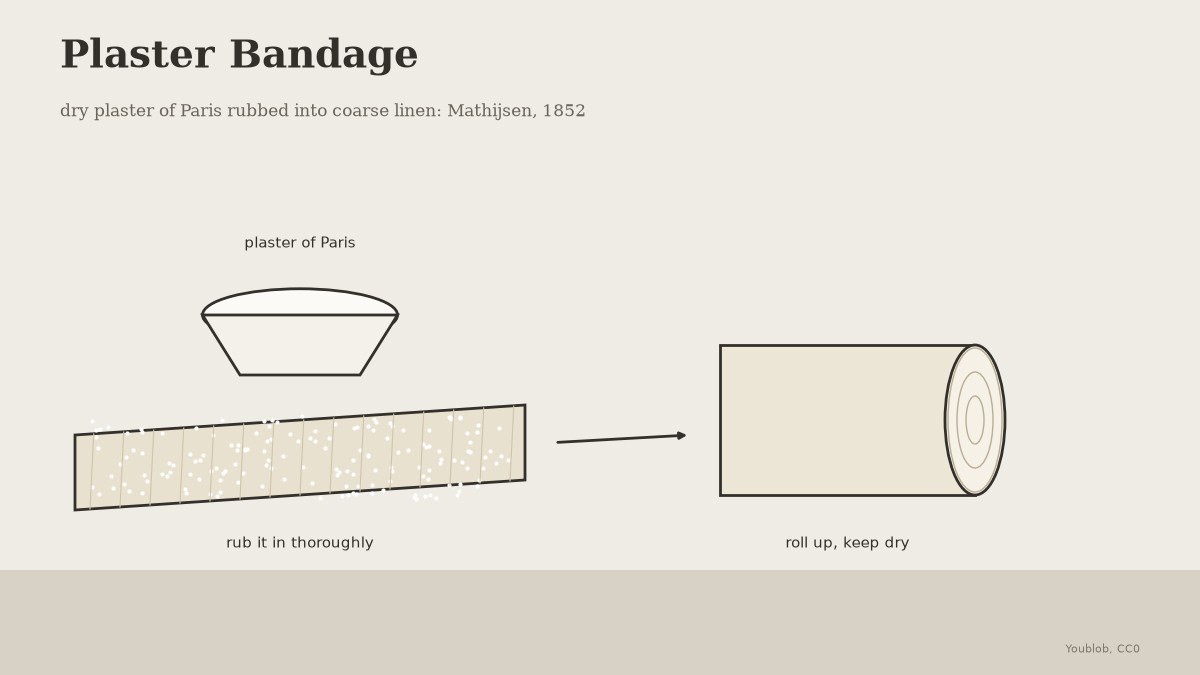


Plaster Bandage: Dry Plaster of Paris Rubbed into Coarse Linen, Mathijsen 1852
The plaster bandage of the Dutch army surgeon Antonius Mathijsen (1852): coarse linen with dry plaster of Paris rubbed well into it. Wetted as it goes on and rubbed by hand, it sets hard within minutes. Until 1931 hospitals made their own this way.
The picture: our own drawing.
Principiante
1 hour
Instrucciones
1
1
Cut coarse linen strips
Cut coarse linen strips
Cut a coarsely woven linen into long strips, bandage width.
Materiales para este paso:
 Tejido de lino1 sqm
Herramientas necesarias:
 Tijeras de sastre
2
2
Rub the plaster in
Rub the plaster in
Lay a strip flat and rub dry plaster of Paris thoroughly into the weave, working along its length. Do it slowly so the dust stays down.
Materiales para este paso:
 Escayola500 g
Herramientas necesarias:
 Cuenco
 Mascarilla respiratoria N95
3
3
Roll and keep dry
Roll and keep dry
Roll each strip loosely and store it closed and dry: any damp sets the plaster. To use, wet it as it goes on and rub it smooth by hand.
Herramientas necesarias:
 Tarros de vidrio con tapa
Herramientas requeridas
4- Marcador de posición
- Marcador de posición
- Marcador de posición
- Marcador de posición
Este plano hace

CC0 Dominio público
Este Blueprint se publica bajo CC0. Eres libre de copiar, modificar, distribuir y usar este trabajo para cualquier propósito, sin pedir permiso.
Apoya al Maker comprando productos a través de su Blueprint, donde gana una Comisión del Maker establecida por los vendedores, o crea una nueva iteración de este Blueprint e inclúyela como conexión en tu propio Blueprint para compartir ingresos.