ARTE
BELLEZA Y BIENESTAR
ARTESANÍA
CULTURA E HISTORIA
ENTRETENIMIENTO
MEDIO AMBIENTE
COMIDA Y BEBIDAS
INGENIERÍA INVERSA
CIENCIAS
DEPORTES
TECNOLOGÍA
TECNOLOGÍA VESTIBLE


Polypropylene Pellets by Bulk Polymerisation in Liquid Propylene
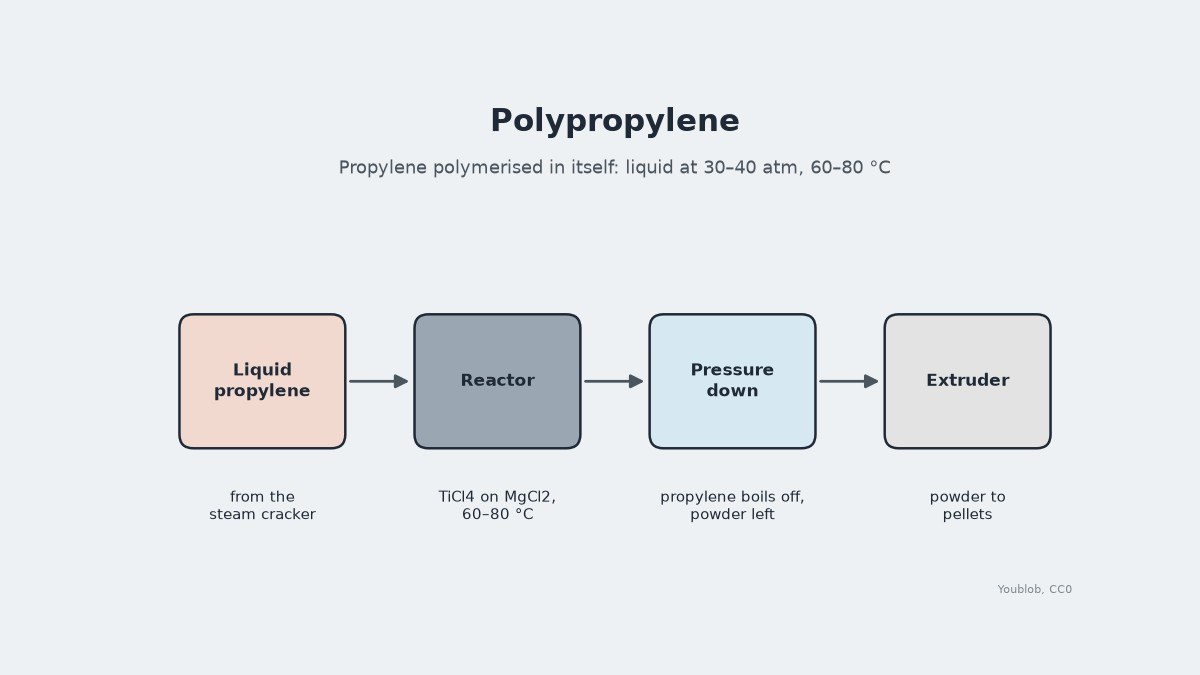
Polypropylene is propylene strung into long chains. In the bulk process the propylene itself is the liquid: kept liquid at 30–40 atm, it polymerises at 60–80 °C on a catalyst of titanium tetrachloride on magnesium chloride. Letting the pressure down boils off the unreacted propylene and leaves a powder, which is extruded into pellets. Natta found the regular (isotactic) form in 1954.
The picture: our diagram of reactor, flash and pelletiser.
Avanzado
Continuous
Instrucciones
1
1
Polymerise in liquid propylene
Polymerise in liquid propylene
Feed propylene and the TiCl4-on-MgCl2 catalyst into the reactor. Hold it at 30–40 atm so the propylene stays liquid, at 60–80 °C.
Materiales para este paso:
 Propileno1 t
Herramientas necesarias:
 Reactor a presión
 Catalizador Ziegler-Natta (TiCl4 sobre MgCl2)
 Compresor de gas
2
2
Let the pressure down
Let the pressure down
Release the pressure: the unreacted propylene boils off and the polymer is left as a fine powder. Compress the propylene and return it.
Herramientas necesarias:
Compresor de gas3
3
Pelletise
Pelletise
Melt the powder in the extruder, with any additives the grade needs, and cut the strand into pellets.
Herramientas necesarias:
 Extrusora de plástico
4
4
Pressure units
Pressure units
Cargando el cuaderno de Jupyter…
Herramientas requeridas
4- Marcador de posición
- Marcador de posición
- Marcador de posición
- Marcador de posición
Este plano hace

Blueprints relacionados
Estos blueprints comparten conocimiento — técnicas, materiales o principios
CC0 Dominio público
Este Blueprint se publica bajo CC0. Eres libre de copiar, modificar, distribuir y usar este trabajo para cualquier propósito, sin pedir permiso.
Apoya al Maker comprando productos a través de su Blueprint, donde gana una Comisión del Maker establecida por los vendedores, o crea una nueva iteración de este Blueprint e inclúyela como conexión en tu propio Blueprint para compartir ingresos.