ARTE
BELLEZA Y BIENESTAR
ARTESANÍA
CULTURA E HISTORIA
ENTRETENIMIENTO
MEDIO AMBIENTE
COMIDA Y BEBIDAS
INGENIERÍA INVERSA
CIENCIAS
DEPORTES
TECNOLOGÍA
TECNOLOGÍA VESTIBLE


Spiral-Slot Dasher Churn: The Dasher Turns As It Rises and Falls
A plain dash churn only moves the cream up and down.
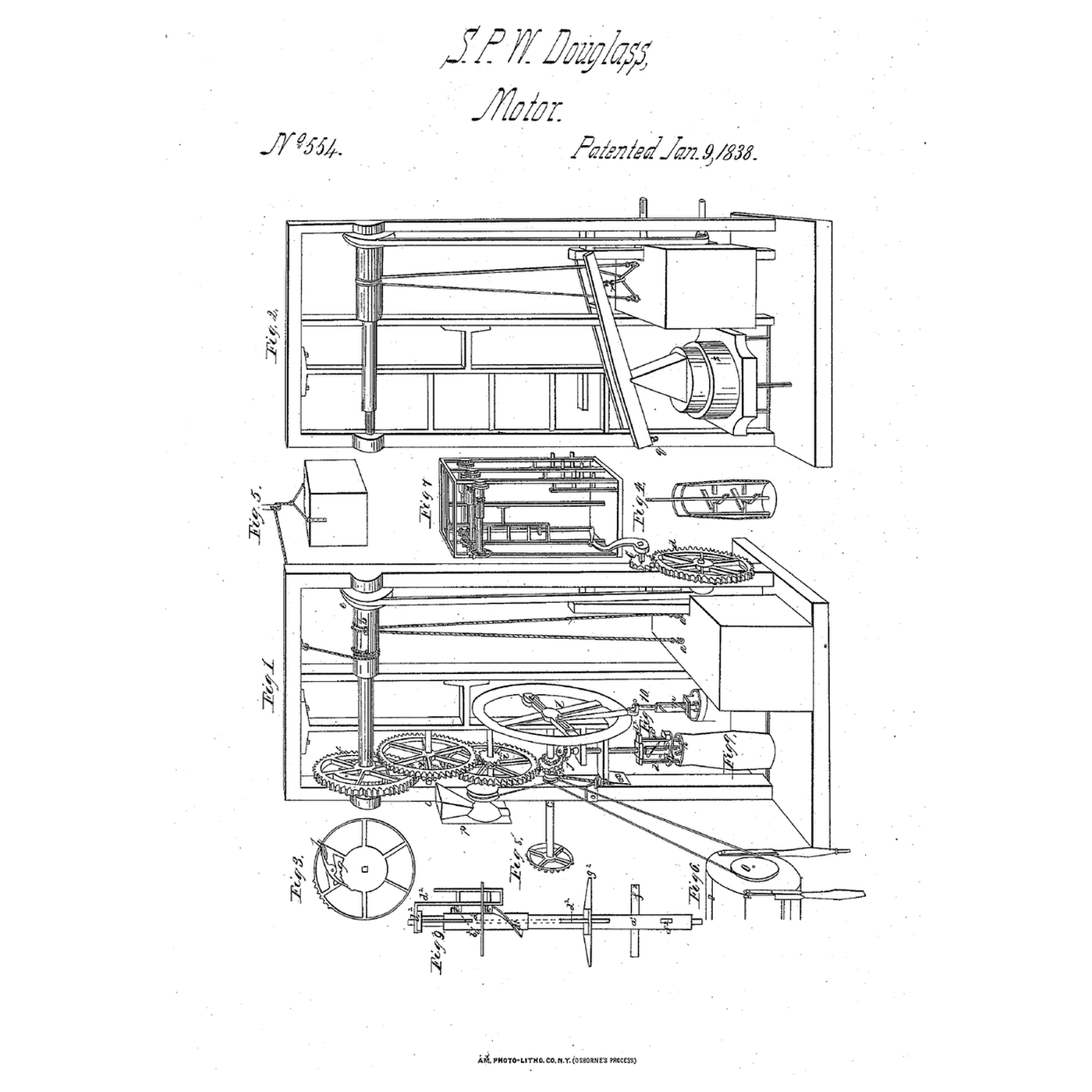
Stephen P. W. Douglass of Lansingburgh, New York, received US 554, dated 9 January 1838, for a mode of constructing and operating churns "to be propelled by machinery": a falling weight driving a train of gearing, and a dasher given "a revolving motion, and also a reciprocating motion, up and down, simultaneously." In one form a tube on the churn top has a spiral slot, and a pin on the dasher's staff runs in it, so the whole dasher "rises and falls by a reciprocating rotary motion."
This rung works through his gear train, then prints the slotted tube and the dasher, fits them to a jar, and makes butter.
Intermedio
About 3 hours, plus printing
Instrucciones
1
1
His gear train and our slot
His gear train and our slot
Cargando el cuaderno de Jupyter…
2
2
A falling weight that drives a train of wheels
A falling weight that drives a train of wheels
A weight clock runs for hours from one wind. Douglass drove his churn the same way: a weight wound up by a crank, then let down through gearing.
3
3
Read US 554
Read US 554
"In my second modification, Fig. X, the whole dasher rises and falls by a reciprocating rotary motion, i², i², is a tube of metal affixed to the top of the churn, and through which the shaft j², j², works freely. The tube has a spiral slot k² through it, which admits a pin l², or friction roller affixed to the staff or shaft j². This shaft is made to rise and fall by a crank motion, which from the arrangement described produces the desired effect."
4
4
Print the tube and dasher
Print the tube and dasher
Print the slotted tube upright on its flange: its slot turns 120° over 60 mm of rise. Print the four-bladed dasher. Print in PETG at 0.2 mm layers, 30 % infill, 4 walls; wash before first use.
Materiales para este paso:
 Filamento PETG1 pieza
Herramientas necesarias:
 Impresora 3D de filamento (FDM)
5
5
Print the tube
6
6
Print the dasher
Print the dasher
The dasher, printed as step 4 describes.
7
7
Fit the tube to the jar lid
Fit the tube to the jar lid
Drill a 13 mm hole in the centre of the lid of a 1-litre wide-mouth jar and three holes for M3 screws on a 40 mm circle. Bolt the tube's flange over it with nuts and washers.
Materiales para este paso:
 Tarro de vidrio1 pieza
 Tornillos de máquina1 pieza
 Tuerca hexagonal1 pieza
 Arandela plana1 pieza
Herramientas necesarias:
 Taladro inalámbrico
 Juego de brocas
 Juego de destornilladores
 Llave inglesa ajustable
8
8
Staff, pin and knob
Staff, pin and knob
Cut a 12 mm hardwood dowel to reach from 10 mm above the jar's floor to 110 mm above the lid. Glue the dasher on its foot and pin it with a small screw through the hub's cross hole. Pass the staff up through the lid and tube, drill it across at the slot, and screw an M4 machine screw through as the pin, its head in the slot. Glue a hardwood knob on top.
Materiales para este paso:
 Espigas de madera dura1 pieza
 Bloque de madera dura1 piezaTornillos de máquina1 pieza
 Cola de carpintero1 pieza
 Tornillo para madera n.º 8 x 1"1 pieza
Herramientas necesarias:
 SerruchoTaladro inalámbricoJuego de brocas
 Papel de lija
9
9
The patent drawing
The patent drawing
US 554 drawing sheet, public domain (expired patent).
10
10
Plunge and make butter
Plunge and make butter
Let the heavy cream stand until it reaches about 15 °C, checked with the thermometer. Fill the jar no more than a third full and fit the lid. Plunge the knob steadily up and down. The slot turns the dasher a third of a turn each way as it moves. Time until the butter comes. Pour off the buttermilk, add cold water, churn a little and pour off again until it runs clear; work in a pinch of salt and weigh the butter.
Materiales para este paso:
 Crema de leche espesa300 ml
 Sal marina gruesa1 pieza
 Agua1 pieza
Herramientas necesarias:
 Termómetro de sonda permanente
 Cronómetro
 Báscula digital de cocina
 Bol grande de acero inoxidable
11
11
A pin that sticks, a dasher that will not turn
A pin that sticks, a dasher that will not turn
Spiral-slot dasher churn troubleshooting.
Flow
Loading...
12
12
History and honest limits
History and honest limits
**Stephen P. W. Douglass** of Lansingburgh, Rensselaer County, New York, formerly of Pittston, received US 554, dated 9 January 1838. A crank winds up the weight; a ratchet holds it; a friction band with an adjusting screw regulates or stops the machinery. He calculated that "a weight can be raised six feet by a woman of ordinary strength or a sturdy boy ten years old in one and a half minutes or by a man in half a minute," enough for three quarters of an hour and "so as to churn effectually twenty gallons of cream." The same machine could also work a rotary dasher, an up-and-down dasher on a crank, or both at once. He claimed "the giving a rotary and vertical motion to the dasher of the churn."
**Honest limits.** We work the staff by hand instead of by his weight and crank, and a printed tube stands in for his metal one. FDM prints hold food in their layer lines, so wash well and replace when worn. Your times and weights are the result.
Materiales
12- 1 piezaMarcador de posición
- 1 piezaMarcador de posición
- 2 piezasMarcador de posición
- 1 piezaMarcador de posición
- 1 piezaMarcador de posición
- 1 piezaMarcador de posición
- 1 piezaMarcador de posición
- 1 piezaMarcador de posición
- Marcador de posición
- 300 mlMarcador de posición
- 1 piezaMarcador de posición
- 1 piezaMarcador de posición
Herramientas requeridas
11- Marcador de posición
- 1 vendor sell this, none ship to you yetMarcador de posición
- Marcador de posición
- Marcador de posición
- Marcador de posición
- Marcador de posición
- Marcador de posición
- Marcador de posición
- Marcador de posición
- Marcador de posición
- Marcador de posición
Archivos de diseño
2Este plano hace
Blueprints relacionados
Estos blueprints comparten conocimiento — técnicas, materiales o principios



CC0 Dominio público
Este Blueprint se publica bajo CC0. Eres libre de copiar, modificar, distribuir y usar este trabajo para cualquier propósito, sin pedir permiso.
Apoya al Maker comprando productos a través de su Blueprint, donde gana una Comisión del Maker establecida por los vendedores, o crea una nueva iteración de este Blueprint e inclúyela como conexión en tu propio Blueprint para compartir ingresos.