ARTE
BELLEZA Y BIENESTAR
ARTESANÍA
CULTURA E HISTORIA
ENTRETENIMIENTO
MEDIO AMBIENTE
COMIDA Y BEBIDAS
INGENIERÍA INVERSA
CIENCIAS
DEPORTES
TECNOLOGÍA
TECNOLOGÍA VESTIBLE



The Cap-and-Cone Lemon Squeezer: Squeeze Sideways, Not Inside Out
A squeezer that presses a half lemon straight down has to turn it nearly inside out to get the juice, and that takes a strong grip.
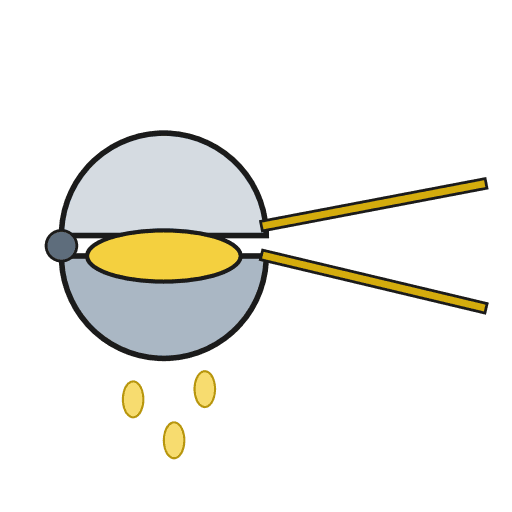
Lewis S. Chichester of New York received US 28,967, dated 3 July 1860, for a lemon squeezer in which "a cap and cone arranged substantially as hereinafter described, whereby a lateral pressure is exerted against the lemon and in such a way as to fully express the juice with a moderate application of power." The half lemon sits cut side down on the cone in a cup with a pouring nozzle, and a lever brings the cap down over it.
This rung works out the force of the lever and the sideways push of the cone, with a work check, then builds the squeezer from a tin can, a turned cone and a hinged lever and weighs its juice against a flat press.
Intermedio
About 3 hours
Instrucciones
1
1
Lever force and cone push
Lever force and cone push
Cargando el cuaderno de Jupyter…
2
2
Why the handle is long
Why the handle is long
The embedded blueprint works out the lever law. Chichester's cap sits near the fulcrum so the hand's push is multiplied on the lemon.
3
3
Read US 28,967
Read US 28,967
"The ordinary lemon squeezers require considerable power in order to express the juice fully from the lemon or rather from the half lemon which is fitted in them, in consequence of the pressure being exerted upon it axially or in the direction of its length and involving the necessity of nearly turning it inside out at the completion of the pressure."
"The operator then depresses the lever or handle D, and the cap E, descends on the lemon forcing the latter down on the projection C, and subjecting the lemon to a downward and lateral pressure and effectually expressing the juice therefrom which is retained by the cup A."
4
4
Build the squeezer and weigh the juice
Build the squeezer and weigh the juice
**Cup.** Take a clean tin can a little wider than half a lemon and file a pouring notch in its rim. Punch small holes round the bottom's edge so juice can pass to a glass beneath if you prefer.
**Cone.** Rasp a cone 5 cm tall and as wide at the base as the can from hardwood block, with a 30° half-angle checked with the protractor, and screw it to the can's centre from below.
**Lever and cap.** Screw a hardwood upright to a board as the fulcrum post and bolt a 25 cm hardwood lever to it. Hollow a hardwood block into a cap that fits over the cone with a few millimetres to spare and bolt it to the lever 3 cm from the fulcrum, loose enough to tilt and seat itself, as Chichester's pin let it. Stand the can under it.
**Test.** Weigh two lemons and halve them. Squeeze two halves with the lever, reading your push at the lever's end with the spring scale. Press the other two halves flat on a plate with a jar base at the same force. Weigh the juice from each.
Materiales para este paso:
 Lata1 pieza
 Bloque de madera dura2 piezas
 Tabla de madera dura1 pieza
 Tablero contrachapado1 pieza
 Surtido de tornillos hexagonales1 pieza
 Tuerca hexagonal2 piezas
 Tornillos para madera4 piezas
 Limón2 piezas
Herramientas necesarias:
 Serrucho
 Escofina
 Limas (lima de mano)
 Clavos
 Martillo
 Taladro inalámbrico
 Juego de brocas
 Transportador de ángulos
 Juego de destornilladores
 Llave inglesa
 Cuchillo de cocina
 Jarra medidora
 Báscula digital de cocina
 Dinamómetro (balanza de resorte)
5
5
A squeezer that slips, sprays or leaves juice behind
A squeezer that slips, sprays or leaves juice behind
Cap-and-cone lemon squeezer troubleshooting.
Flow
Loading...
6
6
History and honest limits
History and honest limits
**Lewis S. Chichester** of New York received US 28,967, dated 3 July 1860. His cup, handle and cone could be cast in one piece of metal, the cap was pinned to the lever so it could adjust itself over the cone, and the cone could be conical or pyramidal. His claim is the cap, cone and cup combined.
**Honest limits.** A tin can, a hardwood cone and cap and a board lever stand in for his cast metal. The notebook ignores friction; its forces, lengths and angles are examples. Your juice weights are the result.
Materiales
8- 1 piezaMarcador de posición
- 2 piezasMarcador de posición
- 1 piezaMarcador de posición
- 1 piezaMarcador de posición
- Marcador de posición
- 2 piezasMarcador de posición
- 4 piezasMarcador de posición
- 2 piezasMarcador de posición
Herramientas requeridas
14- Marcador de posición
- Marcador de posición
- Marcador de posición
- Marcador de posición
- Marcador de posición
- 1 vendor sell this, none ship to you yetMarcador de posición
- Marcador de posición
- Marcador de posición
- Marcador de posición
- Marcador de posición
- Marcador de posición
- Marcador de posición
- Marcador de posición
- Marcador de posición
Este plano hace
Blueprints relacionados
Estos blueprints comparten conocimiento — técnicas, materiales o principios



CC0 Dominio público
Este Blueprint se publica bajo CC0. Eres libre de copiar, modificar, distribuir y usar este trabajo para cualquier propósito, sin pedir permiso.
Apoya al Maker comprando productos a través de su Blueprint, donde gana una Comisión del Maker establecida por los vendedores, o crea una nueva iteración de este Blueprint e inclúyela como conexión en tu propio Blueprint para compartir ingresos.