ARTE
BELLEZA Y BIENESTAR
ARTESANÍA
CULTURA E HISTORIA
ENTRETENIMIENTO
MEDIO AMBIENTE
COMIDA Y BEBIDAS
INGENIERÍA INVERSA
CIENCIAS
DEPORTES
TECNOLOGÍA
TECNOLOGÍA VESTIBLE


The Toe-Holding Bootjack: A Shaft That Pins the Boot Down
A plain bootjack grips the heel, but a tight boot lifts off the jack and comes up with the foot.
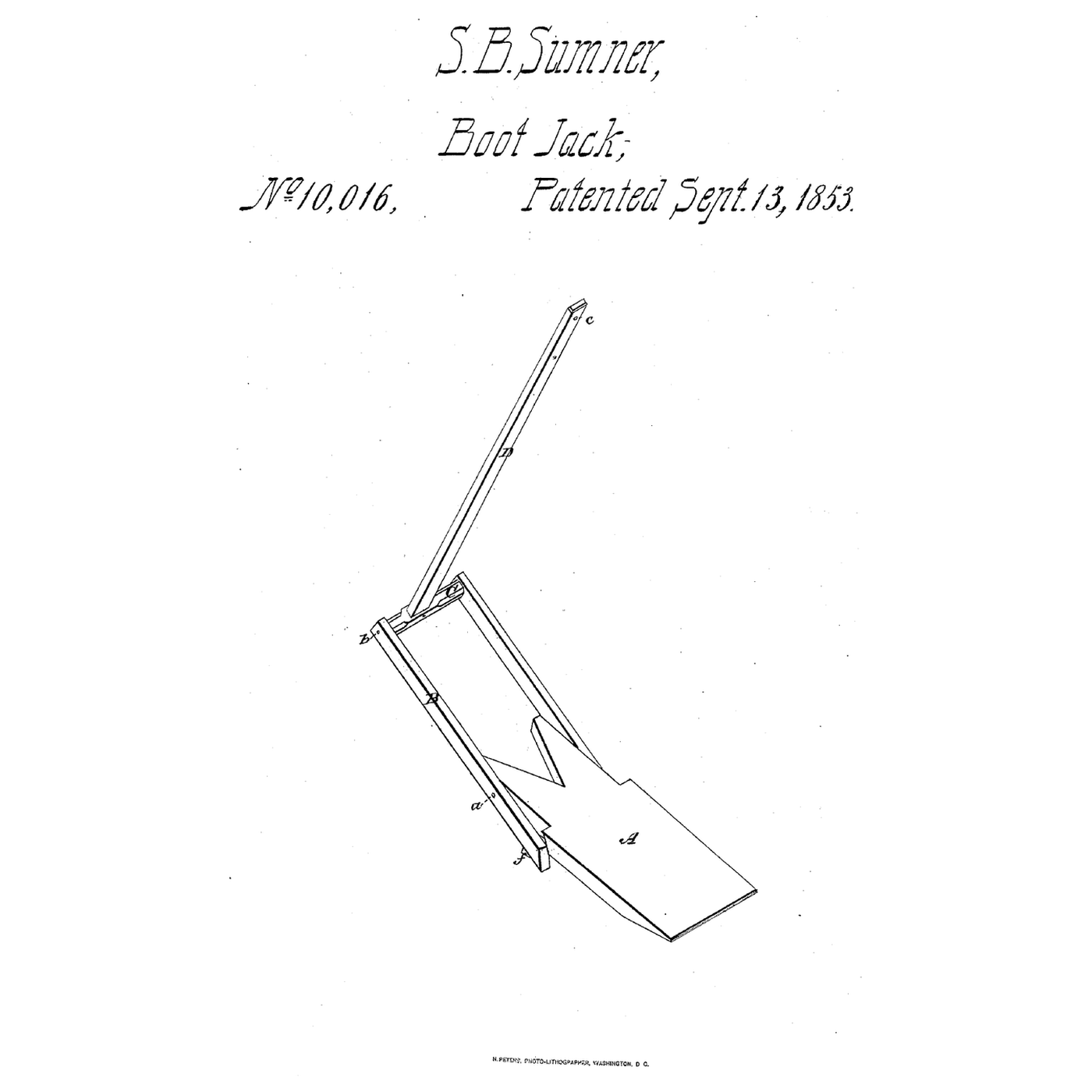
Samuel B. Sumner of Grantville, Massachusetts, received US 10,016, dated 13 September 1853, for an improvement in machines for taking off boots: two side bars pivoted to an ordinary bootjack and joined by a shaft, into which a bar is mortised. With one foot on the jack and the heel of the other in the jaws, "the bar D, being grasped by the hand, the shaft C, is pressed down upon the toe of the boot, by which means it is easily withdrawn."
This rung works out how hard the shaft holds the toe, then builds the jack from hardwood and dowel and times taking a boot off with and without the bar.
Principiante
About 3 hours
Instrucciones
1
1
Force on the toe
Force on the toe
Cargando el cuaderno de Jupyter…
2
2
Why the long bar helps
Why the long bar helps
The embedded blueprint works out the lever law. Sumner's bar is a lever that turns the side bars about their pivot and presses the shaft on the toe.
3
3
Read US 10,016
Read US 10,016
"A is the body of the ordinary boot jack. B are two side bars, pivoted to the jack at the point a. These side bars are connected together by the shaft C, which is permitted to revolve around the points b, and into which is mortised the bar or handle D."
"f, is the bar or bridge upon which the jack rests as usual for the purpose of raising the forked end from the ground."
4
4
Build the jack and take a boot off
Build the jack and take a boot off
**Body.** Saw a board 40 × 12 cm from hardwood board. Cut a V-notch 7 cm deep and 7 cm wide in one end with the coping saw: the jaws. Glue and screw a 3 cm block across the underside 12 cm from the notch: the bridge.
**Side bars.** Saw two strips 28 × 3 cm. Bolt one to each side of the body 3 cm behind the bottom of the notch, loose enough to swing, with a washer each side.
**Shaft and bar.** Cut 16 cm of hardwood dowel to span between the side bars' free ends, about 20 cm back from the pivot, and screw it on. Drill its middle, glue in 50 cm of dowel as the bar, and drill a hole near the bar's top to hang the jack up.
**Test.** Wearing a rubber boot, stand on the jack with the other foot, heel in the jaws, and time taking the boot off without touching the bar. Then do it again pulling the bar so the shaft presses the toe; hook the spring scale to the bar once to read your pull. Compare with a plain bought boot jack.
Materiales para este paso:
 Tabla de madera dura1 pieza
 Espigas de madera dura0.7 metro
 Surtido de tornillos hexagonales1 pieza
 Tuerca hexagonal2 piezas
 Arandela plana4 piezas
 Tornillos para madera6 piezas
 Cola de carpintero10 ml
Herramientas necesarias:
 Serrucho
 Segueta (sierra de marquetería)
 Taladro inalámbrico
 Juego de brocas
 Juego de destornilladores
 Llave inglesa
 Papel de lija
 Regla
 Lápiz
 Dinamómetro (balanza de resorte)
 Cronómetro
 Botas de goma
 Sacabotas
5
5
A jack that slides, pinches or will not hold the toe
A jack that slides, pinches or will not hold the toe
Toe-holding bootjack troubleshooting.
Flow
Loading...
6
6
History and honest limits
History and honest limits
**Samuel B. Sumner** of Grantville, Norfolk County, Massachusetts, signed US 10,016 on 5 April 1853; it is dated 13 September 1853. His claim is the side bars, shaft and bar arranged on an instrument for taking off boots.
**Honest limits.** Bolts, a screwed-on dowel and a glued dowel stand in for Sumner's pivots and mortise. The notebook treats the hand's pull as square to the bar; its pull and lengths are examples. Your times and pull are the result.
Materiales
7- 1 piezaMarcador de posición
- 0.7 metroMarcador de posición
- Marcador de posición
- 2 piezasMarcador de posición
- 4 piezasMarcador de posición
- 6 piezasMarcador de posición
- 10 mlMarcador de posición
Herramientas requeridas
13- Marcador de posición
- Marcador de posición
- 1 vendor sell this, none ship to you yetMarcador de posición
- Marcador de posición
- Marcador de posición
- Marcador de posición
- Marcador de posición
- Marcador de posición
- 1 vendor sell this, none ship to you yetMarcador de posición
- Marcador de posición
- Marcador de posición
- Marcador de posición
- Marcador de posición
Este plano hace
Blueprints relacionados
Estos blueprints comparten conocimiento — técnicas, materiales o principios


CC0 Dominio público
Este Blueprint se publica bajo CC0. Eres libre de copiar, modificar, distribuir y usar este trabajo para cualquier propósito, sin pedir permiso.
Apoya al Maker comprando productos a través de su Blueprint, donde gana una Comisión del Maker establecida por los vendedores, o crea una nueva iteración de este Blueprint e inclúyela como conexión en tu propio Blueprint para compartir ingresos.