ARTE
BELLEZA Y BIENESTAR
ARTESANÍA
CULTURA E HISTORIA
ENTRETENIMIENTO
MEDIO AMBIENTE
COMIDA Y BEBIDAS
INGENIERÍA INVERSA
CIENCIAS
DEPORTES
TECNOLOGÍA
TECNOLOGÍA VESTIBLE
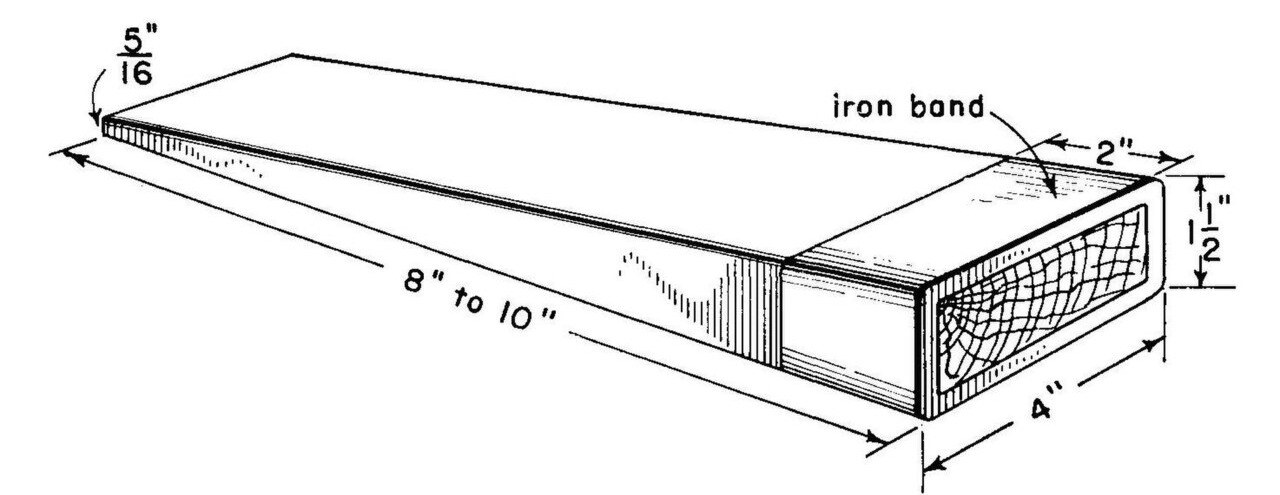


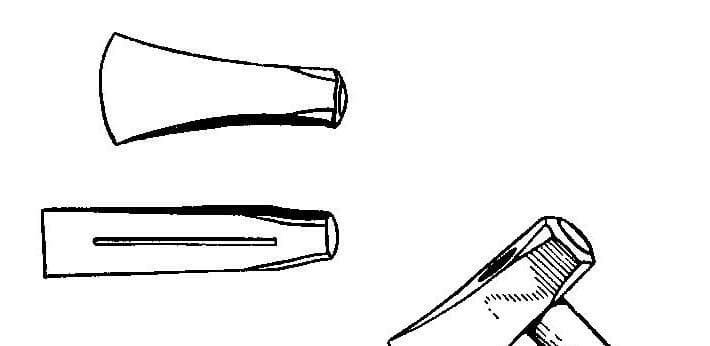
Wooden Felling Wedge with an Iron Band, USDA 1962
A wooden wedge driven into the saw cut when felling with a chain saw. The US farm bulletin of 1962 gives it 8 to 10 inches long and 4 wide, tapering from 1½ inches to 5/16, with an iron band round the head, and says hard, close-grained wood makes the best wedges.
The picture: the bulletin's drawing of the wedge.
Principiante
Two hours
Instrucciones
1
1
Cut the blank
Cut the blank
Saw a straight-grained, close-grained hardwood blank about 250 mm long, 100 mm wide and 38 mm thick, with the grain running its length.
Materiales para este paso:
 Madera de haya1 pieza
Herramientas necesarias:
 Serrucho
 Regla
2
2
Taper it
Taper it
Mark 8 mm at one end. On the shaving horse, take it down from the head to that mark with the drawknife, then plane both faces true.
Herramientas necesarias:
 Banco de doladura
 Cuchilla de dos mangos
 Cepillo de carpinteroRegla
3
3
Band the head
Band the head
Cut a strip of hoop iron 50 mm wide, bend it tight round the head on the anvil, drill it and nail it on.
Materiales para este paso:
 Aro de hierro1 pieza
 Clavos de hierro6 piezas
Herramientas necesarias:
 Tijeras de chapa
 Yunque
 Martillo de peña transversal
 Taladro de mano
4
4
Sizes
Sizes
Cargando el cuaderno de Jupyter…
Materiales
3- 1 piezaMarcador de posición
- 1 piezaMarcador de posición
- 6 piezasMarcador de posición
Herramientas requeridas
9- Marcador de posición
- Marcador de posición
- Marcador de posición
- Marcador de posición
- Marcador de posición
- Marcador de posición
- Marcador de posición
- Marcador de posición
- Marcador de posición
Este plano hace

Blueprints relacionados
Estos blueprints comparten conocimiento — técnicas, materiales o principios
CC0 Dominio público
Este Blueprint se publica bajo CC0. Eres libre de copiar, modificar, distribuir y usar este trabajo para cualquier propósito, sin pedir permiso.
Apoya al Maker comprando productos a través de su Blueprint, donde gana una Comisión del Maker establecida por los vendedores, o crea una nueva iteración de este Blueprint e inclúyela como conexión en tu propio Blueprint para compartir ingresos.