Colaboración
ARTE
BELLEZA Y BIENESTAR
ARTESANÍA
CULTURA E HISTORIA
ENTRETENIMIENTO
MEDIO AMBIENTE
COMIDA Y BEBIDAS
INGENIERÍA INVERSA
CIENCIAS
DEPORTES
TECNOLOGÍA
TECNOLOGÍA VESTIBLE
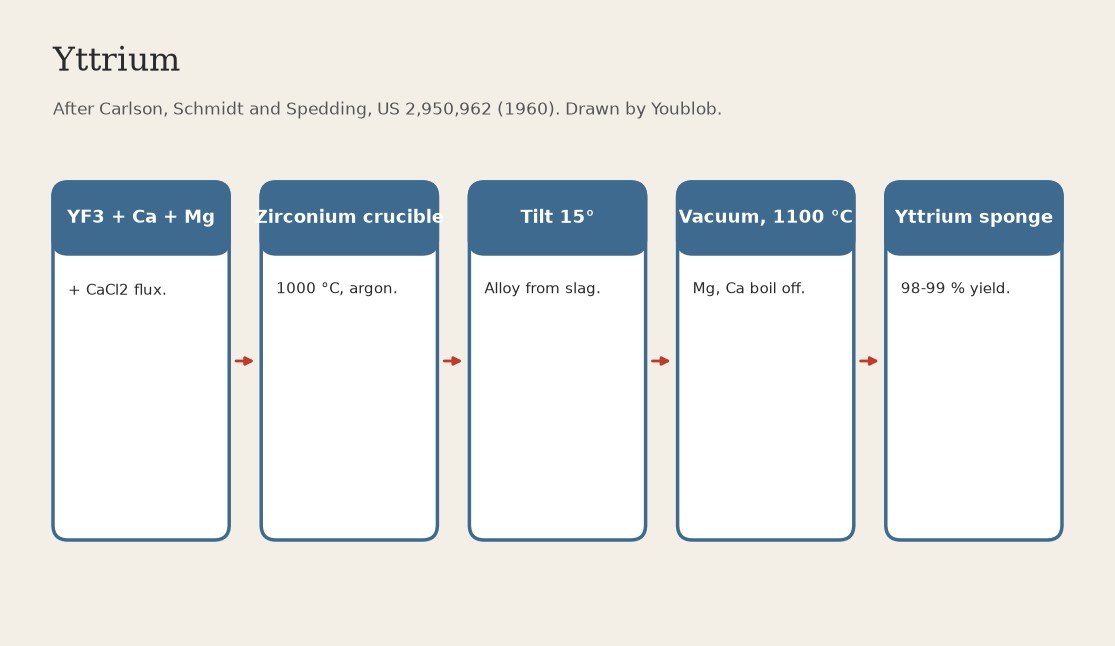


Yttrium: Fluoride Reduced with Calcium and Magnesium at 1000 °C, then Distilled to Sponge (Carlson, Schmidt and Spedding, US 2,950,962)
Calcium alone reduces yttrium fluoride only at 1500 °C. Adding magnesium makes a low-melting yttrium-magnesium alloy, and calcium chloride thins the slag, so the job runs at about 1000 °C. The magnesium and calcium are then boiled off in vacuum, leaving yttrium sponge.
Result: yttrium sponge (yield 98-99 % in the alloy step), usable as a getter or remelted to an ingot.
Source: O. N. Carlson, F. A. Schmidt and F. H. Spedding, US 2,950,962 (1960). Hot work under argon; calcium reacts with water. Picture drawn by Youblob.
Avanzado
2 days
Instrucciones
1
1
Weigh and mix the charge
Weigh and mix the charge
Dry the calcium chloride in vacuum at about 550 °C. Mix thoroughly 2600 g of pure, fine yttrium fluoride, 2090 g of calcium chloride, 1285 g of granular calcium (about 20 % excess) and 395 g of magnesium turnings, and pack it into a zirconium crucible with a lid carrying a pressure-release valve.
Materiales para este paso:
 Fluoruro de itrio1 2600 g
Herramientas necesarias:
 Calcio
 Magnesio
 Cloruro de calcio
 Bomba de vacío
 Crisol de circonio
2
2
Reduce at about 1000 °C
Reduce at about 1000 °C
Under argon (or helium) at about atmospheric pressure, set the crucible in a furnace already at 950-1050 °C and keep heating for about half an hour; the reaction gives off little heat. An yttrium-magnesium-calcium alloy forms under a calcium fluoride-calcium chloride slag.
Herramientas necesarias:
Crisol de circonio Horno de crisol
 Argón
3
3
Separate alloy and slag
Separate alloy and slag
Take the retort out and tilt it about 15° from horizontal so the slag and alloy freeze in thin layers along the side wall, then break them apart. The alloy is brittle (typically 19 % magnesium, 7-8 % calcium). Crush it to pieces of about 1/2 in.
Herramientas necesarias:
Crisol de circonio Mortero y mano de mortero
4
4
Boil off magnesium and calcium in vacuum
Boil off magnesium and calcium in vacuum
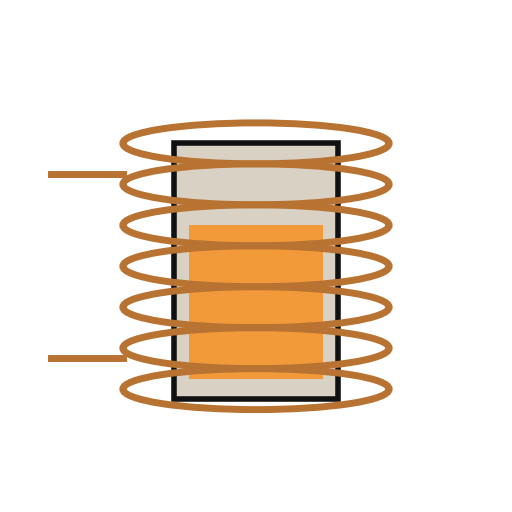
Pack the pieces in a crucible of the same metal set in a graphite heater inside a quartz tube. Pump down to about 1 micron or less and heat by induction to about 800 °C, then more slowly to 1100 °C (about three hours). The alloy does not melt; magnesium and calcium distil away (about 27 % weight loss), leaving porous yttrium sponge.
Herramientas necesarias:
Crisol de circonio Crisol de grafito
 Tubo de cuarzo fundidoBomba de vacío
 Horno de inducción
5
5
Remelt to an ingot (optional)
Remelt to an ingot (optional)
Use the sponge as it is (for example as a getter in vacuum tubes), or remelt it in a consumable arc furnace under helium or vacuum to get a solid ingot.
Herramientas necesarias:
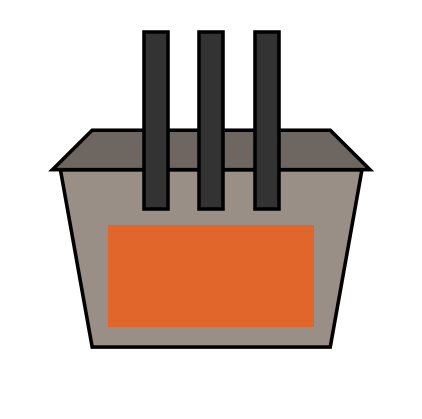 Horno de arco eléctrico
Materiales
1- 1 2600 gMarcador de posición
Herramientas requeridas
12- Marcador de posición
- Marcador de posición
- Marcador de posición
- 1 vendor sell this, none ship to you yetMarcador de posición
- Marcador de posición
- Marcador de posición
- Marcador de posición
- Marcador de posición
- Marcador de posición
- Marcador de posición
- Marcador de posición
- Marcador de posición
Este plano hace

Blueprints relacionados
Estos blueprints comparten conocimiento — técnicas, materiales o principios
CC0 Dominio público
Este Blueprint se publica bajo CC0. Eres libre de copiar, modificar, distribuir y usar este trabajo para cualquier propósito, sin pedir permiso.
Apoya al Maker comprando productos a través de su Blueprint, donde gana una Comisión del Maker establecida por los vendedores, o crea una nueva iteración de este Blueprint e inclúyela como conexión en tu propio Blueprint para compartir ingresos.