ART
BEAUTÉ ET BIEN-ÊTRE
ARTISANAT
CULTURE ET HISTOIRE
DIVERTISSEMENT
ENVIRONNEMENT
NOURRITURE ET BOISSONS
INGÉNIERIE INVERSE
SCIENCES
SPORTS
TECHNOLOGIE
TECHNOLOGIE PORTABLE



Trigonometry — Build a Clinometer and Measure a Tree's Height
A hands-on maths project: make a simple clinometer from a protractor, a straw and a weighted string, use it to measure the angle to the top of a tree or building, and then calculate the height you cannot reach. A Python cell does the trigonometry, and a compendium shows why sine waves run through all of science.
Débutant
30 minutes
Consignes
1
1
Turning an angle into a height
Turning an angle into a height
Ancient astronomers invented trigonometry to turn the ANGLES they measured into the LENGTHS of triangles. You will use it to measure the height of something too tall to reach.
2
2
Build a clinometer
Build a clinometer
Tape a drinking straw along the straight edge of a protractor to sight through. Tie a short string to the centre of the protractor with a small weight on the end, so it hangs down and shows the angle. That is a clinometer -- it measures how steeply you are looking up.
Matériaux pour cette étape :
 Assortiment de papier cartonné1 pièce
 Ficelle de cuisine en coton1 pièce
 Jeu de pailles en acier inoxydable1 pièce
Outils nécessaires :
 Rapporteur / mesureur d'angle
3
3
Sight the treetop and measure
Sight the treetop and measure
Stand back from a tree or building and look through the straw at its very top. Read the angle the hanging string marks on the protractor (this tells you the angle above horizontal). Then measure your distance from the base with a tape measure. Write down the angle and the distance.
Outils nécessaires :
 Mètre ruban
4
4
Calculate the height
Calculate the height
Chargement du notebook Jupyter…
Outils nécessaires :
 Ordinateur de bureau
 Calculatrice
5
5
Compendium: the mathematics of waves
Compendium: the mathematics of waves
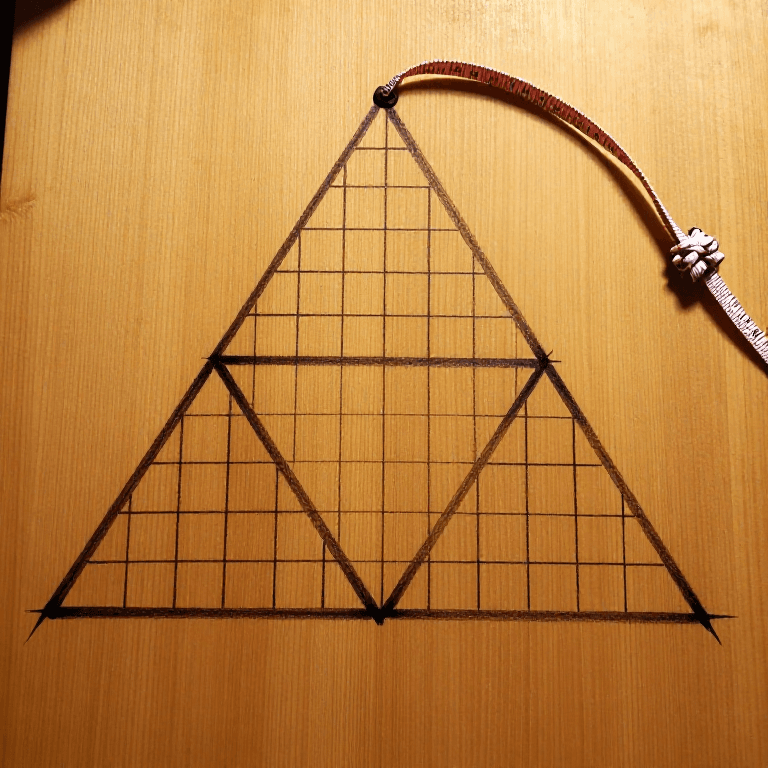
What your clinometer teaches. (1) In a right triangle the sine, cosine and tangent are ratios of the sides that depend ONLY on the angle, so a single table of them works for every triangle -- Ptolemy tabulated them around 150 AD, and Indian mathematicians shaped them into the 'sine' we use (the word comes from Sanskrit jya). (2) The tangent turns an angle you can see into a length you cannot reach -- the everyday tool of surveyors and sailors. (3) As an angle turns full circle, sine and cosine trace smooth repeating WAVES. (4) Those sine waves describe sound, light, radio, tides and alternating current, and underlie GPS, music synthesis and the Fourier analysis that compresses every image and song on your phone.
Matériaux
4- Espace réservé
- 1 pièceEspace réservé
- Espace réservé
- 1 feuilleEspace réservé
Outils requis
5- Espace réservé
- 1 vendor sell this, none ship to you yetEspace réservé
- Espace réservé
- Espace réservé
- Espace réservé
Blueprints liés
Ces blueprints partagent des connaissances — techniques, matériaux ou principes

CC0 Domaine public
Ce blueprint est publié sous CC0. Vous êtes libre de copier, modifier, distribuer et utiliser ce travail pour tout usage, sans demander la permission.
Soutenez le Maker en achetant des produits via son Blueprint où il perçoit une Commission Maker définie par les Vendeurs, ou créez une nouvelle itération de ce Blueprint et incluez-le comme connexion dans votre propre Blueprint pour partager les revenus.