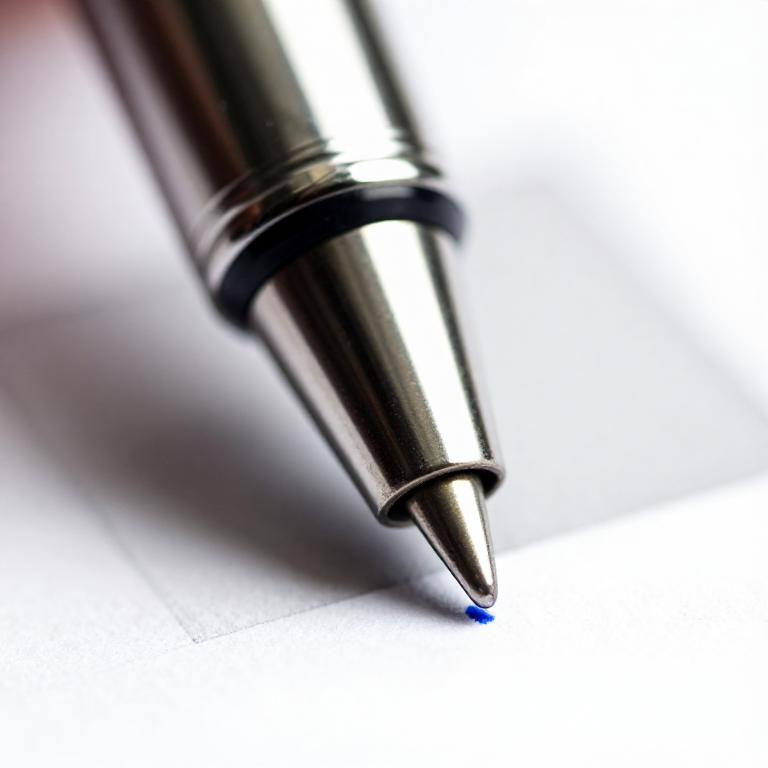


Ballpoint Pen
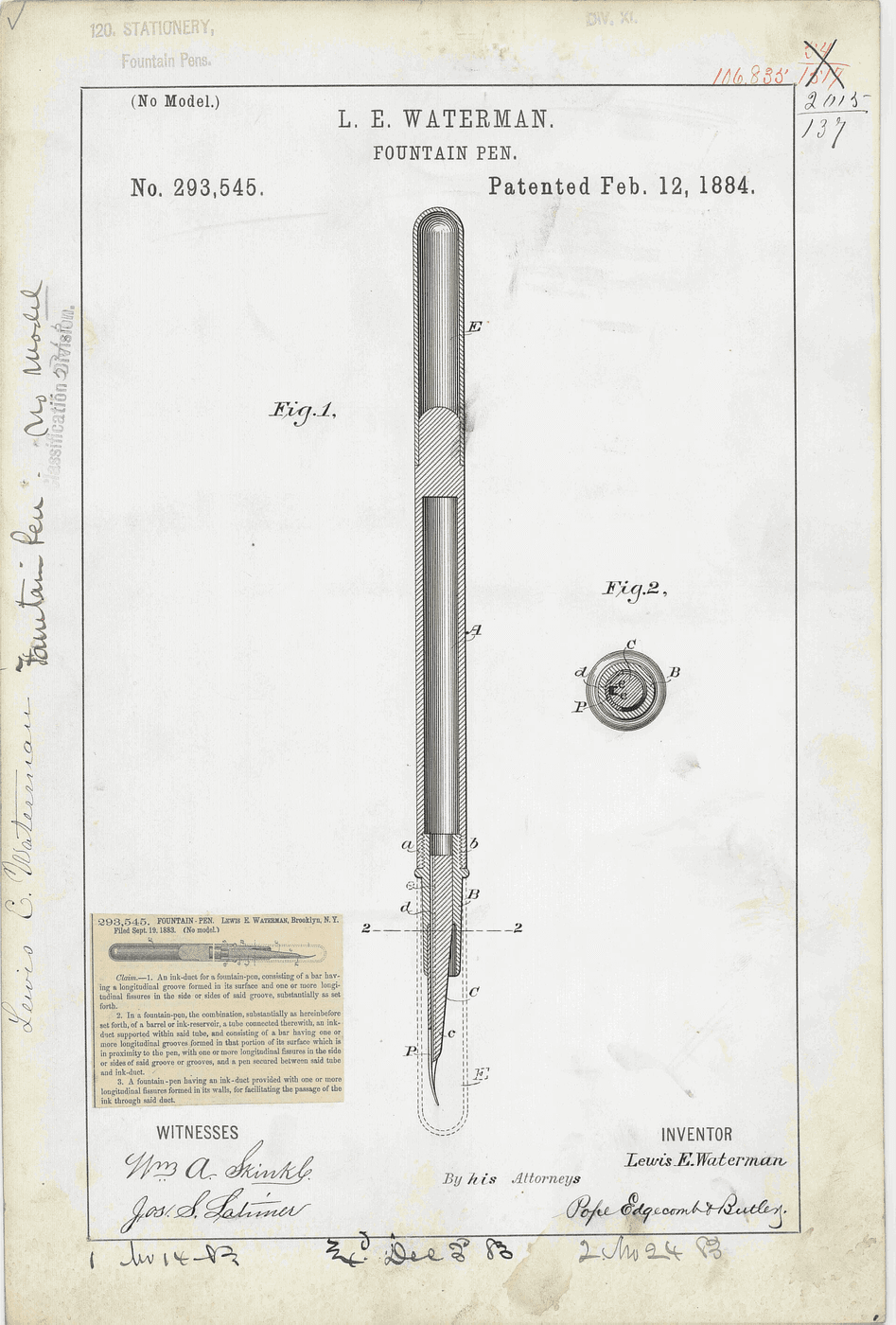
A fountain pen delivers thin ink by capillary action, which means it also leaks by capillary action — in a warm pocket, at altitude, upside down. László Bíró was a newspaper editor who noticed that printing ink dried on paper almost instantly and wanted that ink in a pen.
You cannot: it is far too thick to flow through a nib. So the delivery mechanism has to change. A ball seated in a socket picks up viscous ink from the reservoir on its inner face and rolls it onto the paper on its outer face — a rotating valve that is open only where it touches, and closed everywhere else.
Ball and socket must fit within a couple of microns. Too tight and it will not turn; too loose and it floods. US Patent 2,258,841, granted 14 October 1941 — and filed, confusingly, under the title "Fountain pen".
Consignes
Read US 2,258,841 and note the filed title
Read US 2,258,841 and note the filed title
Bíró's ballpoint is filed as "Fountain pen". Patent titles describe the category the examiner filed it under, not what the thing became known as.
Try to put thick ink through a nib
Try to put thick ink through a nib
Thicken some ink and load a dip pen with it. Nothing flows. The nib's capillary channels only work with thin ink, and that constraint is what forces a new mechanism.
Matériaux pour cette étape :
 Encre à écrire30 ml
Watch newsprint ink dry
Watch newsprint ink dry
Compare a newspaper with fountain-pen writing on the same paper. The printing ink is dry immediately and does not feather — that observation is where the invention starts.
Understand the ball as a valve
Understand the ball as a valve
The ball is not a nib. It is a rotating seal, open only at the moving line of contact with the paper and closed against the socket everywhere else.
Source a hard, truly spherical ball
Source a hard, truly spherical ball
Use a small precision bearing ball. Sphericity is what makes the seal work at every rotation — an out-of-round ball leaks at some angles and skips at others.
Matériaux pour cette étape :
 Roulements à billes en acier10 pièces
Machine a socket a few microns larger than the ball
Machine a socket a few microns larger than the ball
Bore and lap a seat that lets the ball spin freely with almost no play. This clearance is the entire manufacturing difficulty of the product.
Matériaux pour cette étape :
 Barre ronde de laiton1 pièce
Outils nécessaires :
 Lime à métaux
Crimp the socket lip to retain the ball
Crimp the socket lip to retain the ball
Roll the rim over slightly so the ball is captive but still rotates. Too much and it binds; too little and it falls out on first use.
Cut feed channels behind the ball
Cut feed channels behind the ball
Groove the seat so ink can reach the ball's inner surface. Without channels the ball seals perfectly against its own supply.
Mix an ink far thicker than writing ink
Mix an ink far thicker than writing ink
Use an oil-based paste — thousands of times more viscous than fountain-pen ink. It must not run under gravity, which is precisely why the pen does not leak.
Fill the reservoir and leave an air path
Fill the reservoir and leave an air path
Load a narrow tube and leave the back end vented. As ink is used, air must replace it — a sealed tube stops writing after a few centimetres.
Write and check the ball actually rotates
Write and check the ball actually rotates
Draw a line and inspect under magnification. A ball that drags rather than rolls leaves a scratched, skipping line and wears the socket oval.
Outils nécessaires :
 Loupe
LoupeTest it upside down and in the cold
Test it upside down and in the cold
Write inverted and after chilling. Viscous ink and a sealing ball mean orientation barely matters — the failure mode of every fountain pen simply is not present.
Diagnose blobbing and skipping
Diagnose blobbing and skipping
Blobs at the start of a stroke mean too much clearance; skipping means too little, or ink too thick for the temperature. Both are the same tolerance seen from opposite sides.
Try it on smooth plastic and on newsprint
Try it on smooth plastic and on newsprint
The ball needs friction from the surface to roll at all. On a glossy non-absorbent surface it slides and deposits almost nothing — the paper is part of the mechanism.
Compendium — a rotating valve two microns wide
Compendium — a rotating valve two microns wide
The patent. US 2,258,841, filed under the title "Fountain pen", granted 14 October 1941 to László József Bíró, a Hungarian newspaper editor who developed the pen with his brother György, a chemist who formulated the ink. Ballpoints were not new as an idea — John J. Loud patented one in 1888 (US 392,046) for marking leather — but Loud's was too coarse for paper and was never commercialised. What the Bírós added was the combination of a precise ball-and-socket with an ink formulated for it. They fled Nazi Europe and patented and manufactured in Argentina, which is why the pen is called a birome there.
The ball is a valve, not a nib. A fountain pen relies on capillary action pulling thin ink through channels, which is why it also leaks when temperature or pressure changes the balance. A ballpoint inverts the problem: the ink is a paste far too viscous to flow on its own, and it is transferred mechanically. The ball picks it up on the inner face, rotates, and lays it down on the paper. The pen only writes when the ball turns, and the ball only turns when it is dragged across a surface with grip — which is why a ballpoint fails on glossy plastic and why the paper is genuinely part of the mechanism.
The tolerance is the product. Ball and socket must be matched within a few micrometres. Too tight and the ball will not rotate, so the pen scratches and skips; too loose and paste escapes around it and the pen blobs. This is why early ballpoints were unreliable and expensive, and why the story is really one of precision manufacturing rather than of a clever idea. Marcel Bich bought rights and licences and spent years driving the cost down, launching the Bic Cristal in 1950 — a pen that now sells in the tens of billions and whose barrel is deliberately vented, and its cap deliberately holed, so a swallowed cap does not fully obstruct an airway.
Where it was wanted first. The Royal Air Force bought early ballpoints because fountain pens leak at altitude, where reduced cabin pressure pushes ink out of the reservoir — the ballpoint's viscous ink and sealed tip are indifferent to it. That is a good illustration of the general rule: a new mechanism usually finds its first market where the incumbent's specific failure mode hurts most, not where the average user is.
Matériaux
3- 30 mlEspace réservé
- 10 piècesEspace réservé
- 1 pièceEspace réservé
Blueprints liés
Ces blueprints partagent des connaissances — techniques, matériaux ou principes

CC0 Domaine public
Ce blueprint est publié sous CC0. Vous êtes libre de copier, modifier, distribuer et utiliser ce travail pour tout usage, sans demander la permission.
Soutenez le Maker en achetant des produits via son Blueprint où il perçoit une Commission Maker définie par les Vendeurs, ou créez une nouvelle itération de ce Blueprint et incluez-le comme connexion dans votre propre Blueprint pour partager les revenus.