ART
BEAUTÉ ET BIEN-ÊTRE
ARTISANAT
CULTURE ET HISTOIRE
DIVERTISSEMENT
ENVIRONNEMENT
NOURRITURE ET BOISSONS
INGÉNIERIE INVERSE
SCIENCES
SPORTS
TECHNOLOGIE
TECHNOLOGIE PORTABLE

Balls or Rods: The Media Decide the Product, Not Just the Fineness
Two grinding mills can be the same drum, turning at the same speed, holding the same weight of steel, and produce products that are not remotely alike.
The reason is contact geometry. A ball touches its neighbour at a point, and whatever happens to be at that point gets broken — coarse, fine, or already fine enough. A rod touches along a line down the whole length of the mill, and a line cannot come down past the largest lump beneath it. So a rod charge breaks the coarse and steps over the fine.
That is a selection rule, and it decides the shape of the product distribution rather than just its average. This rung derives what size media can grip what size particle — it turns out to be the jaw crusher's nip angle again, in a different costume — and then generates what the two selection rules do to the same starting bed.
Avancé
About 3 hours
Consignes
1
1
Watch a rod pick the big one
Watch a rod pick the big one
Spread a single layer of mixed stone on a flat plate — a good spread of sizes, nothing sorted. Lay a length of steel bar across it and press down evenly with both hands.
Watch which stones crack. It will be the big ones, and only the big ones, because the bar is resting on them and cannot reach anything else.
Now do it again with a ball bearing or a round pebble, pressed down at a point. Whatever is under the point breaks, and whether that is a large stone or a small one is entirely a matter of where you put your hand.
That is the whole rung, done in two minutes with a bar and a ball. Everything that follows is putting numbers on it.
Do the bar version twice: once on a single layer and once on a heap two or three deep. On the heap the selection gets weaker, because the bar is now resting on a lumpy surface rather than on individual stones. Rod mills are run with a thin charge for exactly that reason.
Matériaux pour cette étape :
 Pierres de granulat1 poignée
 Barre d'acier brut1 pièce
 Roulements à billes1 pièce
Outils nécessaires :
 Plaque d'acier doux
 Pied à coulisse numérique 6 pouces
 Gants de travail en cuir
 Lunettes de sécurité transparentes
2
2
The nip condition, again
The nip condition, again
Chargement du notebook Jupyter…
3
3
Charge a mill properly: fill, grade and top up
Charge a mill properly: fill, grade and top up
Three numbers describe a media charge and all three matter.
**Fill.** The fraction of the mill's volume the charge occupies, usually a third or a little more. Too little and the charge has room to fall further than the toe, which hammers the liner instead of the material. Too much and there is no free space for the charge to cataract into, so it rolls instead, and the mill quietly turns into a cascading machine that grinds slowly and makes fines.
**Grading.** A new charge is never one size. It is a distribution, because the mill needs the big media for the feed and the small media for the surface — the same argument as the tube mill's compartments, solved a different way.
**Top-up.** Media wear away, and as they wear they get smaller, so a mill that is topped up only with the largest size drifts toward a coarse charge over months. Top up with a graded mix, and weigh what goes in. The commonest slow failure in a grinding circuit is a charge that has been maintained by eye.
Measure the fill with the mill stopped: the charge's chord against the shell, taken with a tape, converts straight to a filled fraction. Record it every time. A drifting fill is visible in a log and invisible in a glance.
Matériaux pour cette étape :
 Corps broyants (boulets d'acier)1 charge
 Corps broyants (barres d'acier)1 charge
Outils nécessaires :
 Balance numérique
 Mètre rubanPied à coulisse numérique 6 pouces
 SeauGants de travail en cuirLunettes de sécurité transparentes
4
4
Point contact against line contact, generated
Point contact against line contact, generated
Chargement du notebook Jupyter…
5
5
Close the circuit, or grind what is already finished
Close the circuit, or grind what is already finished
An open-circuit mill has to hold everything until the *worst* particle is fine enough, which means the average particle is ground far past the point of usefulness. That over-grinding is wasted power and unwanted fines, and it is entirely avoidable.
A **closed circuit** puts a screen or a classifier on the mill's discharge and returns the coarse fraction to the feed. Each particle now leaves as soon as it is small enough. The coarse that comes back is the **circulating load**, and on a well-run circuit it is often larger than the fresh feed — two or three times, sometimes more — which surprises people the first time they see the figure.
That number is not a sign of something wrong. A high circulating load means material is being removed promptly, which is exactly the point. What it costs is a bigger mill feed conveyor, a bigger classifier and more pumping, so there is an optimum rather than a maximum.
The screening rung is what the classifier is doing, and its partition curve is why the circulating load can never be sharp: every pass returns some material that was already fine enough and passes some that was not.
Matériaux pour cette étape :
 Toile de crible en fil tissé1 pièce
 Tamis classeur1 pièce
Outils nécessaires :
Balance numérique Tamis grossier
 Tamis à maille fine
 Tamis 60 mesh
 Tamis 120 maillesSeau
 Masque anti-poussièreLunettes de sécurité transparentes
6
6
History and context
History and context
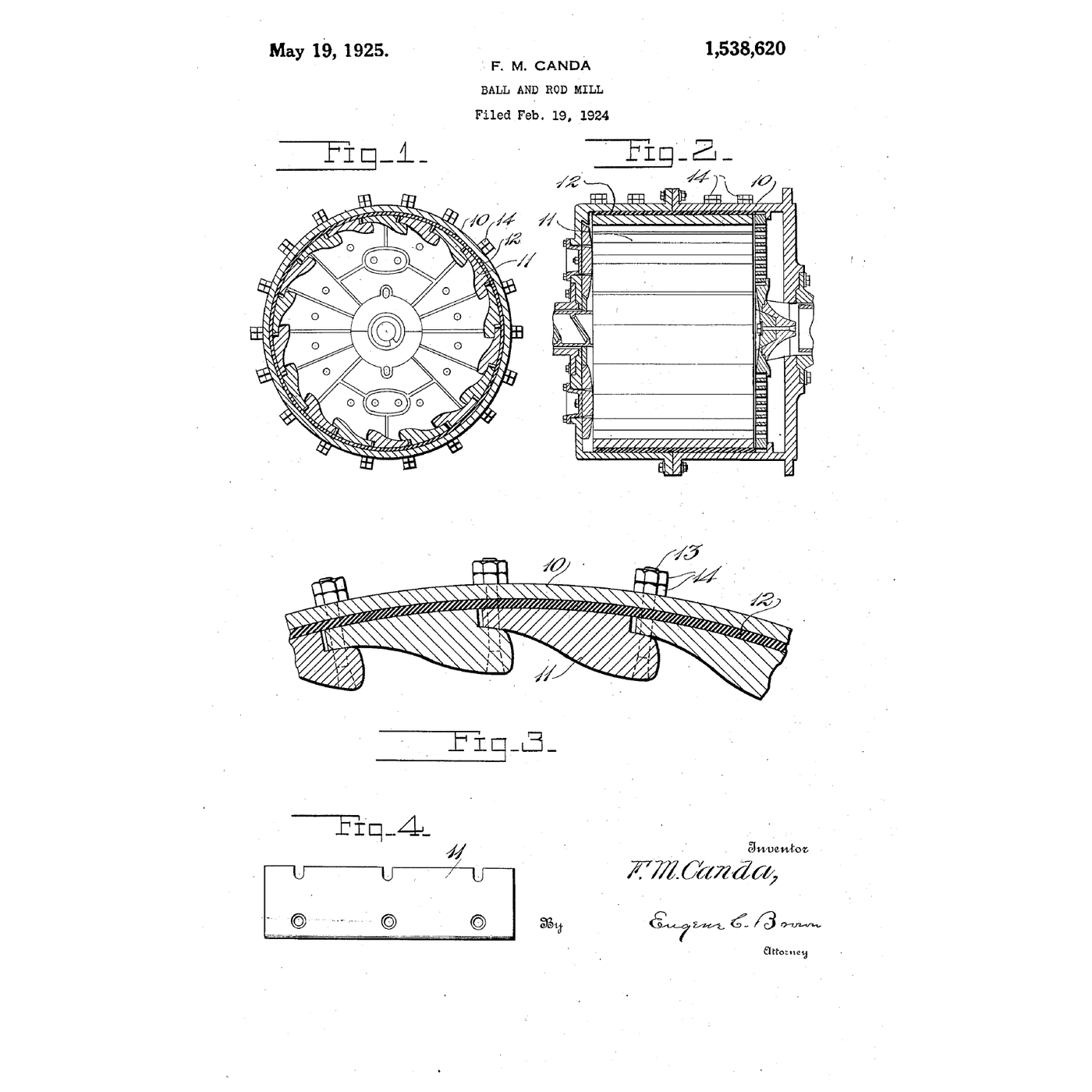
**US 1,538,620, 'Ball and Rod Mill', Ferdinand Mora Canda of Chrome, New Jersey, application filed 19 February 1924, granted 19 May 1925.** The claims are about the mill's lining — 'a metal shell or casing, a circumferential series of brittle hard steel plates bolted to the shell, and a resilient shock absorbing medium interposed between the plates and the shell' — and the title covers both media in one breath, because the body of the machine does not care what is in it.
That detail of the claim is worth noticing. By 1924 the mill itself was not the invention any more; what was being fought over was how to line it so the liners survived, which is the mark of a mature machine.
Rod mills became the standard first stage of grinding in metalliferous plants for half a century, precisely because of the selection rule in step 4: gravity separation and flotation both work badly on slimes, and a rod mill delivered a narrow product without making them. They faded when autogenous and semi-autogenous mills took over the coarse grinding duty, not because the physics changed.
**Honest limits.** A rod mill cannot be made long relative to its diameter — beyond about six to one the rods tangle, and a tangled charge is a day of work with a crane and a lot of swearing. Rods wear unevenly and have to be culled as well as topped up. A rod mill will not grind fine: the selection rule that protects the fines from being over-ground is the same rule that stops you reaching a fine product at all, so almost every rod mill in history had a ball mill downstream of it. And both are media mills, so both consume steel continuously — in a large plant the media bill can exceed the power bill.
Matériaux
7- 1 poignéeEspace réservé
- 1 pièceEspace réservé
- 1 pièceEspace réservé
- 1 chargeEspace réservé
- 1 chargeEspace réservé
- 1 pièceEspace réservé
- 1 pièceEspace réservé
Outils requis
12- Espace réservé
- Espace réservé
- Espace réservé
- Espace réservé
- Espace réservé
- 1 vendor sell this, none ship to you yetEspace réservé
- Espace réservé
- Espace réservé
- Espace réservé
- Espace réservé
- Espace réservé
- Espace réservé
Blueprints liés
Ces blueprints partagent des connaissances — techniques, matériaux ou principes
Grinding in a Tumbling Mill: Critical Speed, and Why the Media Are Graded
par Emma
Mécanique
2
0
0
0
0
0

Sorting by Size: Why a Screen Never Makes a Clean Cut
par Emma
Mécanique
2
0
0
0
0
0
Breaking Stone by Compression: The Nip Angle Decides Everything
par Martin
Travail des Métaux
4
0
0
0
0
0
Ore Dressing
par Mary
Travail des Métaux
31
0
0
0
0
0
Panning for Alluvial Gold — Gravity Separation in Stream Sediment
par Mary
Travail des Métaux
79
0
0
0
0
0
CC0 Domaine public
Ce blueprint est publié sous CC0. Vous êtes libre de copier, modifier, distribuer et utiliser ce travail pour tout usage, sans demander la permission.
Soutenez le Maker en achetant des produits via son Blueprint où il perçoit une Commission Maker définie par les Vendeurs, ou créez une nouvelle itération de ce Blueprint et incluez-le comme connexion dans votre propre Blueprint pour partager les revenus.