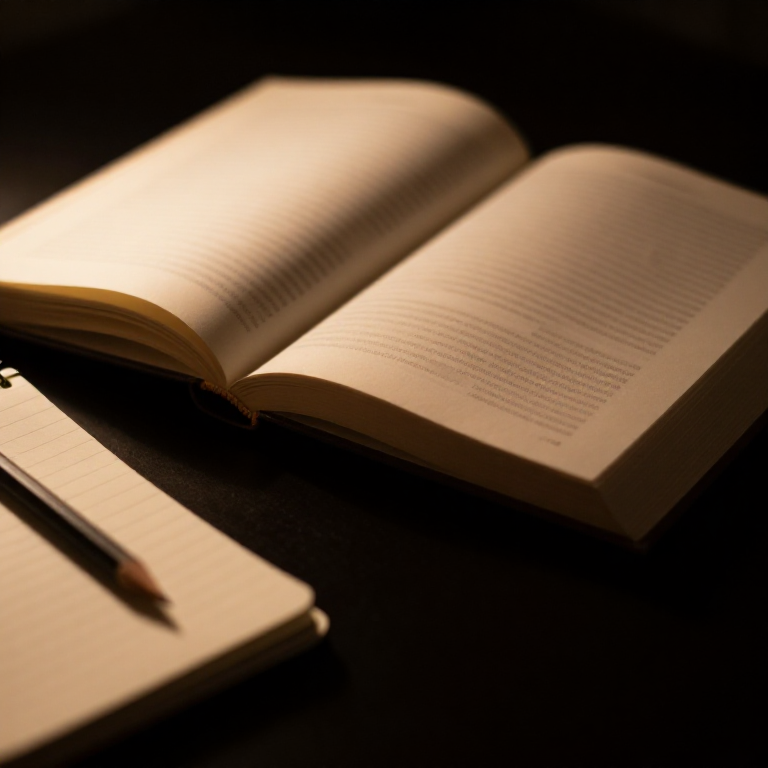


Book Cipher
Consignes
Agree the key book exactly
Agree the key book exactly
Both parties need the same book — and same means identical.
- Choose a book you both own.
- Check the publisher, the edition and the printing year match.
- Verify by comparing the first word on several pages.
Matériaux pour cette étape :
 Carnet de terrain tout temps1 paquet
Encode a message as coordinates
Encode a message as coordinates
Every word becomes three numbers.
- Write your message.
- For each word, find it in the book and note page, line and word position.
- Write the message as a list of number triples.
Matériaux pour cette étape :
 Papier millimétré1 pad
 Jeu de crayons graphite1 jeu
Decode, and hit the vocabulary wall
Decode, and hit the vocabulary wall
Now try to send something the book cannot say.
- Have your partner decode your message using their copy.
- Now try to encode a proper name, or a technical word your book does not contain.
- Work out a fallback — spelling it letter by letter using first letters of words.
Compare the key problem head-on
Compare the key problem head-on
Set the two approaches side by side on the axis that matters.
- List what a one-time pad needs: random generation, physical distribution, key as long as the message, destruction after use.
- List what a book cipher needs: an agreed edition, and nothing else.
- Now list what each gives up.
History and context
History and context
Book ciphers are old and were widely used precisely because they need no special equipment. Benedict Arnold corresponded with the British using Blackstone's Commentaries on the Laws of England and later a dictionary. The Beale ciphers — three ciphertexts said to describe buried treasure in Virginia — used the United States Declaration of Independence as the key for the one part that has been decoded; the other two remain unread, and a plausible reading is that no matching key text exists to find.
The variant that actually gets used replaces page-line-word with a straightforward running key: take the book's text from an agreed starting point and combine it letter by letter with the plaintext, exactly as a one-time pad does. That removes the vocabulary wall entirely, but weakens it further, because English combined with English leaves statistical structure that a determined analyst can pull apart.
The lasting lesson is about key distribution, not about ciphers. Every symmetric method faces the same question: how do two parties come to share a secret before they can communicate securely? The pad answers by carrying the secret; the book answers by hiding the secret in plain sight; both require a prior meeting. That constraint stood until public-key cryptography answered it a different way in the 1970s — which is why key exchange, not cipher strength, is the thread worth following through this part of the catalogue.
Matériaux
3- 1 paquetEspace réservé
- 1 padEspace réservé
- Espace réservé
Blueprints liés
Ces blueprints partagent des connaissances — techniques, matériaux ou principes
CC0 Domaine public
Ce blueprint est publié sous CC0. Vous êtes libre de copier, modifier, distribuer et utiliser ce travail pour tout usage, sans demander la permission.
Soutenez le Maker en achetant des produits via son Blueprint où il perçoit une Commission Maker définie par les Vendeurs, ou créez une nouvelle itération de ce Blueprint et incluez-le comme connexion dans votre propre Blueprint pour partager les revenus.