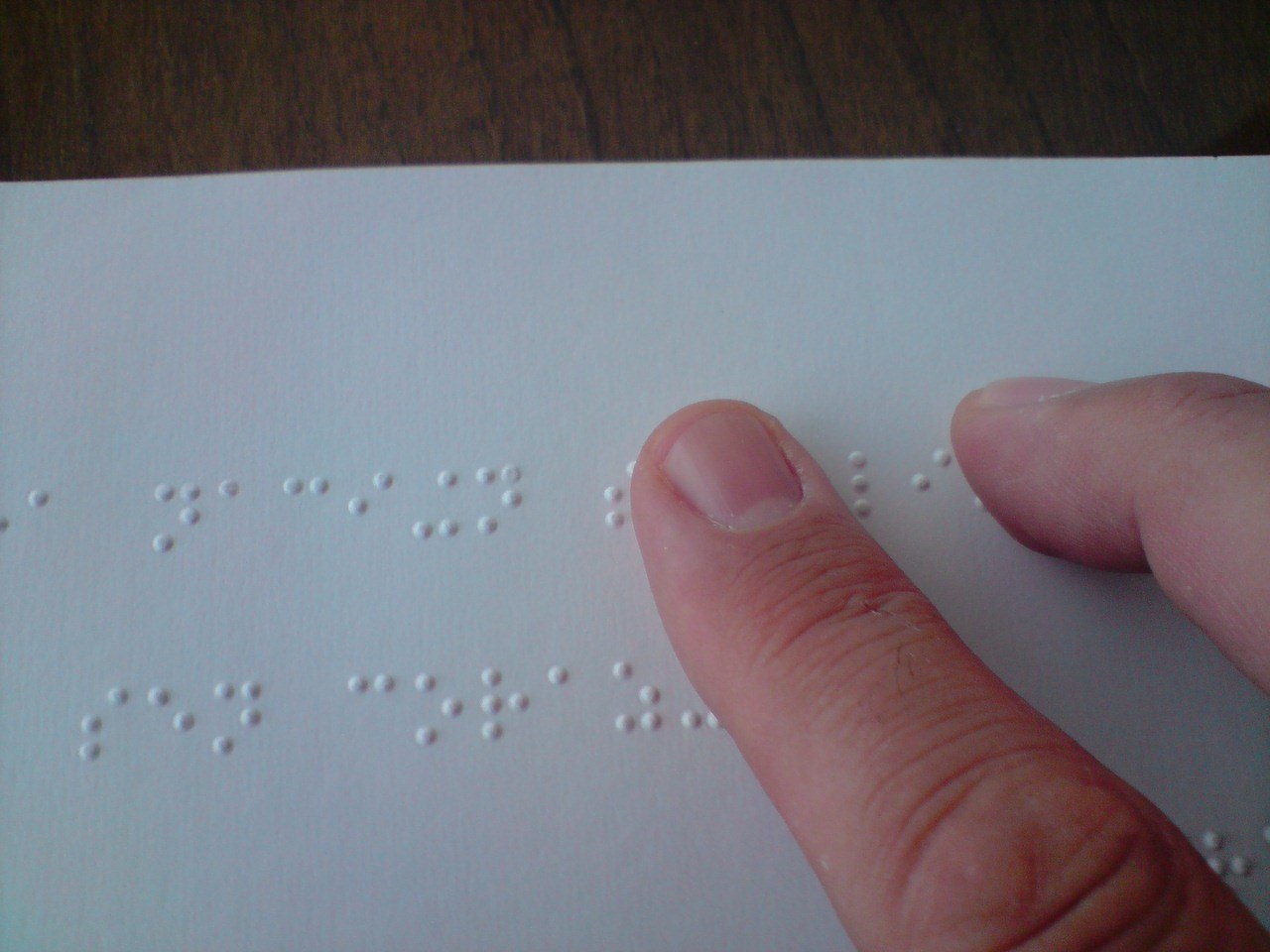


Braille
Every process in this batch puts ink on a surface for an eye to read. Braille asks the same question — how do you record an idea so someone else can recover it — and answers it for the finger.
The obvious approach, and the one tried first, was to emboss the ordinary alphabet in raised letters. It fails, and it fails for a specific reason: a fingertip does not scan, it feels a patch. Reading a raised S means tracing a curve and holding its shape in mind, which is slow, and the curves of the Latin alphabet were designed for a moving eye, not a resting finger.
The insight is to stop translating the visual alphabet and design for the sensor you actually have. A fingertip can reliably resolve a small number of distinct dots inside one contact patch — so make the character a fixed grid of six positions, two across and three down, and let a letter be which dots are raised.
Six positions, each present or absent, gives 2⁶ = 64 combinations: enough for the alphabet, punctuation, numbers and contractions. The whole cell sits under one fingertip at once, so a character is recognised in a single touch rather than traced.
It is a binary encoding, designed for a specific sensor, roughly a century before anyone spoke of bits — and it was devised by a fifteen-year-old who was blind and could see what a sighted committee could not.
Consignes
Try to read raised letters and find out why it fails
Try to read raised letters and find out why it fails
Emboss several ordinary capital letters into card from the back with a blunt point, so they stand proud on the front. Close your eyes and have someone present them one at a time.
Time how long each takes to identify, and note which are confused.
Expect it to be slow, and expect C, G, O and E, F to be repeatedly mistaken.
Record what your finger is doing: tracing an outline and assembling it from memory. That is the failure — the shapes were designed for a sensor that takes in a whole letter at a glance.
Matériaux pour cette étape :
 Card Stock
Measure what a fingertip can actually resolve
Measure what a fingertip can actually resolve
Make a card with pairs of raised dots at decreasing spacings — 4 mm, 3 mm, 2.5 mm, 2 mm, 1.5 mm, 1 mm. With eyes closed, judge for each pair whether you feel two dots or one.
Find your threshold.
Expect it to be somewhere around 2 to 3 mm on a fingertip, and much coarser on your forearm — try both.
Now compare with real braille: dots about 2.5 mm apart within a cell. The standard was not chosen aesthetically. It sits just above the measured resolution of the reader, which is the only sensible way to design an interface.
Outils nécessaires :
 Digital Caliper 6-Inch
Build the cell and count what it can carry
Build the cell and count what it can carry
Lay out a 2×3 grid at your measured spacing. Work out how many distinct patterns exist if each of the six positions may be raised or flat.
The answer is 2⁶ = 64, or 63 usable patterns plus the empty cell as a space.
Now compare with what a language needs: 26 letters, ten digits, punctuation.
Expect 64 to be comfortably enough with room to spare — and note where the spare capacity went in practice: contractions, single cells standing for common whole words, which is what makes braille compact enough to be readable at speed.
Emboss from the back and discover the reversal
Emboss from the back and discover the reversal
Punch dots into card from the back with a stylus so they stand up on the front, and write a short word.
Turn it over and read it.
Expect it to come out mirrored — you must punch right-to-left for it to read left-to-right.
This is why a traditional slate and stylus is written backwards, and why the mechanical brailler, which pushes dots up from beneath, was such a relief: it lets the writer work in reading order.
It is the same reversal the etching and letterpress blueprints deal with. Any process that forms an image from the other side inverts it.
Outils nécessaires :
 Stylus
Read a line and find where the speed comes from
Read a line and find where the speed comes from
Write a full line in braille cells and read it with a single fingertip moving steadily, eyes closed.
Notice what your finger does: it slides along, and each cell registers as a whole pattern as it passes, without stopping to trace anything.
Compare with your timings from step 1.
The gain is not that dots are simpler than letters. It is that a cell is recognised in one contact instead of being assembled from a path. Experienced readers reach speeds comparable with reading aloud — impossible with embossed Latin letters at any size.
History & Context
History & Context
A fifteen-year-old redesigned it from a military code. Louis Braille, blind from an early childhood accident, encountered night writing — a raised-dot system devised so soldiers could read messages in darkness without a light. It used twelve dots per cell, which is too large for a fingertip to take in at once, and encoded sounds rather than letters. Braille cut it to six, made it map to the alphabet, and added punctuation and music. He had the design essentially finished as a teenager.
The institution that taught him resisted it for decades. Sighted educators preferred embossed Latin letters, partly because they could read them without learning anything, and braille was discouraged and at times banned at the school where he taught. It was adopted officially in France only after his death. The people who could not use the system were the ones deciding which system was used — a failure of design authority that recurs constantly, and the reason "nothing about us without us" is a principle rather than a slogan.
It is a binary character encoding. Six bits, fixed-width cells, 64 code points, with escape codes to shift meaning — the number sign turns following letters into digits, exactly as a modern encoding uses a prefix to change interpretation. This predates telegraph codes and Baudot, and it was arrived at not from mathematics but from measuring a sensor and fitting the code to it.
It is still being extended, and that is the point. Six-dot braille grew to eight-dot for computing so a cell can carry a full byte; there are braille systems for mathematics, music, chemistry and for scripts worldwide. Refreshable displays raise and lower pins electrically so a single line of cells can present anything on a screen — the encoding outlived every technology that has carried it.
Honest limits. Braille is bulky: a printed book becomes several heavy volumes, which is why contractions exist and why refreshable displays matter so much. It must be learned, and learning it later in life is harder. Embossed paper wears flat with use and with careless storage. And audio has displaced it for many readers — a real convenience, but one that quietly trades away spelling, punctuation and the ability to skim, which is the difference between listening to a text and reading it.
Matériaux
1- 1 pièceEspace réservé
Outils requis
2- Espace réservé
- Espace réservé
Matériaux des Blueprints connectés
Blueprints liés
Ces blueprints partagent des connaissances — techniques, matériaux ou principes

CC0 Domaine public
Ce blueprint est publié sous CC0. Vous êtes libre de copier, modifier, distribuer et utiliser ce travail pour tout usage, sans demander la permission.
Soutenez le Maker en achetant des produits via son Blueprint où il perçoit une Commission Maker définie par les Vendeurs, ou créez une nouvelle itération de ce Blueprint et incluez-le comme connexion dans votre propre Blueprint pour partager les revenus.