ART
BEAUTÉ ET BIEN-ÊTRE
ARTISANAT
CULTURE ET HISTOIRE
DIVERTISSEMENT
ENVIRONNEMENT
NOURRITURE ET BOISSONS
INGÉNIERIE INVERSE
SCIENCES
SPORTS
TECHNOLOGIE
TECHNOLOGIE PORTABLE
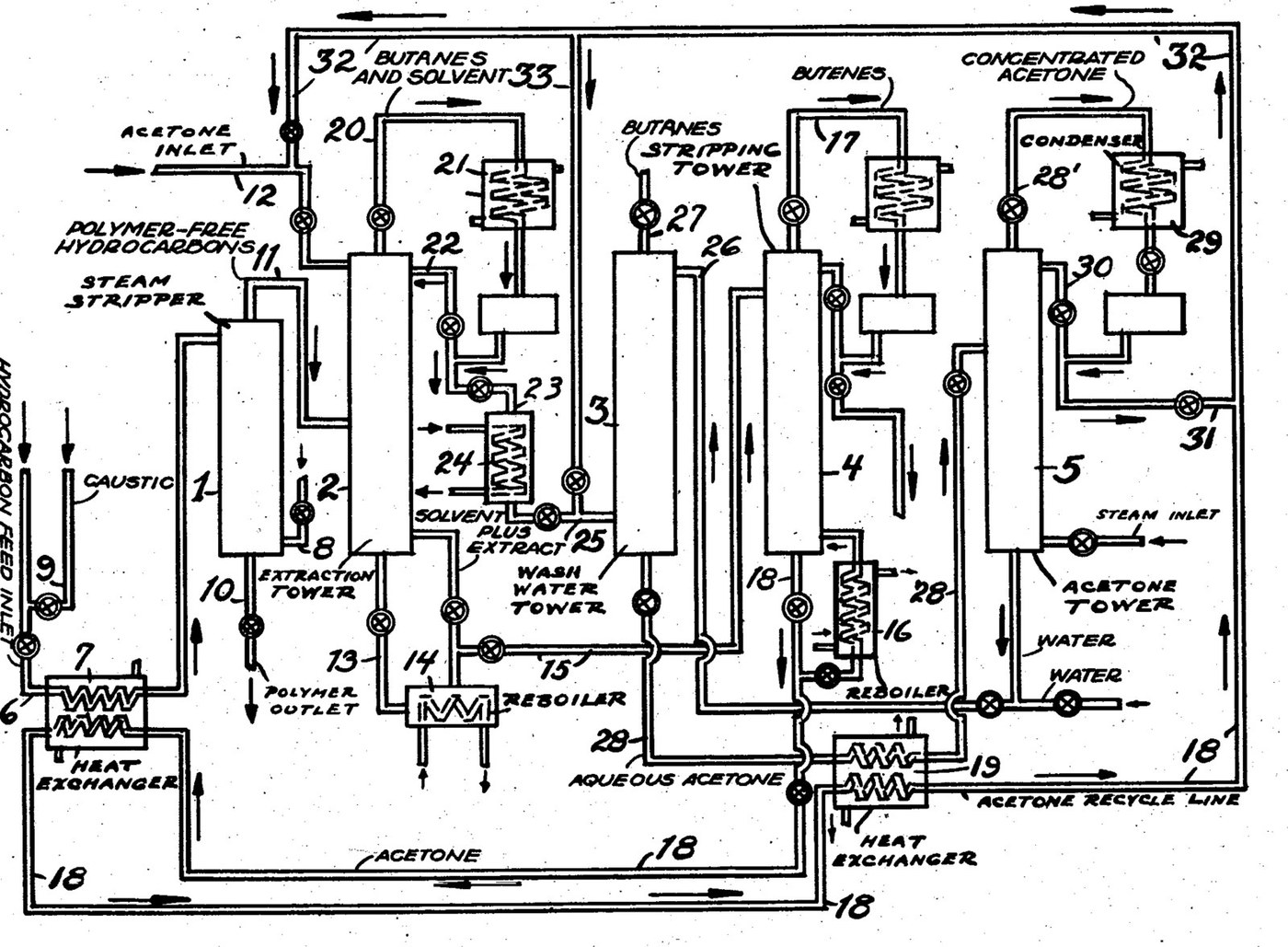


Normal Butylene Fraction: Cracked-Gas C4 Cut Extractively Distilled with Aqueous Acetone (Long, Standard Oil Development, US 2,449,610)
Butanes and butylenes boil too close together to part by plain distillation. Distil them through a stream of watery acetone, which holds back the butylenes, and the butanes go overhead while the butylenes come out at the bottom.
Result: a butylene fraction of 26.7 % butene-1 and 63.5 % butenes-2 (90.2 % normal butylenes), with 3.6 % isobutylene, 4.4 % normal butane and 1.8 % isobutane.
Source: Long, US 2,449,610 (1948). Not given: tower sizes and plates, water amounts, caustic strength. Long does not say how the acid-treated C4 cut is made; it is matched by kind to the Packie & Rupp blueprint. Extremely flammable gases under pressure. Picture: the patent drawing.
Expert
1 day
Consignes
1
1
Start from the acid-treated C4 cut of cracked gas oil
Start from the acid-treated C4 cut of cracked gas oil
Use the four-carbon fraction from cracking a gas oil, with the bulk of its isobutylene removed by sulphuric acid. Long's, by volume: isobutane 42.4 %, normal butane 9.4, isobutylene 2.0, butene-1 15.0, butenes-2 30.2, high-boiling material 1.0.
Matériaux pour cette étape :
 Fraction butane-butylène, sans isobutylène1 as required
Outils nécessaires :
 Bouteille de gaz sous pression
2
2
Steam-strip out the heavy material
Steam-strip out the heavy material
Strip the feed with steam in the first tower, adding caustic to neutralise any sulphuric acid esters left from the acid treatment. The heavy material leaves at the bottom; the hydrocarbons go overhead as vapour.
Outils nécessaires :
 Alambic à fractionner
 Chaudière à vapeur
 Eau
 Solution d'hydroxyde de sodium
3
3
Distil through aqueous acetone
Distil through aqueous acetone
Feed the vapour into the second tower and pass it up through aqueous acetone (14-17 % water) flowing down, at 120-200 °F and 50-150 lbs pressure. With 85 % solvent on the top plate and a cold reflux ratio of 6.5 to 1, the butanes go overhead and the butylenes leave in the acetone at the bottom.
Outils nécessaires :
Alambic à fractionner Acétone
 Manomètre
 Serpentin de condenseur
4
4
Strip the butylenes from the acetone
Strip the butylenes from the acetone
In a third tower, reboiled at the bottom and refluxed at the top with product butylenes, distil the butylenes off the acetone. They come over as 26.7 % butene-1 and 63.5 % butenes-2, with 3.6 % isobutylene and 6.2 % butanes.
Outils nécessaires :
Alambic à fractionnerSerpentin de condenseurBouteille de gaz sous pression5
5
Recover the acetone and keep it clean
Recover the acetone and keep it clean
Wash the acetone out of the overhead butanes with water, keeping it below 15 % in the water or the layers emulsify badly. Reconcentrate the dilute acetone to about 83 % acetone, 17 % water, and recycle it. Bleed part of the recycled acetone into the butanes before washing, so the heavy material building up in it leaves with them.
Outils nécessaires :
Alambic à fractionnerEauAcétoneMatériaux
1- 1 as requiredEspace réservé
Blueprints liés
Ces blueprints partagent des connaissances — techniques, matériaux ou principes
CC0 Domaine public
Ce blueprint est publié sous CC0. Vous êtes libre de copier, modifier, distribuer et utiliser ce travail pour tout usage, sans demander la permission.
Soutenez le Maker en achetant des produits via son Blueprint où il perçoit une Commission Maker définie par les Vendeurs, ou créez une nouvelle itération de ce Blueprint et incluez-le comme connexion dans votre propre Blueprint pour partager les revenus.