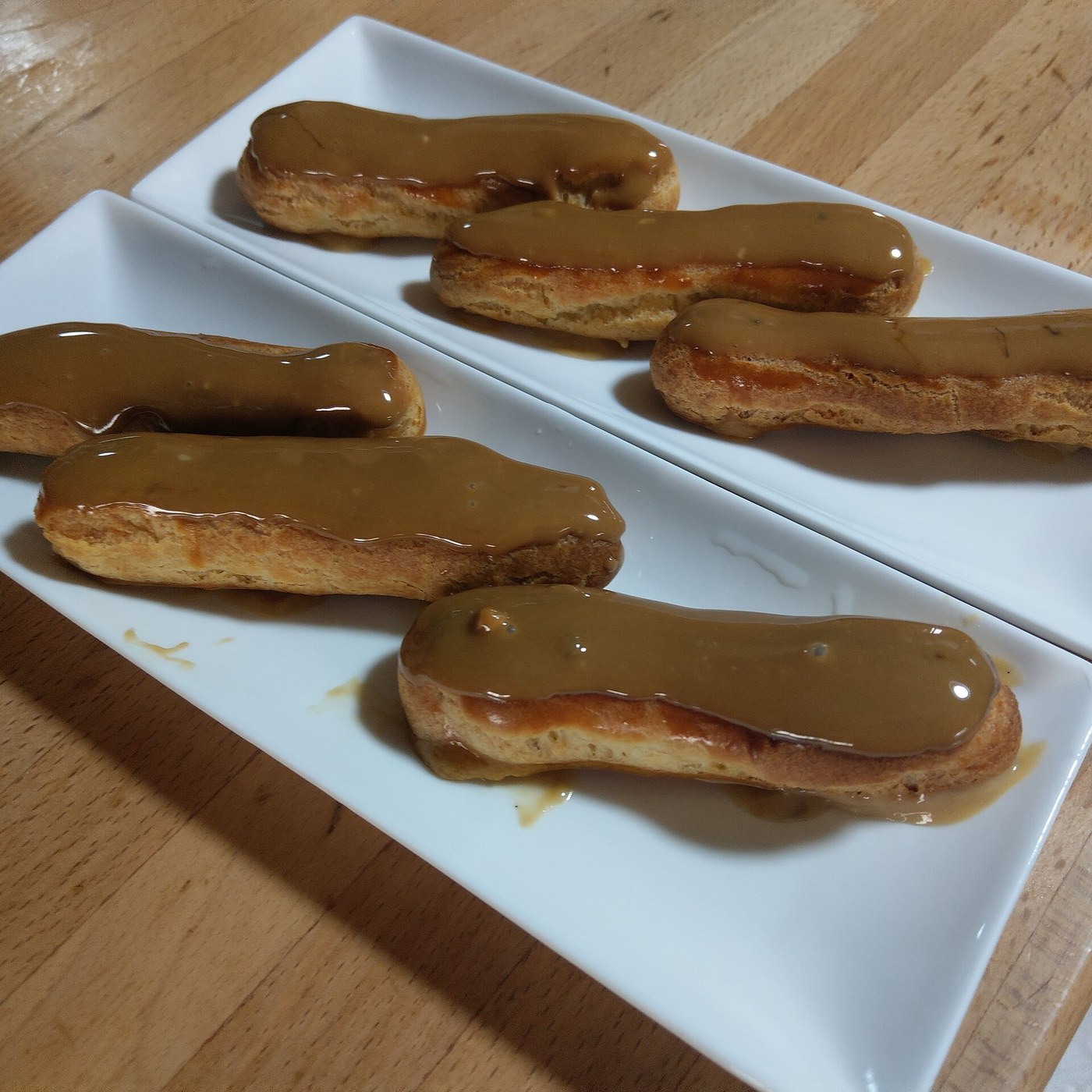


Choux Pastry
Almost every pastry is raised by a gas you put into it — yeast, baking powder, or air whipped into butter. Choux has none of those. It is raised by its own water turning to steam.
That is why it is made backwards. Flour is cooked into boiling water and butter on the hob first, making a thick paste called the panade. Cooking gelatinises the starch — the granules swell and burst, and the paste can then hold far more liquid than raw flour ever could. Eggs are beaten in off the heat, adding still more water plus the protein that will set the walls.
In a hot oven that water flashes to steam and inflates each mound from the inside. The outside sets before the inside does, so the ball puffs, then the egg and starch set into a rigid shell around a hollow. Drop the temperature too soon, or open the door, and the steam condenses before the shell is strong enough — and the whole thing collapses.
Two numbers do most of the work. Bring the panade to 74-79 °C so the starch properly gelatinises. Cool it below about 54 °C before the eggs go in, or you scramble them. Then bake hot first, around 220 °C, to generate steam and lift, and drop to 175-180 °C to dry the shell out.
Make a batch, and make a deliberately bad batch, and taste the difference.
Consignes
Boil the liquid and butter together
Boil the liquid and butter together
Put 125 ml water, 125 ml whole milk, 100 g butter, a pinch of salt and 5 g sugar in a saucepan. Heat until the butter is fully melted, then bring to a rolling boil.
The butter must melt before the liquid boils.
If it boils first you lose water as steam, the ratio shifts, and the paste comes out too dry — an error you cannot correct later.
Matériaux pour cette étape :
 Whole Milk125 ml
 Butter Dish100 g
Outils nécessaires :
 Saucepan
 Digital Kitchen Scale
Beat in the flour and cook the panade to 74-79 °C
Beat in the flour and cook the panade to 74-79 °C
Take off the heat, tip in 150 g flour all at once and beat to a smooth paste. Return to medium heat and beat for 2-3 minutes.
Check with a thermometer: hold the paste at 74-79 °C.
Expect it to come together into a ball that leaves a thin film on the pan base.
That temperature range is where the starch gelatinises — undercook it and the paste will not absorb the eggs.
Matériaux pour cette étape :
 All-Purpose Flour150 g
Outils nécessaires :
 Instant-Read Thermometer
Cool below 54 °C, then add eggs one at a time
Cool below 54 °C, then add eggs one at a time
Transfer to a bowl and beat until the paste drops below 54 °C.
Beat in 4 eggs, one at a time, fully incorporating each before the next.
The paste will look split after each addition and come back together — this is normal.
Add eggs to a paste above 54 °C and the egg protein cooks into visible flecks, and those flecks cannot hold steam.
Matériaux pour cette étape :
 Egg4 pièces
Outils nécessaires :
 Large Mixing Bowl (Glass, 4L)
Judge the consistency by the V test
Judge the consistency by the V test
Lift the spoon. The paste should fall slowly and hang in a V shape from the spoon, and a furrow drawn through it should close slowly but not instantly.
If it is too stiff, beat in a little more beaten egg, a teaspoon at a time.
Egg quantity is a target consistency, not a fixed number. Eggs vary in size and flour varies in absorbency, so the recipe's "4 eggs" is an estimate and the V is the actual specification.
Pipe, then bake hot and drop the heat
Pipe, then bake hot and drop the heat
Pipe 4 cm mounds onto a lined baking sheet, well spaced. Pat down any peaks with a wet fingertip.
Bake at 220 °C for 15 minutes, then without opening the door drop to 175-180 °C for a further 20-25 minutes until deep golden and firm.
Opening the door during the first stage is the classic collapse. The shell is still soft, the steam escapes, and the puff deflates permanently.
Matériaux pour cette étape :
 Parchment Paper Rolls1 rouleau
Outils nécessaires :
 Pastry Piping Bag
 Aluminum Baking Sheet
 Oven Thermometer
Pierce, dry, and measure what you made
Pierce, dry, and measure what you made
Pierce each bun in the base as it comes out and return to a switched-off oven for 10 minutes to dry the inside.
Cut three in half and record: total height, wall thickness, and whether the centre is hollow or has a wet dough plug.
Then bake a deliberately faulty batch — door opened at 8 minutes — and measure the same three things.
Expect the faulty batch to be shorter, thicker-walled and wetter inside. A hollow choux and a heavy one differ in process, not ingredients.
Outils nécessaires :
 Digital Caliper 6-Inch
History & Context
History & Context
The traditional origin story is 1540 and should be repeated with caution. A cook variously named Pantarelli or Popelini is said to have come to France in Catherine de' Medici's household and made a hot dried paste — pâte à chaud — which became pâte à Popelin and eventually pâte à choux, named for the little cabbages the buns resemble. The story is repeated everywhere and the documentary evidence behind it is thin. What is solid is the nineteenth century: Antonin Carême refined the paste into essentially its modern form and built it into the architectural desserts he is famous for, and the éclair, the profiterole, the religieuse and the croquembouche all descend from that work.
Steam leavening is the whole idea, and the physics is dramatic. Water expands enormously on turning to vapour — roughly a factor of 1,600 at atmospheric pressure — so a small amount of water in the paste can inflate a mound many times its own volume. This is the same mechanism that raises Yorkshire pudding, popovers and true puff pastry; the difference is that puff pastry traps its steam in hundreds of butter-separated layers, while choux traps it in one big bubble. Nothing is added to make choux rise: the leavening was in the recipe as water all along.
Why the paste has to be cooked first. Raw flour cannot hold this much liquid — the mixture would simply be a batter, and a batter spreads instead of holding a piped shape. Gelatinising the starch lets the paste absorb the water and the four eggs and still be stiff enough to pipe. It also damages the gluten's elasticity, which is desirable here: you want a paste that stretches and stays stretched, not one that pulls back. This is the opposite of bread, where gluten development is the goal.
Honest limits and failure modes. Choux is intolerant of humidity — shells go soft within hours and are best filled shortly before serving. Too much egg makes a paste that spreads flat; too little makes a dense bun that never hollows. Underbaking is the single commonest fault and it does not show until the pastry cools and sinks, so bake until you think it is slightly too dark, then pierce and dry. Fan ovens run hotter than their dial and can set the shell before the puff is complete. And the paste does not keep well raw: pipe and bake it the day it is made.
Matériaux
5- 125 mlEspace réservé
- 100 gEspace réservé
- 150 gEspace réservé
- 4 piècesEspace réservé
- 1 rouleauEspace réservé
Outils requis
8- Espace réservé
- Espace réservé
- Espace réservé
- Espace réservé
- Espace réservé
- Espace réservé
- Espace réservé
- Espace réservé
Matériaux des Blueprints connectés

Blueprints liés
Ces blueprints partagent des connaissances — techniques, matériaux ou principes
CC0 Domaine public
Ce blueprint est publié sous CC0. Vous êtes libre de copier, modifier, distribuer et utiliser ce travail pour tout usage, sans demander la permission.
Soutenez le Maker en achetant des produits via son Blueprint où il perçoit une Commission Maker définie par les Vendeurs, ou créez une nouvelle itération de ce Blueprint et incluez-le comme connexion dans votre propre Blueprint pour partager les revenus.