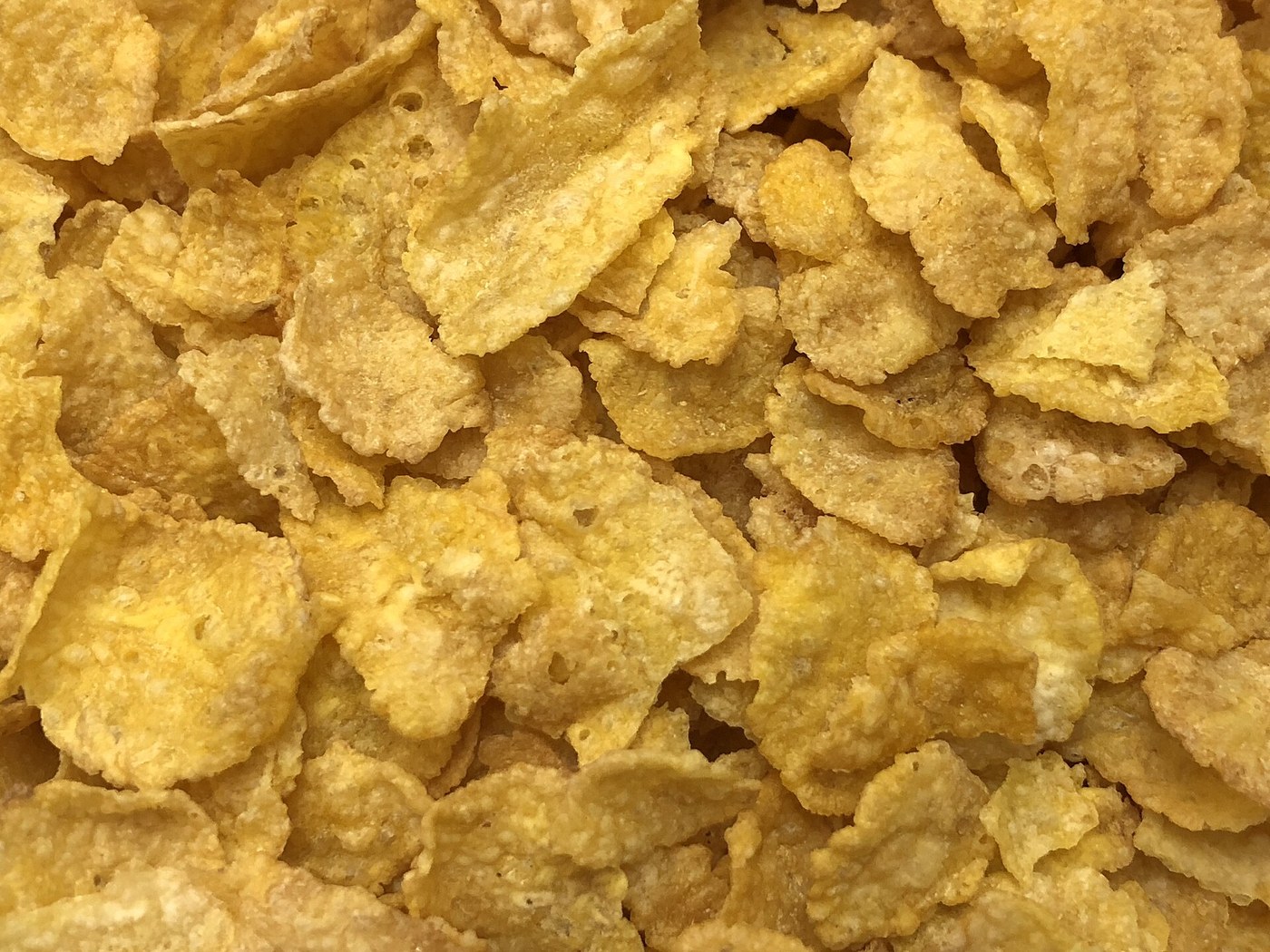


Corn Flakes
Consignes
Cook the grain through
Cook the grain through
The starch must be fully gelatinised or nothing later works.
- Simmer whole grain in plenty of water until soft all the way to the centre.
- Test by crushing one grain — no hard core.
- Drain well.
Matériaux pour cette étape :
 Grains de blé entiers500 g
Temper — the step that was the discovery
Temper — the step that was the discovery
Do nothing, for a long time. This is the whole invention.
- Spread the cooked grain and let it stand, covered and cool, for several hours to a day.
- Turn it occasionally.
- The surface should feel dry-ish while the inside stays moist.
Roll into flakes
Roll into flakes
Flatten each grain individually.
- Pass the tempered grain through rollers set to a thin gap, or press with a rolling pin.
- Aim for separate flattened grains, not a continuous sheet.
- Keep the layer single — overlapping grains weld together.
Matériaux pour cette étape :
 Tamis à toile métallique fine1 pièce
Toast, and test the crispness
Toast, and test the crispness
Toasting removes the last moisture and sets the texture.
- Spread the flakes on a tray and bake in a moderate oven until crisp and lightly coloured.
- Cool completely — they crisp further as they cool.
- Leave a few out in the air overnight and taste them again.
Matériaux pour cette étape :
 Thermomètre à lecture instantanée1 pièce
History and context
History and context
John Harvey Kellogg was superintendent of the Battle Creek Sanitarium, a health institution run on Seventh-day Adventist principles. He and his brother Will Keith Kellogg were looking for an easily digested, ready-cooked grain food. The flaking discovery — cooked wheat left standing before rolling — is dated to 1894, and the patent, US 558,393, Flaked cereals and process of preparing same, was granted on 14 April 1896.
The brothers' quarrel decided what breakfast is. Will wanted to sweeten the flakes and sell them commercially; John Harvey regarded sugar as precisely the sort of stimulation the sanitarium existed to remove. Will founded what became the Kellogg Company in 1906 and added sugar. The mass-market breakfast cereal industry descends from the brother who lost the argument about health and won the argument about sales.
The uncomfortable part, stated plainly. John Harvey Kellogg's dietary programme was not only about digestion — he advocated bland food explicitly as a means of suppressing sexual appetite, and he was a prominent advocate of eugenics, founding the Race Betterment Foundation. Those views were central to his thinking, not incidental to it, and any honest account of where corn flakes came from includes them.
Competition arrived immediately. C. W. Post, a former patient at the sanitarium, launched Grape-Nuts in 1897 and Post Toasties soon after, and Battle Creek filled with cereal companies. Litigation over the flaking process ran for years — an early example of a food process patent proving very hard to defend once the idea was public.
Matériaux
3- Espace réservé
- Espace réservé
- Espace réservé
Blueprints liés
Ces blueprints partagent des connaissances — techniques, matériaux ou principes

CC0 Domaine public
Ce blueprint est publié sous CC0. Vous êtes libre de copier, modifier, distribuer et utiliser ce travail pour tout usage, sans demander la permission.
Soutenez le Maker en achetant des produits via son Blueprint où il perçoit une Commission Maker définie par les Vendeurs, ou créez une nouvelle itération de ce Blueprint et incluez-le comme connexion dans votre propre Blueprint pour partager les revenus.