ART
BEAUTÉ ET BIEN-ÊTRE
ARTISANAT
CULTURE ET HISTOIRE
DIVERTISSEMENT
ENVIRONNEMENT
NOURRITURE ET BOISSONS
INGÉNIERIE INVERSE
SCIENCES
SPORTS
TECHNOLOGIE
TECHNOLOGIE PORTABLE


Crank-Point Can Opener: A Bent Point to Turn On, a Knife Set in a Slot
A can opened with a lever knife leaves a jagged hole of any size.
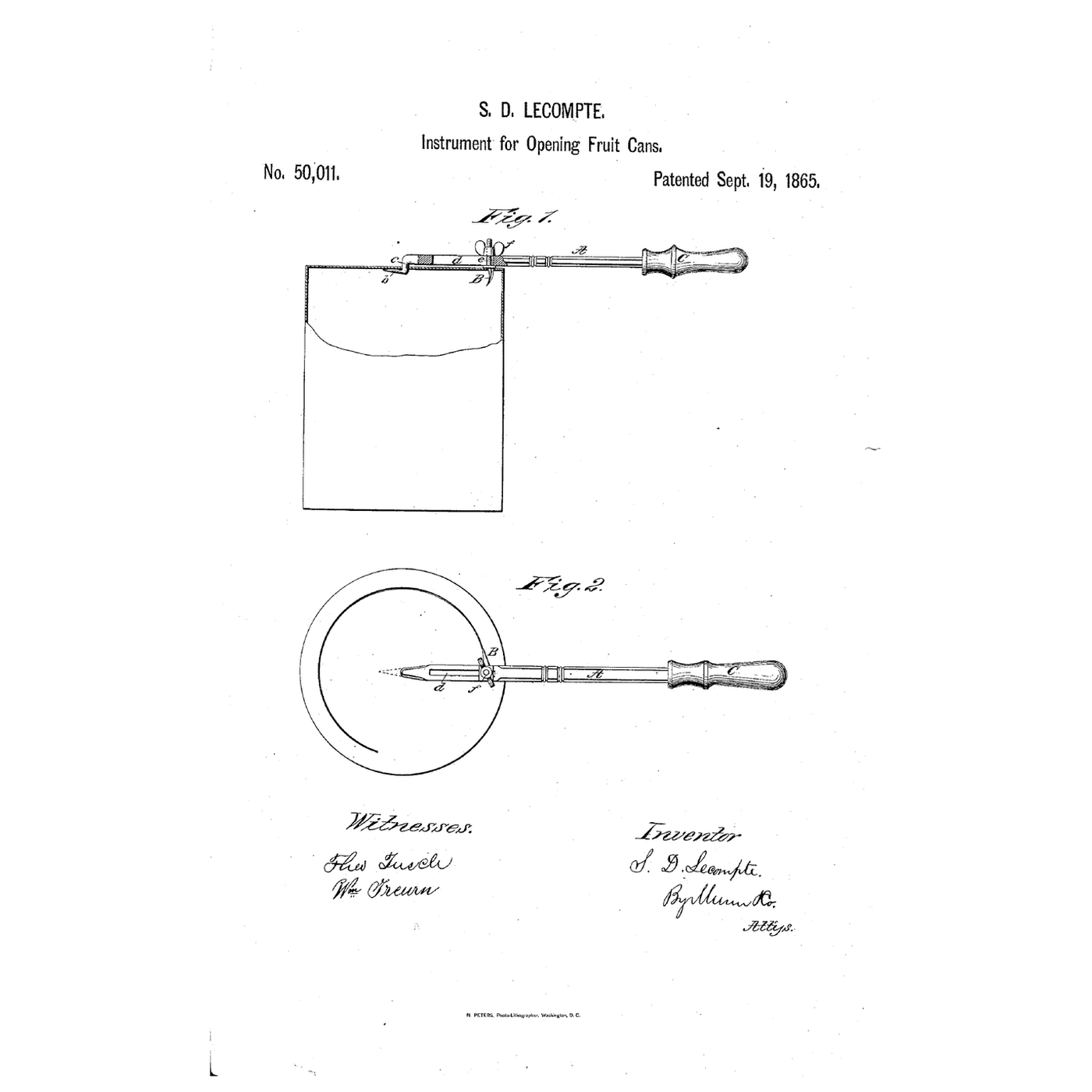
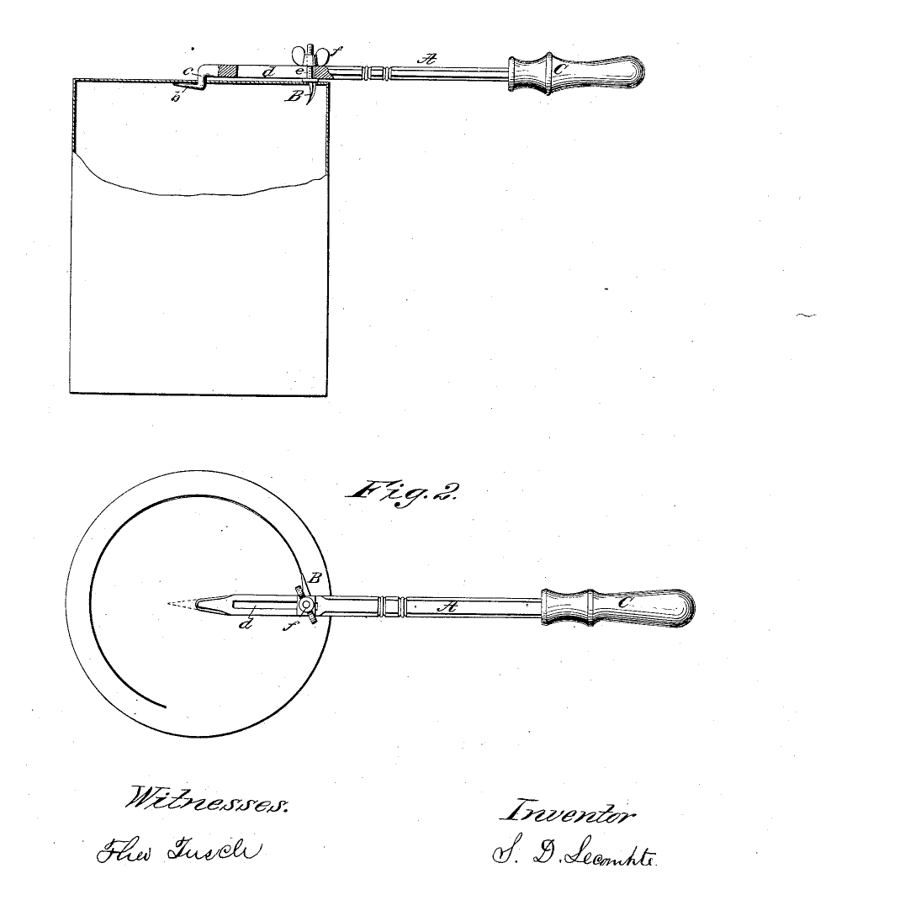
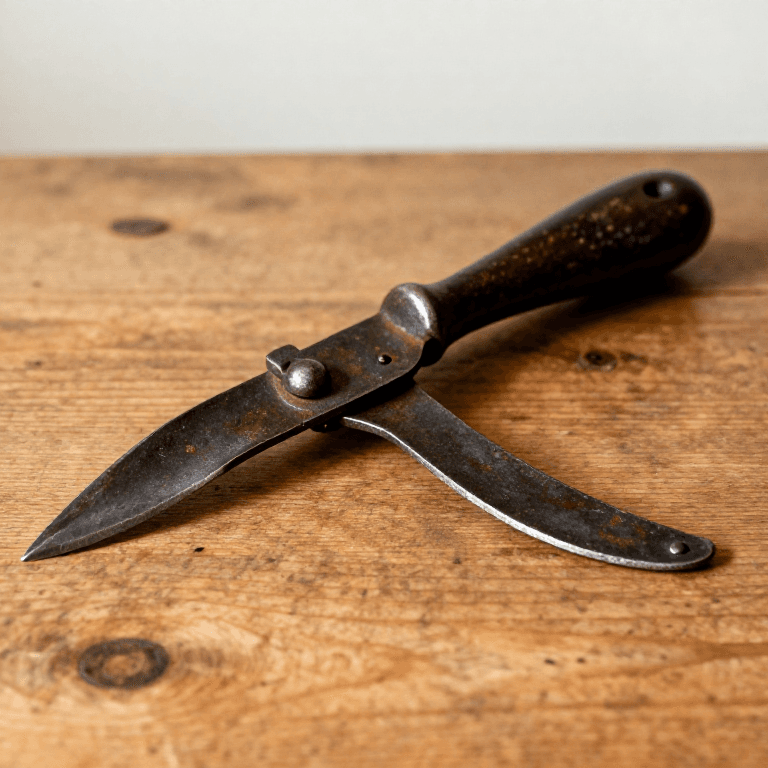
Samuel D. Lecompte of Leavenworth, Kansas, received US 50,011, dated 19 September 1865, for an instrument for opening fruit and other sealed cans: a bar with a handle, its end bent like a crank and pointed so that, thrust through the top, the bent part is held by the edges of the hole as a bearing; a knife slides along a slot in the bar on a set screw, and the instrument is turned round to cut.
This rung works out where to set the knife for each can, then forges the bar, crank and knife and cuts a round opening.
Intermédiaire
About 3 hours
Consignes
1
1
Knife position for each can
Knife position for each can
Chargement du notebook Jupyter…
2
2
A lever opener before it
A lever opener before it
The embedded blueprint saws round a can with a lever knife. Lecompte gives the knife a centre to turn about and a slot to set its radius.
3
3
Read US 50,011
Read US 50,011
"The end of the instrument is bent somewhat in the form of a crank, and pointed, as shown by the letters b c in Fig. 1. This enables the instrument to be thrust into the top of the can in such manner that the part c, which is bent at right angles to the bar A, will be encircled by the edges of the hole made in the top of the can, thus insuring a good and sufficient bearing to enable the instrument to be operated."
4
4
Slot the bar
Slot the bar
Cut 170 mm of 25 × 3 mm flat bar. Drill a row of 5 mm holes along its centre from 25 to 70 mm from one end and file them into a slot.
Matériaux pour cette étape :
 Plat en acier doux1 pièce
Outils nécessaires :
 Scie à métaux
 Étau d'établi
 Pointeau
 Perceuse sans fil
 Jeu de forets
 Jeu de limes aiguilles
 Règle
Règle5
5
Forge the crank point
Forge the crank point
File the bar's slotted end down to 6 mm wide for its last 30 mm. Bend it down 15 mm, along 10 mm, and down again 15 mm in the vice, and file the end to a sharp point.
Outils nécessaires :
 Limes (lime à main)Étau d'établi
 Marteau
 Lunettes de sécurité transparentes
6
6
Make the knife
Make the knife
Cut a 6 × 25 mm knife from 1 mm steel sheet with a pointed lower end and a 5 mm hole at the top. Hone its edge.
Matériaux pour cette étape :
 Tôle d'acier doux1 pièce
Outils nécessaires :
 Cisaille à tôlePerceuse sans filJeu de foretsLimes (lime à main)
 Pierre à aiguiser
7
7
Fit the knife and handle
Fit the knife and handle
Bolt the knife under the slot with an M5 screw, washer and nut as the set screw. Fit a hardwood handle to the bar's other end with epoxy.
Matériaux pour cette étape :
 Vis à métaux1 pièce
 Rondelle plate1 pièce
 Écrou hexagonal1 pièce
 Goujons de bois dur1 pièce
 Époxy à deux composants1 pièce
Outils nécessaires :
 Clé à molettePerceuse sans filJeu de forets
8
8
The patent drawing
The patent drawing
US 50,011 drawing sheet, public domain (expired patent).
9
9
Cut a round opening
Cut a round opening
Set the knife for the can and tighten it. Stand a sealed can on the kitchen scale, thrust the point through the top's centre, press the knife in and turn round; read the peak load, time it, and measure the hole.
Matériaux pour cette étape :
 Boîte de conserve1 pièce
Outils nécessaires :
 Balance de cuisine numérique
 Chronomètre
 Pied à coulisse numérique 6 pouces
 Gants de travail en cuir
10
10
A point that tears out, a knife that slips
A point that tears out, a knife that slips
Crank-point can opener troubleshooting.
Flow
Loading...
11
11
History and honest limits
History and honest limits
**Samuel D. Lecompte** of Leavenworth, Kansas, received US 50,011, dated 19 September 1865, for cans used for fruits, preserves and oysters. He did not limit himself to one knife shape, having adopted various styles. The patent was reissued on 4 February 1868 (No. 2,851). F. S. Wyman's 1868 patent names it as the circular opener he added a side knife to.
**Honest limits.** A bolt and nut stand in for his set screw, and the knife is unhardened. Your loads and times are the result.
Matériaux
8- 1 pièceEspace réservé
- 1 pièceEspace réservé
- 1 pièceEspace réservé
- 1 pièceEspace réservé
- 1 pièceEspace réservé
- 1 pièceEspace réservé
- 1 pièceEspace réservé
- 1 pièceEspace réservé
Outils requis
17- Espace réservé
- Espace réservé
- Espace réservé
- 1 vendor sell this, none ship to you yetEspace réservé
- Espace réservé
- Espace réservé
- Espace réservé
- Espace réservé
- Espace réservé
- Espace réservé
- Espace réservé
- Espace réservé
- Espace réservé
- Espace réservé
- Espace réservé
- Espace réservé
- Espace réservé
Blueprints liés
Ces blueprints partagent des connaissances — techniques, matériaux ou principes



CC0 Domaine public
Ce blueprint est publié sous CC0. Vous êtes libre de copier, modifier, distribuer et utiliser ce travail pour tout usage, sans demander la permission.
Soutenez le Maker en achetant des produits via son Blueprint où il perçoit une Commission Maker définie par les Vendeurs, ou créez une nouvelle itération de ce Blueprint et incluez-le comme connexion dans votre propre Blueprint pour partager les revenus.