ART
BEAUTÉ ET BIEN-ÊTRE
ARTISANAT
CULTURE ET HISTOIRE
DIVERTISSEMENT
ENVIRONNEMENT
NOURRITURE ET BOISSONS
INGÉNIERIE INVERSE
SCIENCES
SPORTS
TECHNOLOGIE
TECHNOLOGIE PORTABLE
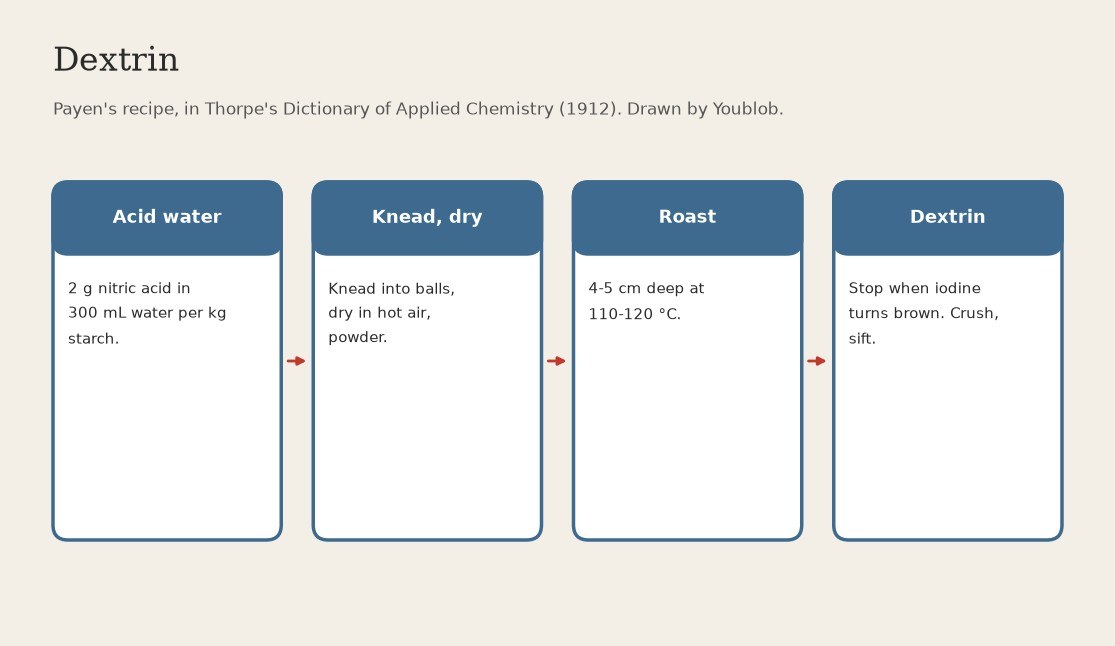


Dextrin: Starch Moistened with Dilute Nitric Acid and Heated at 110-120 °C (Payen, in Thorpe 1912)
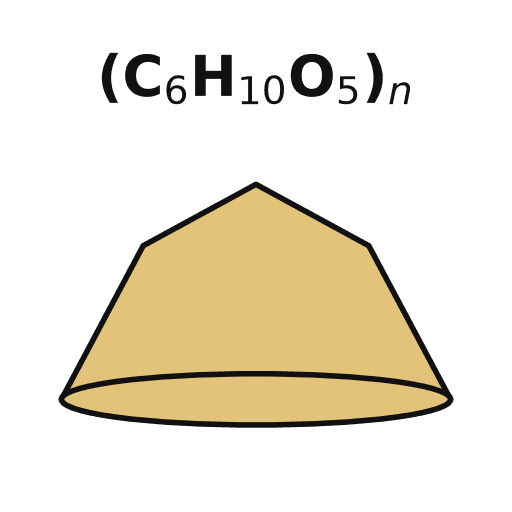
Dextrin, also called British gum, is starch broken down by heat into a powder that dissolves in water to a sticky gum. A trace of nitric acid lets it form at a lower heat, 110 to 120 °C, so it comes out paler. The lower the heat and the drier the starch, the whiter the dextrin.
Source: Thorpe, Dictionary of Applied Chemistry, vol. 2 (1912), Dextrins, giving Payen's recipe. Ours: potato starch (Payen names no starch) and the scaling to 1 kg. Not given: how long to dry and to heat. Picture drawn by Youblob.
Débutant
2 days
Consignes
1
1
Mix 2 g nitric acid into 300 mL water
Mix 2 g nitric acid into 300 mL water
Payen: 30 gallons of water holding 2 lb nitric acid (sp. gr. 1.38) for 1000 lb starch. Ours, scaled to 1 kg of starch: weigh 2 g of the acid into about 300 mL water. Add acid to water, not water to acid. Goggles and gloves for the strong acid.
Matériaux pour cette étape :
 Acide nitrique2 g
 Eau300 ml
Outils nécessaires :
 Balance à fléau
 Verre doseur
 Lunettes-masque anti-projections chimiques
 Gants en nitrile
2
2
Knead 1 kg starch with the acid water into balls
Knead 1 kg starch with the acid water into balls
Moisten 1 kg of starch with the acid water, knead it well and make it up into balls. Payen names no starch; ours: potato starch.
Matériaux pour cette étape :
 Fécule de pomme de terre1 kg
Outils nécessaires :
 Bol en verreGants en nitrile
3
3
Dry the balls in hot air, then powder them
Dry the balls in hot air, then powder them
Dry the balls in a hot-air chamber, then powder them. Time and heat for this drying are not given. Ours: a drying oven, and a mortar to powder.
Outils nécessaires :
 Étuve de séchage
 Mortier et pilon
4
4
Heat 4-5 cm deep on trays at 110-120 °C
Heat 4-5 cm deep on trays at 110-120 °C
Spread the powder 1 1/2 to 2 inches (4 to 5 cm) deep on trays (Payen: brass trays) and heat in a hot-air oven at 110 to 120 °C. Time not given.
Outils nécessaires :
 Plateau plat de séchageÉtuve de séchage
 Thermomètre de four
5
5
Stop as soon as iodine turns a sample brown
Stop as soon as iodine turns a sample brown
Test small samples with iodine. Starch turns iodine blue; commercial dextrin, mostly erythrodextrin, gives a brown colour. When the change is complete, stop the heating at once. Ours: a few iodine crystals shaken in water as the test liquid.
Outils nécessaires :
 Cristaux d'iodeEauÉtuve de séchage
6
6
Crush, sift and store dry
Crush, sift and store dry
Crush the roasted dextrin and sift it (in works: crushing pans or rollers, then a rotating silk screen as in flour mills). Ours: mortar and a fine sieve. Keep it dry in a closed jar.
Outils nécessaires :
Mortier et pilon Tamis à toile métallique fine
 Bocal en verre
Matériaux
3- Espace réservé
- 300 mlEspace réservé
- Espace réservé
Outils requis
13- Espace réservé
- Espace réservé
- Espace réservé
- Espace réservé
- Espace réservé
- Espace réservé
- Espace réservé
- Espace réservé
- Espace réservé
- Espace réservé
- Espace réservé
- Espace réservé
- Espace réservé
Ce plan fabrique
Blueprints liés
Ces blueprints partagent des connaissances — techniques, matériaux ou principes

CC0 Domaine public
Ce blueprint est publié sous CC0. Vous êtes libre de copier, modifier, distribuer et utiliser ce travail pour tout usage, sans demander la permission.
Soutenez le Maker en achetant des produits via son Blueprint où il perçoit une Commission Maker définie par les Vendeurs, ou créez une nouvelle itération de ce Blueprint et incluez-le comme connexion dans votre propre Blueprint pour partager les revenus.