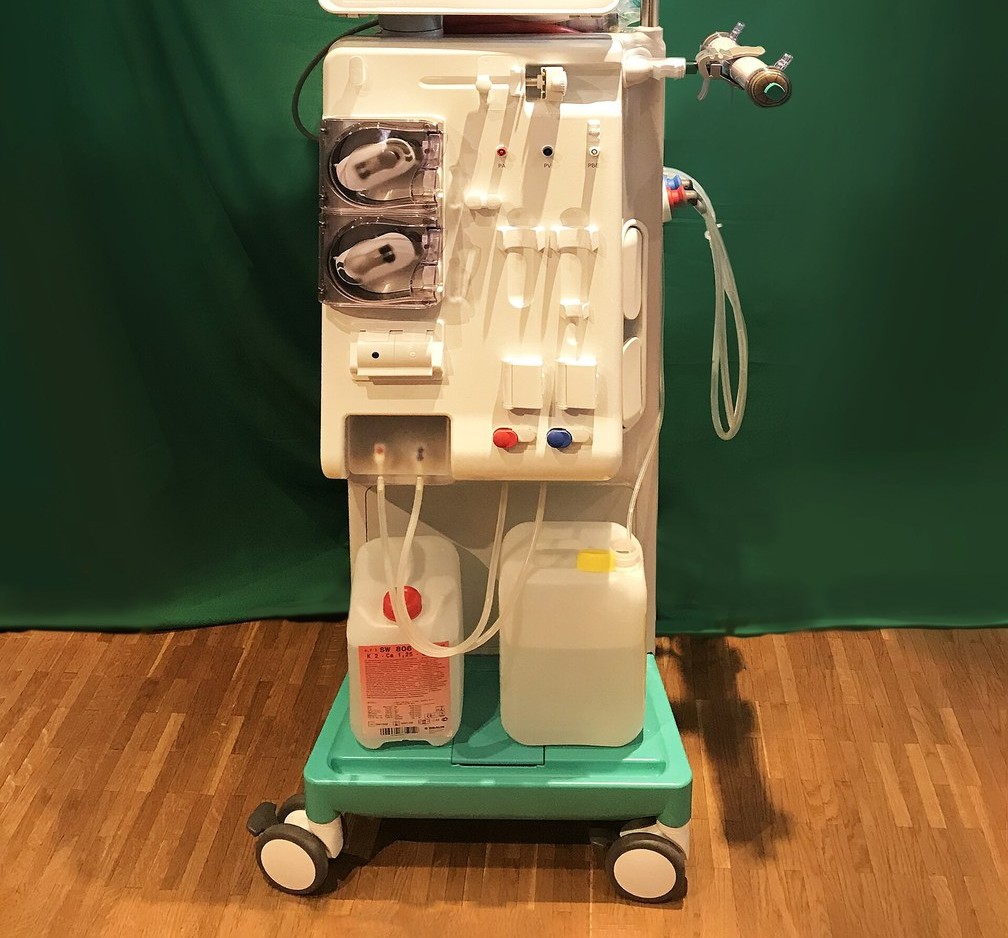


Dialysis
Blood is a mixture in which almost everything must stay and a few small things must go. Waste molecules like urea are tiny; proteins and blood cells are enormous by comparison. No filter that removes urea by force could avoid removing much else with it.
Dialysis does not filter. It lets molecules leave under their own power, and only the small ones can.
The device is a membrane with pores large enough for water, salts and urea and too small for protein. Put blood on one side and a clean fluid on the other. Molecules move constantly in all directions, so any species more concentrated on one side will, purely by chance, cross more often outward than inward — diffusion down a concentration gradient, with nothing driving it but the molecules' own motion.
The urea leaves because there is none on the far side. The protein stays because it does not fit. Nothing had to be selected or recognised; the pore size does the choosing and thermodynamics does the work.
The dialysate is therefore not "clean water" — it is deliberately made to match blood in the things you want to keep. Match sodium and potassium and calcium, and they have no gradient and stay put. Leave urea out entirely, and it goes.
You control what is removed by choosing what you put on the other side.
Consignes
Watch a membrane sort by size
Watch a membrane sort by size
Fill a length of dialysis tubing — or a well-rinsed sausage casing — with a mixture of starch solution and salt solution. Knot both ends and suspend it in a beaker of distilled water.
After an hour, test the outside water two ways: for salt with a conductivity meter or by taste of a drop on clean skin, and for starch with iodine.
Expect salt outside and no starch.
Both were free to move. Only one could fit. That is the entire principle, and nothing pushed anything.
Matériaux pour cette étape :
 Boyau à dialyse1 m
 Eau distillée1 L
Prove the gradient is the engine
Prove the gradient is the engine
Run the same experiment twice: once with distilled water outside, once with a salt solution outside at the same concentration as inside.
Measure salt movement in both.
Expect the matched case to show almost no net transfer.
The membrane has not changed. What changed is that there is no longer a gradient, so crossings in each direction cancel.
Write down the design consequence: anything you do not want removed, you put in the dialysate at the same concentration. That single sentence explains the entire composition of a clinical dialysis fluid.
Find how much surface area the job needs
Find how much surface area the job needs
Repeat step 1 with a short piece of tubing and then a long one, keeping volumes equal, and compare how much salt has left after the same time.
Expect transfer to scale with membrane area.
Now scale it up mentally: a human needs several square metres of membrane to clear waste in a few hours.
That is why a modern dialyser is a cartridge the size of a drink can containing thousands of hollow fibres, blood inside them and dialysate outside. Bundling fibres is how you fit square metres into a fist — the same trick as a car radiator, for the same reason.
Run the two flows against each other
Run the two flows against each other
Set up a tube-in-tube rig and run the two liquids first in the same direction, then in opposite directions, and compare how much salt has crossed at the far end.
Expect counterflow to win.
With both flowing the same way, the two sides approach equal concentration part-way along and transfer stops. Running them opposite keeps a gradient along the entire length, because the most-cleaned blood always meets the freshest fluid.
This is the same counterflow trick as the heat exchanger in the air-liquefaction blueprint. Whenever two streams exchange anything, run them against each other.
Remove water as well, by pressure
Remove water as well, by pressure
Diffusion moves solutes but not much water. Now apply gentle pressure to the inside of your filled tubing — a raised head or a light squeeze — and measure the volume that comes out.
Expect water to be pushed across, carrying dissolved small molecules with it.
That is ultrafiltration, and it is a separate control from diffusion.
A patient who cannot pass urine is retaining fluid as well as waste, so a dialysis machine must do both jobs: diffusion to clear solutes, and pressure to remove litres of water. Two mechanisms, two knobs, in one cartridge.
History & Context
History & Context
Built out of sausage casing and orange juice cans. Willem Kolff constructed the first practical artificial kidney in the occupied Netherlands during the Second World War, using cellulose sausage skin as the membrane, wound on a drum turning in a bath. Materials were unobtainable and his first patients died. In 1945 a woman in uraemic coma recovered — she was, by his own account, a Nazi collaborator, and he treated her anyway. He later gave his machines away to hospitals abroad rather than patent them.
The barrier was not the membrane, it was the plumbing. Dialysis could rescue someone from acute failure, but chronic patients could not be treated because each session destroyed an artery and a vein, and a person only has so many. The Scribner shunt — a permanent external loop joining artery to vein — made repeated access possible, and turned kidney failure from a death sentence into a chronic condition. An enabling accessory mattered as much as the machine, exactly as the flexible hose did for hydraulic brakes.
It forced medicine to ration openly. When Seattle had one machine and many candidates, a lay committee was convened to decide who received treatment — the "God committee". The scrutiny that followed is a founding episode of modern bioethics. A successful technology created a distribution problem that the technology could not answer.
The same separation everywhere else. Size-selective membranes desalinate seawater, concentrate fruit juice, recover proteins in brewing and dairy, and purify laboratory samples. The ceramic candle filter in the sanitation batch is the coarse end of the same family — pores excluding bacteria rather than proteins. Change the pore size and you change the industry.
Honest limits. It replaces one function of a kidney. It does not make the hormones that control blood pressure or red cell production, so those must be supplied separately. It is intermittent — waste accumulates between sessions, and a patient lives on a sawtooth that a working kidney would smooth. It consumes enormous volumes of highly purified water. And it costs a great deal of time: several hours, several times a week, indefinitely, which is a burden no description of the mechanism conveys.
Matériaux
2- Espace réservé
- Espace réservé
Matériaux des Blueprints connectés
Blueprints liés
Ces blueprints partagent des connaissances — techniques, matériaux ou principes

CC0 Domaine public
Ce blueprint est publié sous CC0. Vous êtes libre de copier, modifier, distribuer et utiliser ce travail pour tout usage, sans demander la permission.
Soutenez le Maker en achetant des produits via son Blueprint où il perçoit une Commission Maker définie par les Vendeurs, ou créez une nouvelle itération de ce Blueprint et incluez-le comme connexion dans votre propre Blueprint pour partager les revenus.