

Hydraulic Jack
Bramah's press proved that a liquid can multiply force. It did not make that useful to a man standing alone beside a load. A press is a building; a jack is something you carry to the work.
Turning one into the other is not a matter of scale. It needs the whole hydraulic circuit — reservoir, pump, valves and ram — folded into a single body with no external plumbing at all. Three valves do that work: a suction check valve letting oil into the pump chamber on the up-stroke, a delivery check valve letting it into the ram on the down-stroke and holding it there, and a release valve the operator opens to let the load down. Take away any one and you have a device that lifts once and cannot be reset, or lifts and will not lower.
What it replaced was the screw jack, which the Romans already had. A screw jack wastes most of its input in thread friction, and its capacity is limited by what a thread can carry without seizing. The hydraulic jack routes the force through oil instead, so the multiplication is set by F₂ = F₁ × (A₂/A₁) and nothing is rubbing except two small seals.
That same friction is why the screw refuses to die: it is self-locking. A hydraulic jack is not. It holds its load only for as long as a check valve keeps sealing — which is the single most important thing to understand about it, and step 5 is built around proving it to yourself.
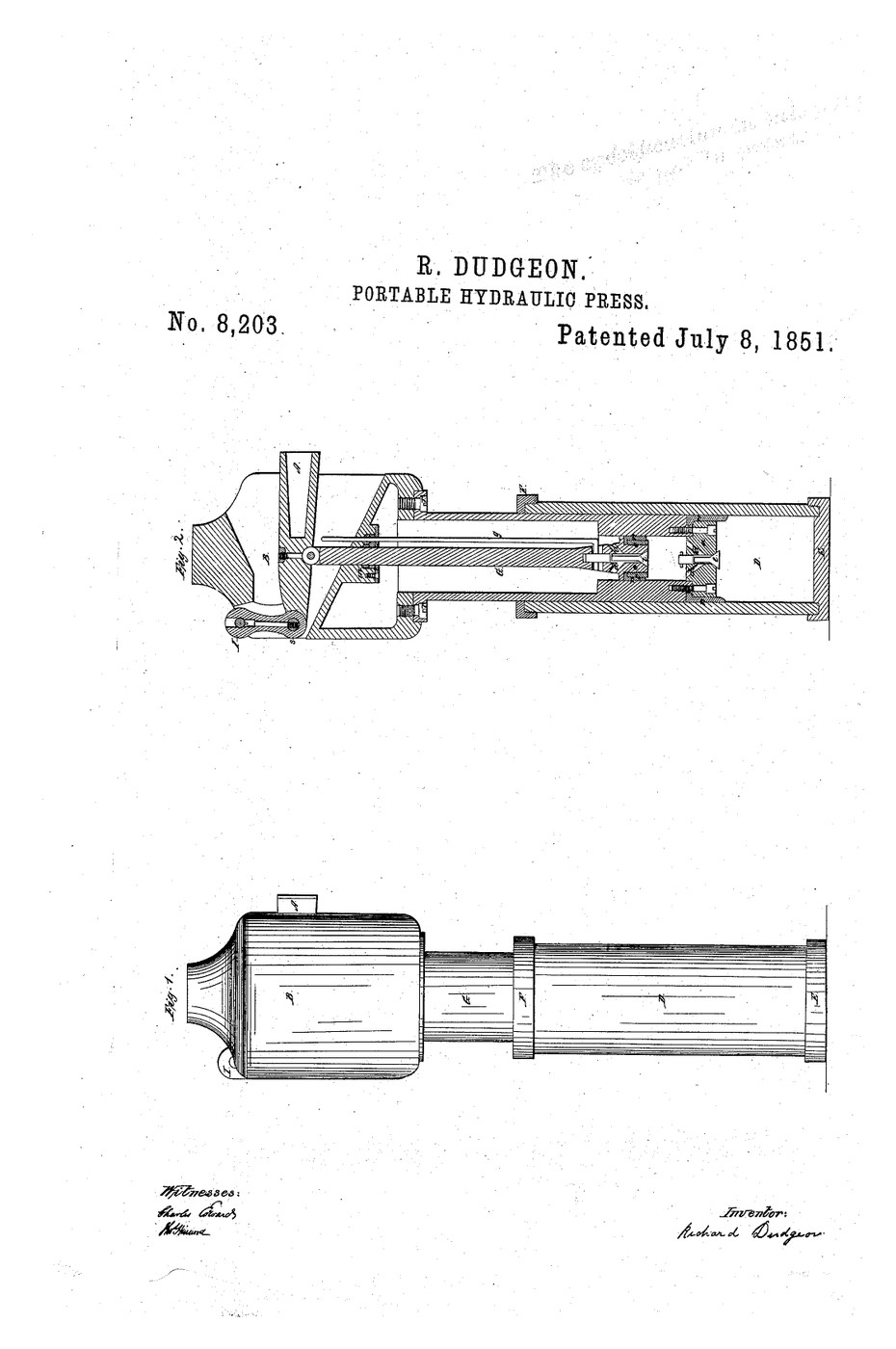
Richard Dudgeon, US 8,203, "Portable Hydraulic Press", granted 8 July 1851.
Consignes
Measure what a screw jack costs you
Measure what a screw jack costs you
Take a screw jack — a car scissor jack will do — and lift a known mass through a measured height.
Compute the work out: m × g × h. Then estimate the work in: your handle force × the distance your hand travelled around the crank.
Expect the output to be well under half the input. The rest went into thread friction as heat.
Write that number down. It is the inefficiency Dudgeon was selling against, and it is also — as step 5 shows — the reason screw jacks are still made.
Outils nécessaires :
 Measuring Tape 3m
Trace the three valves in a real jack
Trace the three valves in a real jack
Find a bottle jack and locate, by feel and by following the passages, its three valves:
Suction check — between reservoir and pump chamber. Opens as the plunger rises.
Delivery check — between pump chamber and ram. Opens as the plunger falls.
Release — a needle valve, operator-controlled, dumping the ram back to reservoir.
Note that the two checks face opposite ways. That opposition is what converts a plunger going up and down into oil going one way only, and it is the same trick as a heart valve or Ctesibius' force pump.
Build the circuit with two check valves
Build the circuit with two check valves
Assemble a working model: a syringe as the pump, a second larger syringe as the ram, a jar of water as the reservoir, and two check valves plumbed in opposition — one from reservoir to pump, one from pump to ram.
Work the small syringe repeatedly. Expect the large one to advance a little on each stroke and to stay put between strokes.
That ratcheting is the whole point of a jack. A bare press gives you one stroke; the valves let you pump a short stroke many times and accumulate the travel.
Matériaux pour cette étape :
 Syringe Set (5ml and 50ml)1 jeu
 Silicone Tubing (6mm ID)1 m
 Brass Check Valve (1/2 inch)2 pièces
 Distilled Water (1 Liter)300 ml
Measure the ratio, and how many strokes it costs
Measure the ratio, and how many strokes it costs
Measure both bores with the caliper and compute A₂/A₁.
Lift a known mass with the ram and read the input force on the scale under the pump plunger. Check it against the ratio.
Now count the strokes needed for 20 mm of ram travel, and compare with the prediction: pump stroke × (A₁/A₂) per stroke.
A big ratio gives a light handle and a great many strokes. That trade is why jacks are rated in tonnes and sold on how fast they lift — the two numbers pull against each other.
Outils nécessaires :
 Digital Caliper 6-Inch
 Digital Kitchen Scale
Prove to yourself that it is not self-locking
Prove to yourself that it is not self-locking
With the ram raised and holding a load, hold a finger lightly on the delivery check valve and ease it off its seat.
The load comes straight down.
Now do the same thought experiment with the screw jack from step 1: let go of the handle and nothing happens. The friction you measured as waste in step 1 is what holds it.
A hydraulic jack holds its load on a valve and a seal, not on geometry. A dirty seat, a nicked seal or a slow leak lets it settle. This is why every workshop rule says the same thing: a jack raises a load, stands hold it, and nobody goes underneath something supported only by a jack.
History & Context
History & Context
The patent. US 8,203, "Portable Hydraulic Press", Richard Dudgeon, granted 8 July 1851. It was the first genuinely new heavy-lifting device since the Roman screw jack — roughly eighteen centuries of nothing.
The whiskey jack. Dudgeon's first design carried its fluid reservoir in the head of the jack, and the patent specifies "water or other fluid". In practice operators filled them with whale oil, and in winter with whiskey, because water froze and heavier oils thickened until the jack would not pump. The nickname stuck. Fourteen years later Dudgeon moved the reservoir to the base, correcting a design that had been top-heavy from the start — a reminder that the first version of a good idea is rarely the version that lasts.
Why it beat the screw so completely. A screw jack's capacity is limited by what a thread will carry before it galls, and most of the operator's effort is lost to friction. The hydraulic jack moved the load path into a fluid, so capacity became a question of cylinder area and wall thickness — both easy to increase. Railroads, shipyards and foundries took it immediately.
What the screw kept. Self-locking, as step 5 showed, plus tolerance of dirt and neglect, plus no fluid to leak or freeze. Scissor jacks in car boots are still screws for exactly these reasons. The hydraulic jack did not replace the screw jack; it took the heavy end of the work and left the rest.
Where the idea went next. The same self-contained pump-and-ram package became the porta-power, the bottle jack, the pallet truck, the log splitter and the trolley jack. And scaled up and given a return line and a control valve, it became the hydraulic cylinder on every excavator — the reason a machine can be strong in a place where no beam could reach.
Honest limitation. Short stroke, slow, and it must be kept upright: nearly all bottle jacks rely on gravity to keep the suction port under oil, so laid on their side they simply pump air.
Matériaux
4- Espace réservé
- Espace réservé
- 2 piècesEspace réservé
- 300 mlEspace réservé
Outils requis
3- Espace réservé
- Espace réservé
- Espace réservé
Matériaux des Blueprints connectés

Blueprints liés
Ces blueprints partagent des connaissances — techniques, matériaux ou principes
CC0 Domaine public
Ce blueprint est publié sous CC0. Vous êtes libre de copier, modifier, distribuer et utiliser ce travail pour tout usage, sans demander la permission.
Soutenez le Maker en achetant des produits via son Blueprint où il perçoit une Commission Maker définie par les Vendeurs, ou créez une nouvelle itération de ce Blueprint et incluez-le comme connexion dans votre propre Blueprint pour partager les revenus.