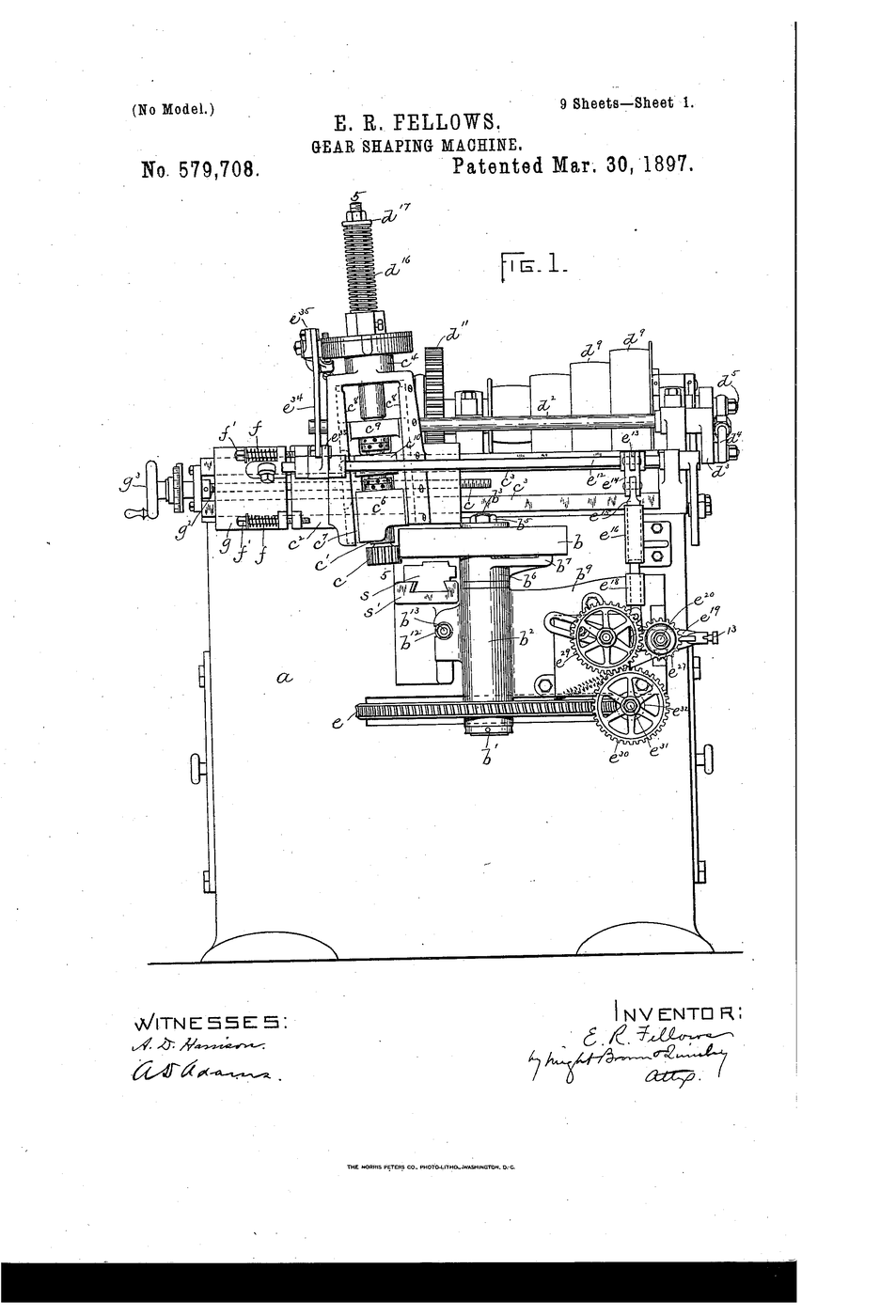


Fellows Gear Shaper
You cannot cut a gear tooth by tracing its shape, because the correct shape — the involute curve — is different for every combination of gears that will ever mesh with it. Cut the wrong curve and the gear runs rough, loud and worn.
Fellows's machine does not copy the tooth — it GENERATES it. A cutter shaped like a gear is rolled slowly in mesh with the blank while it reciprocates up and down, shaving metal. The moving cutter carves the exact curve that will roll smoothly against any matching gear, because it cuts the blank the way a real gear would push it. The tool's motion writes the mathematics.
And because the cutter is itself a small gear, it can reach where a big rotary cutter cannot — internal ring gears, gears crowded against a shoulder, clusters. That was impossible before.
US Patent 579,708, "Gear-shaping machine", granted 30 March 1897 to Edwin R. Fellows of Springfield, Vermont.
Consignes
Read the claim: shaping, and generating
Read the claim: shaping, and generating
Fellows claims a machine that cuts a gear by acting on the blank at many points as it rolls, not by a cutter shaped like a single tooth gap. That rolling is "generation".
Cut a straight-toothed rack from cardboard
Cut a straight-toothed rack from cardboard
Make a cardboard rack — a strip with straight-sided, angled teeth. Straight sides are easy to draw and cut precisely.
Matériaux pour cette étape :
 Plaques de carton ondulé1 feuille
Outils nécessaires :
 Cutter de précision
Roll a clay disc into a soft blank
Roll a clay disc into a soft blank
Form a flat disc of modelling clay as the "blank". It must be soft enough to take an impression from the rack teeth.
Matériaux pour cette étape :
 Coffret de pâte polymère1 jeu
Press the rack straight in — copy one tooth
Press the rack straight in — copy one tooth
Press a single rack tooth into the clay without rolling. You get a straight-sided notch — a copy of the tool. Note that shape.
Now ROLL the rack along the turning disc
Now ROLL the rack along the turning disc
Roll the rack in a straight line while the clay disc turns in step, like a gear on a track. Let each tooth press as it passes. Do not copy — roll.
Look at the curve the straight tool left behind
Look at the curve the straight tool left behind
The disc's teeth are now curved, not straight — even though every cut was made by a straight edge. The rolling motion generated a curve the tool never had. That curve is the involute.
Measure the pressure angle
Measure the pressure angle
With a protractor, measure the slope of the rack's straight flank. That single angle — the pressure angle — sets the whole tooth shape. Standard gears use 20°.
Outils nécessaires :
 Rapporteur / mesureur d'angle
Generate a second disc with more teeth
Generate a second disc with more teeth
Roll the same rack against a larger disc turning more slowly. It gets more teeth, differently curved — yet made by the same tool. One cutter, every gear size.
Mesh the two generated gears
Mesh the two generated gears
Roll the two clay gears together. They mesh smoothly, because both were generated by the same rack — the guarantee of interchangeability.
Swap the rack for a gear-shaped cutter
Swap the rack for a gear-shaped cutter
Fellows's real tool is not a rack but a small gear-shaped cutter that reciprocates up and down. Model this by rolling a rigid pinion template against the clay instead of the rack.
Matériaux pour cette étape :
 Jeu de disques bruts en POM (acétal) pour engrenages1 jeu
Generate teeth on the INSIDE of a ring
Generate teeth on the INSIDE of a ring
Roll the pinion cutter against the inside of a clay ring. It cuts internal teeth — the thing a big external rotary cutter physically cannot reach. This is Fellows's decisive advantage.
Cut teeth right up to a shoulder
Cut teeth right up to a shoulder
Because the shaper cuts on a down-stroke and lifts on the return, it can run teeth close against a raised shoulder. Mark how near the tool can finish — another job a rotary cutter cannot do.
History & Context — the tool that writes the curve
History & Context — the tool that writes the curve
The patent. US 579,708, "Gear-shaping machine", granted 30 March 1897 to Edwin R. Fellows of Springfield, Vermont — a nine-sheet drawing for a machine of real subtlety. Fellows had worked for the Jones & Lamson machine-tool works and built his shaper into one of the great names in gear-cutting.
The idea is generation, and it is worth stating plainly. A gear tooth's working face is an involute — the curve traced by the end of a string unwound from the base circle — and its exact shape depends on how many teeth the gear has. You cannot keep a drawer of form-cutters, one per tooth count, and get true gears; the economics and the accuracy both fail. Fellows's insight, building on the earlier generating work of Joseph Saxton and others, is that if you roll a cutter against the blank as though the two were already a meshing gear pair, the cutter automatically removes exactly the metal that stops them meshing — and what is left is the correct involute, whatever the tooth count. Steps 4 to 6 are the whole idea in clay: a straight tool, rolled, leaves a curve.
Why the cutter is a gear, not a rack. A rack (steps 2 to 9) demonstrates generation beautifully but is awkward to build into a machine — it would have to travel a long straight path. Fellows made the cutter a pinion: a hardened gear-shaped tool that reciprocates up and down to do the cutting while it and the blank rotate together a hair at a time. A rotating cutter that is itself a gear can do what no large disc-shaped cutter can — reach inside a ring to cut internal gears (step 11), and finish teeth hard against a shoulder or between the gears of a cluster (step 12). Those two capabilities are why the gear shaper never went away.
The pressure angle is the quiet standard underneath it all. The straight flank of the rack has one slope — the pressure angle — and that single number (today almost always 20°) fixes the tooth shape for an entire interchangeable system. Two gears of different sizes made to the same pressure angle will mesh; that is the whole basis of buying a gear from a catalogue. Step 7 measures it.
What it enabled. Interchangeable, quiet, load-bearing gears in quantity are a precondition for the automobile gearbox, the aircraft engine, the machine tool itself — every geared machine of the twentieth century. Hobbing (a rack-like generating cut with a rotating worm-shaped tool) does the same for external gears at higher speed, but for internal gears, cluster gears and gears against a shoulder, the Fellows shaper's rolling pinion remains the answer. The tool writes the curve, and the curve runs the century.
Matériaux
3- 1 feuilleEspace réservé
- Espace réservé
- Espace réservé
Outils requis
2- Espace réservé
- Espace réservé
Blueprints liés
Ces blueprints partagent des connaissances — techniques, matériaux ou principes



CC0 Domaine public
Ce blueprint est publié sous CC0. Vous êtes libre de copier, modifier, distribuer et utiliser ce travail pour tout usage, sans demander la permission.
Soutenez le Maker en achetant des produits via son Blueprint où il perçoit une Commission Maker définie par les Vendeurs, ou créez une nouvelle itération de ce Blueprint et incluez-le comme connexion dans votre propre Blueprint pour partager les revenus.