Collaboration
ART
BEAUTÉ ET BIEN-ÊTRE
ARTISANAT
CULTURE ET HISTOIRE
DIVERTISSEMENT
ENVIRONNEMENT
NOURRITURE ET BOISSONS
INGÉNIERIE INVERSE
SCIENCES
SPORTS
TECHNOLOGIE
TECHNOLOGIE PORTABLE
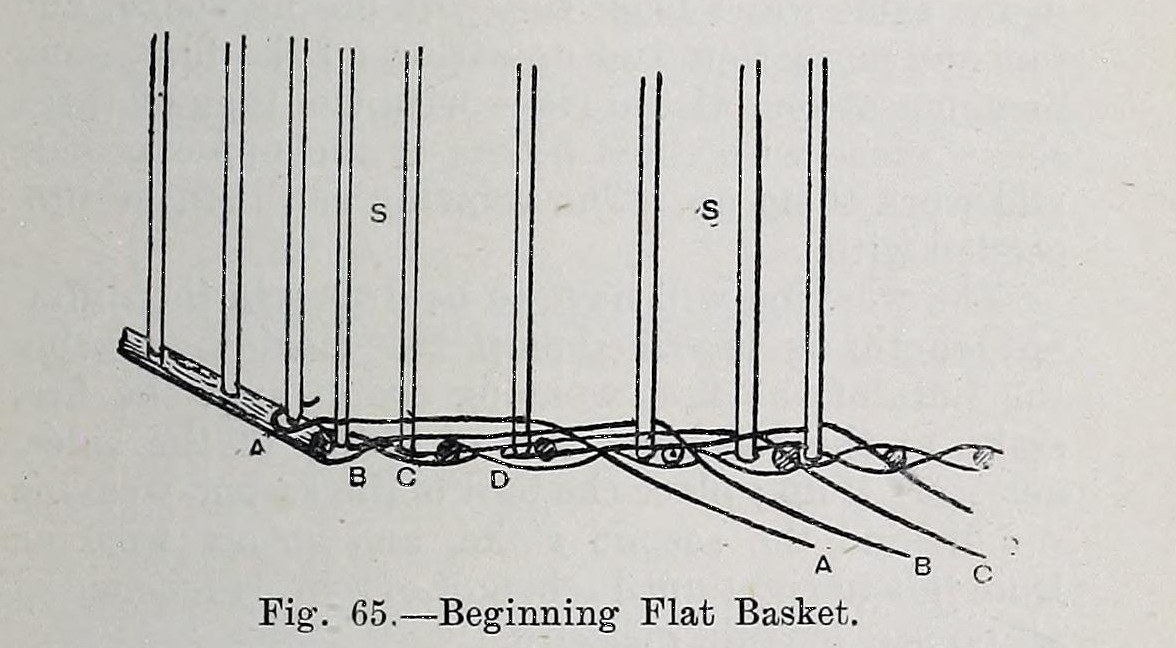


Flat Harvesting Basket: the Willow 3-Peck Fruit Flat (Hasluck, 1903)
The basket-maker's 'flat' for the fruit season: an oblong willow basket with a woven stick bottom about 19 1/2 in wide, straight sides 8 in high, a rope handle at each end and its own flat lid on a bent bow.
Rough brown osiers do for the bottom; eight white ones start the sides.
Source: Paul N. Hasluck, Basket Work of All Kinds (1903), pp. 64-69. Picture: Fig. 65 of the book.
Avancé
Unknown
Consignes
1
1
Soak the osiers and weave the bottom
Soak the osiers and weave the bottom
Soak the osiers until pliable. Cut eight sticks about 17 in long; set the two thickest in the screw-block 19 1/2 in apart outside, the rest between, and weave the bottom with the roughest osiers as for Hasluck's square basket. Take it out and trim it with the picking knife.
Matériaux pour cette étape :
 Brins d'osier plus gros8 17 in
 Brin d'osier1 weavers
Outils nécessaires :
 Eau
 Sécateur à une main
 Planche de bois plate
2
2
Stake up
Stake up
Drive nine stakes into the weaving beside the sticks along each side, and seven through the sticks at each end after opening holes with the bodkin, the eight thickest at the corners. Prick them up and gather them in a hoop.
Matériaux pour cette étape :
 Piquets de saule32 9 per side, 7 per end
Outils nécessaires :
 Passe-lacetSécateur à une main
3
3
Upset the sides
Upset the sides
Point eight white osiers. With no foot rim, start by driving four in beside the first stakes at the left of one 19 1/2 in side. Sitting high with the work between your knees, upset with four rods pulled tight into the bend of each stake, each in front of three stakes, behind the fourth and out (Fig. 65). Start the other four at the opposite corner, finish the tops round the corners, then add one more round with three rods.
Matériaux pour cette étape :
Brin d'osier8 white, upsettingOutils nécessaires :
Sécateur à une mainPasse-lacet Marteau
4
4
Weave and add handles
Weave and add handles
Weave with rods in their lengths, each butt behind the next stake, left to right, until the sides are 8 in high all round outside. For each end handle push a stiff rod down beside the third stake, twist it rope-like, push its top through about 1 1/2 in below the top by the fifth stake, leave a bow, and twist it over the bow three times (Fig. 66).
Matériaux pour cette étape :
Brin d'osier1 weavingBrin d'osier2 handlesOutils nécessaires :
MarteauPasse-lacet5
5
Pair off and border
Pair off and border
Pair off a round with two rods from the back. Make the border by laying down stakes and working them round the corners (Fig. 67), finish by cramming, and trim inside and out.
Matériaux pour cette étape :
Brin d'osier2 pairingOutils nécessaires :
 CisaillesSécateur à une main
6
6
Make the lid
Make the lid
Notch a bow stick at the corners, bend it to the basket's shape and tie a strainer across to hold the width. Bind in two thick split sticks a little longer than the flat, flat side inward, on four scallom rods lapped round the bow (Figs. 68-69), and weave the lid between them.
Matériaux pour cette étape :
Brins d'osier plus gros3 bow, two lid sticksBrin d'osier1 scalloms, weaversOutils nécessaires :
Sécateur à une mainMarteauMatériaux
3- 3 bow, two lid sticksEspace réservé
- 1 scalloms, weaversEspace réservé
- 32 9 per side, 7 per endEspace réservé
Matériaux des Blueprints connectés

Ce plan fabrique

CC0 Domaine public
Ce blueprint est publié sous CC0. Vous êtes libre de copier, modifier, distribuer et utiliser ce travail pour tout usage, sans demander la permission.
Soutenez le Maker en achetant des produits via son Blueprint où il perçoit une Commission Maker définie par les Vendeurs, ou créez une nouvelle itération de ce Blueprint et incluez-le comme connexion dans votre propre Blueprint pour partager les revenus.