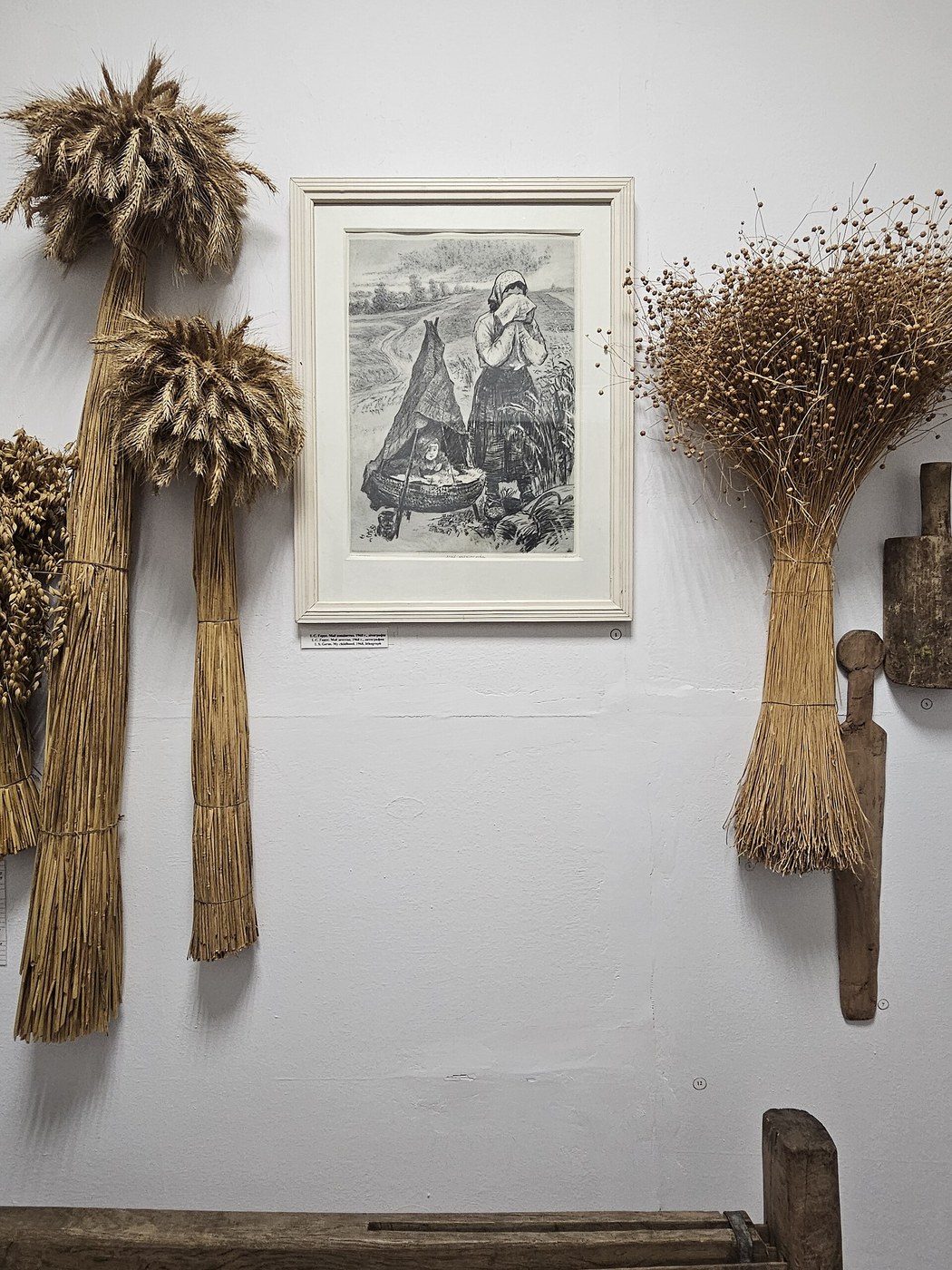


Flax Scutching
Consignes
Check the retting was right
Check the retting was right
Everything downstream depends on this and it cannot be corrected later.
- Take a retted stem and snap it.
- Try to peel the fibre away from the woody core.
- It should separate cleanly with a slight rasping sound.
Matériaux pour cette étape :
 Fibre de chanvre500 g
Break the woody core
Break the woody core
A hinged wooden blade crushes the stem without cutting the fibre.
- Lay a handful of stems across the bed of the brake.
- Bring the upper blade down repeatedly, moving the bundle along.
- Turn the bundle and repeat until it feels soft and rattles.
Matériaux pour cette étape :
 Broie à lin1 pièce
Scutch the shives out
Scutch the shives out
Beat downward, along the fibre, never across it.
- Hang a bundle over the edge of an upright board.
- Strike downward with a wooden scutching blade, sweeping along the length.
- Work outdoors or with good extraction — this raises enormous dust.
Matériaux pour cette étape :
 Planche de chêne blanc1 board
Hackle from coarse to fine
Hackle from coarse to fine
Draw the fibre through beds of spikes, each finer than the last.
- Pull the bundle through a coarse hackle, a little at a time.
- Repeat through progressively finer spike beds.
- Keep what comes out in your hand; keep separately what stays in the spikes.
Matériaux pour cette étape :
 Balance de cuisine numérique1 pièce
History and context
History and context
Flax is among the oldest cultivated fibres — spun flax fibres from Dzudzuana Cave in Georgia have been dated to around 30,000 years ago, which makes linen older than pottery or agriculture. Egyptian linen is famously fine, and the mummy wrappings are the surviving evidence of an industry.
The work was seasonal, communal and mostly done by women. Scutching and hackling happened in winter after harvest, often as a shared gathering — the Irish and Scottish scutching mills later mechanised the beating with water-powered blades, and those mills were notoriously dangerous and unhealthy places.
Flax dust causes real disease. Prolonged exposure to flax, hemp and cotton dust causes byssinosis — chest tightness and breathlessness that begins on the first day back after a break, which is why it was called Monday fever. It was documented in the linen and cotton mills of Belfast, Dundee and Lancashire and was disputed as an occupational disease for decades. Do this work outdoors or with extraction, and do not romanticise the mills.
Why linen and cotton feel different: flax fibre is a long single cell with a stiff crystalline structure, so linen is strong, cool, poor at stretching and creases sharply. Cotton is a short twisted fibre and behaves nothing like it. Linen also gets STRONGER when wet, which is unusual and is why it was used for sailcloth, sacking and thread.
What happened to it: cheap cotton from mechanised spinning undercut linen in the nineteenth century for everyday cloth, and flax retreated to fine linens and to industrial uses. It is returning modestly as a low-input crop and as reinforcement in composites, where its stiffness-to-weight is genuinely competitive.
Matériaux
4- 500 gEspace réservé
- 1 pièceEspace réservé
- 1 boardEspace réservé
- 1 pièceEspace réservé
Blueprints liés
Ces blueprints partagent des connaissances — techniques, matériaux ou principes
CC0 Domaine public
Ce blueprint est publié sous CC0. Vous êtes libre de copier, modifier, distribuer et utiliser ce travail pour tout usage, sans demander la permission.
Soutenez le Maker en achetant des produits via son Blueprint où il perçoit une Commission Maker définie par les Vendeurs, ou créez une nouvelle itération de ce Blueprint et incluez-le comme connexion dans votre propre Blueprint pour partager les revenus.