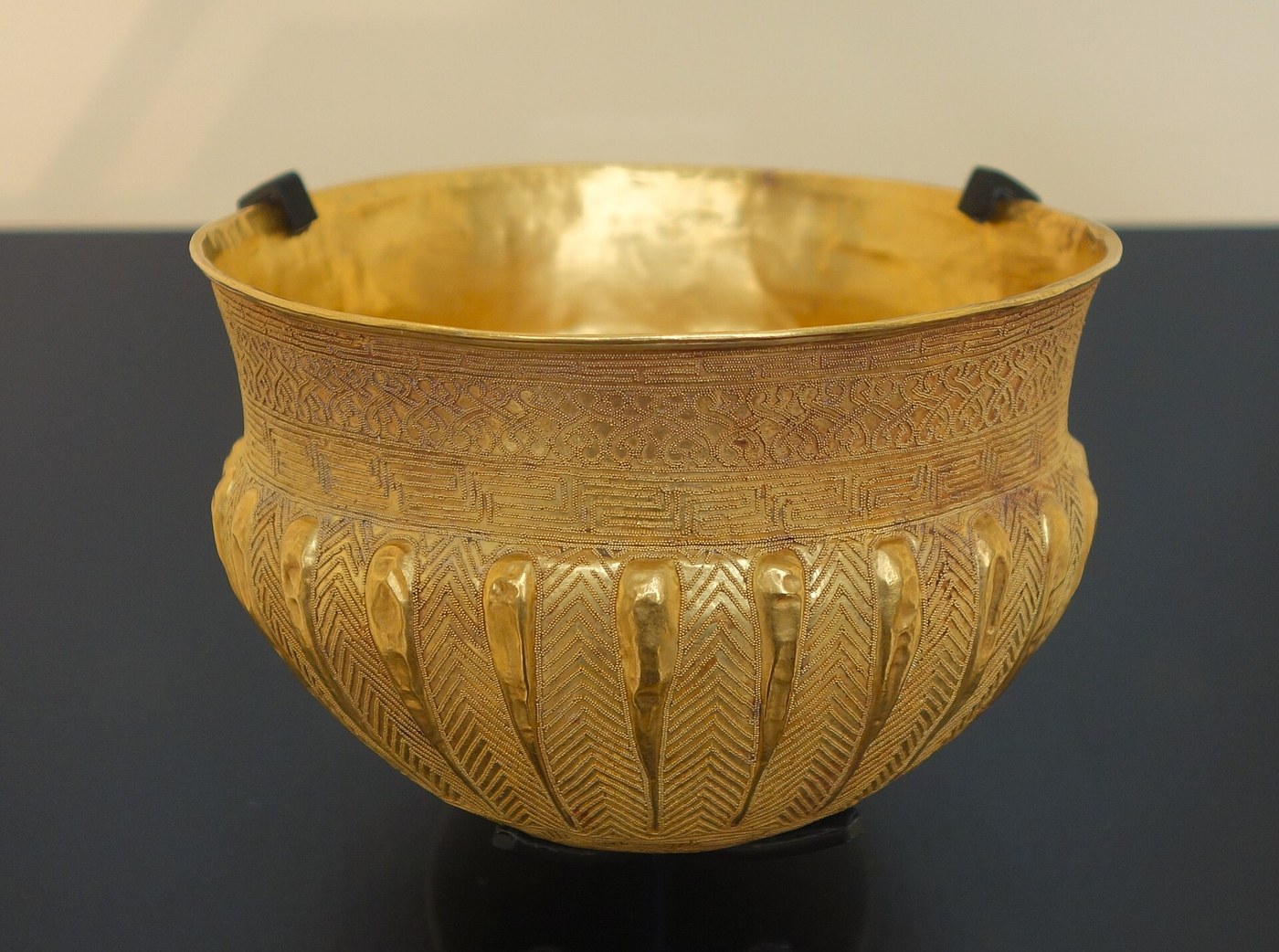


Gold Granulation
Consignes
Make the grains
Make the grains
Surface tension does the shaping — you only supply heat and separation.
- Cut tiny, equal snippets from fine silver or gold wire.
- Bed them separately in charcoal dust so they cannot touch.
- Heat until each melts and pulls itself into a sphere, then cool.
Matériaux pour cette étape :
 Grenaille d'argent fin 999 de 31 g1 oz
 Creuset en argile profond1 pièce
Grade them by size
Grade them by size
Uniformity is what makes granulation look like granulation.
- Sieve the cooled grains through graded meshes.
- Keep each size separately.
- Inspect a sample under magnification for spheres that are flattened or doubled.
Matériaux pour cette étape :
 Tamis 60 mesh1 pièce
 Lentille convexe1 pièce
Understand the joint before making it
Understand the joint before making it
This is diffusion bonding, not soldering, and the distinction is the whole subject.
- A copper salt plus an organic binder is painted where the grains sit.
- On heating, the binder chars to carbon, which reduces the copper salt to metallic copper.
- Copper diffuses into the gold at the contact point, forming an alloy that melts BELOW pure gold.
- That thin alloy layer melts, wets the joint, and the piece is removed from heat.
Matériaux pour cette étape :
 Feuille de cuivre1 feuille
 Borax en poudre100 g
Fire it, and accept the narrow window
Fire it, and accept the narrow window
The temperature margin is small and the failure is total.
- Place the grains, dry the binder completely.
- Bring the whole piece up evenly and watch for the surface to flash slightly.
- Remove heat immediately at that moment.
Matériaux pour cette étape :
 Thermomètre à lecture instantanée1 pièce
History and context
History and context
Granulation appears in Mesopotamia in the third millennium BC and reaches its extraordinary peak with the Etruscans between roughly the seventh and third centuries BC. Etruscan pulviscolo work uses grains so fine that surfaces look dusted rather than beaded, and the technique effectively disappears with them.
The rediscovery is a good story about evidence. Nineteenth-century goldsmiths — notably the Castellani family in Rome — studied Etruscan pieces obsessively and produced fine imitations, but by soldering. The colloidal or eutectic bonding explanation was worked out later, with H. A. P. Littledale patenting a copper-salt method in the 1930s that is generally credited with cracking it. The ancient method was reconstructed from the physical evidence and metallurgy, not from any written source — nobody wrote it down.
Why it was lost at all is worth sitting with. It is a craft whose critical variable is a temperature judged by eye within a narrow band, taught hand to hand, with no text. Break the chain of apprenticeship for a generation and the knowledge is simply gone, however many finished objects survive. Artefacts do not encode their own process.
The same chemistry elsewhere: diffusion bonding joins metals below their melting points across aerospace and electronics, and the eutectic principle — that a mixture can melt lower than either pure component — is what makes solder work at all. The Etruscans were exploiting a phase diagram they had no way to describe.
Matériaux
7- Espace réservé
- 1 pièceEspace réservé
- 1 pièceEspace réservé
- 1 pièceEspace réservé
- 1 feuilleEspace réservé
- 100 gEspace réservé
- Espace réservé
CC0 Domaine public
Ce blueprint est publié sous CC0. Vous êtes libre de copier, modifier, distribuer et utiliser ce travail pour tout usage, sans demander la permission.
Soutenez le Maker en achetant des produits via son Blueprint où il perçoit une Commission Maker définie par les Vendeurs, ou créez une nouvelle itération de ce Blueprint et incluez-le comme connexion dans votre propre Blueprint pour partager les revenus.