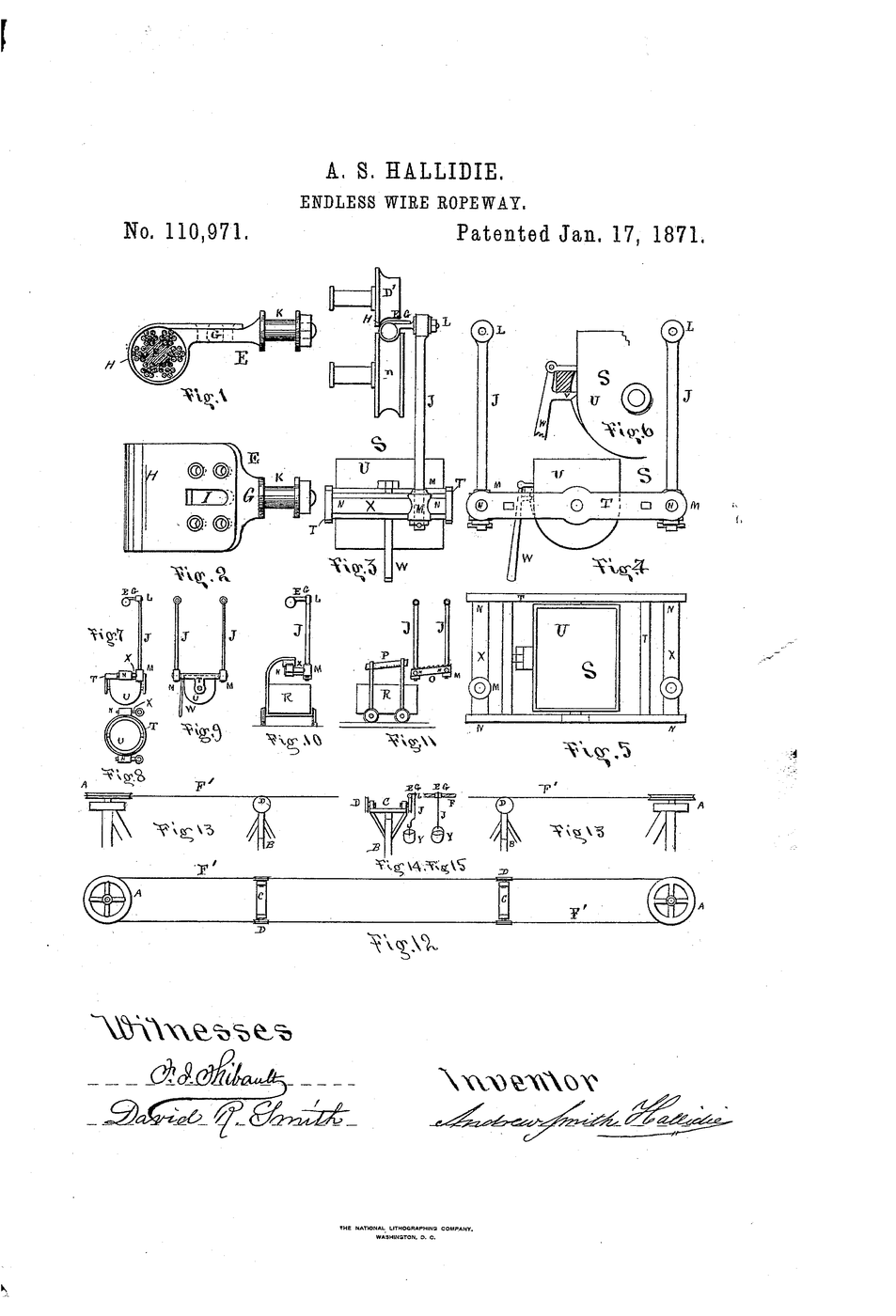


Endless Wire Ropeway
Getting ore down off a mountain used to mean mules, or a road you had to cut first. A ropeway does away with both: a single wire rope runs in a loop between two wheels, and buckets hang from it and ride along.
Hallidie's patent is about how you hang things on a moving rope without stopping it. His hanger projects sideways from the upper and outer quarter of the rope rather than clamping over the top of it — so it stays put under load, and, crucially, the car can pass a support or round a bend without being lifted off.
The patent also covers a car that tips and dumps its load automatically at the end of the run, and jointed hangers that let the cars follow curves and angles while the rope keeps moving.
US Patent 110,971, "Improvement in endless-wire-rope ways", granted 17 January 1871 to Andrew Smith Hallidie of San Francisco, California.
This is not the cable car patent, although it is constantly described as one. See the last step.
Consignes
Read the claim: it is about the hanger
Read the claim: it is about the hanger
Hallidie's claim is where the hanger meets the rope — projecting horizontally from the upper and outer quarter. Plus automatic dumping, plus joints for curves. Note all three.
Stand two towers about 1 m apart
Stand two towers about 1 m apart
Fix a dowel upright in a card base at each end of a table, one about 100 mm taller than the other so the line runs downhill.
Matériaux pour cette étape :
 Dowel Rod2 pièces
 Corrugated Cardboard Sheets (25-Pack)1 feuille
Outils nécessaires :
 Hot Glue Gun
Mount a pulley on each tower
Mount a pulley on each tower
Fit a pulley at the top of each dowel so both turn freely in the same vertical plane.
Matériaux pour cette étape :
 Pulley Set1 jeu
Close the rope into an endless loop
Close the rope into an endless loop
Run twine over both pulleys and tie the ends together into a continuous loop. Take up the slack — a slack rope will slip instead of driving.
Matériaux pour cette étape :
 Cotton Twine (for bundling)2 mètres
Make the wrong hanger first
Make the wrong hanger first
Bend a wire hook that simply hangs over the top of the rope. Hang a card bucket on it. This is the obvious design — and the one Hallidie improved on.
Matériaux pour cette étape :
 Galvanised Steel Wire1 mètre
 Card Stock1 feuille
Load it and drive the rope
Load it and drive the rope
Half-fill the bucket with clay pebbles and turn the upper pulley by hand. Watch what the hanger does as it approaches the tower.
Matériaux pour cette étape :
 Clay Pebbles (Hydroton)100 g
Watch the over-the-top hanger fail
Watch the over-the-top hanger fail
The hook rides up, twists, and lifts off at the pulley. A loaded top hook cannot pass a support — the whole line must stop to unload.
Now build Hallidie's hanger
Now build Hallidie's hanger
Bend a second hanger that grips the rope's upper outer quarter and projects sideways, carrying the bucket clear of the rope's centreline.
Matériaux pour cette étape :
Galvanised Steel Wire1 mètreRun it past the tower
Run it past the tower
Load and drive again. The offset hanger passes the pulley on the outside and keeps going. The load never touches the wheel.
Matériaux pour cette étape :
Clay Pebbles (Hydroton)100 gHang the bucket on a pivot
Hang the bucket on a pivot
Re-hang the bucket on a brass fastener through its side, above its centre of gravity, so it can swing and tip.
Matériaux pour cette étape :
 Brass Paper Fasteners2 pièces
Fit a trip bar and dump automatically
Fit a trip bar and dump automatically
Glue a small wire bar across the line just before the low tower, set to catch the bucket's lip. The bucket tips, dumps and rights itself — without stopping the rope.
Matériaux pour cette étape :
Galvanised Steel Wire1 mètreOutils nécessaires :
Hot Glue GunRun a continuous train of buckets
Run a continuous train of buckets
Add three more hangers spaced evenly round the loop. Turn steadily: buckets load, ride, dump and return in one unbroken cycle. That is what "endless" means.
Matériaux pour cette étape :
Galvanised Steel Wire1 mètreCard Stock3 feuillesMeasure what the rope carries
Measure what the rope carries
Count buckets dumped per minute and weigh one load. Multiply: that is the line's throughput — from one loop of twine and two wheels.
Outils nécessaires :
 Stopwatch
History & Context — the patent that is not the cable car
History & Context — the patent that is not the cable car
The patent. US 110,971, "Improvement in endless-wire-rope ways", granted 17 January 1871 to Andrew Smith Hallidie of San Francisco. It claims attaching the suspension-rods to the rope by a hanger projecting from the upper and outer quarter of the rope, an automatic dump-car, and jointed connections letting cars round curves and angles without leaving the moving rope.
🔴 This is not the cable car patent. You will read everywhere that on 17 January 1871 Hallidie patented the San Francisco cable car. He did not. This document describes an ore-carrying aerial ropeway — a mining machine, of the kind he had already been selling for years. The cable street railway came later: Hallidie worked with engineer William Eppelsheimer on the Clay Street Hill Railroad, which first ran on 2 August 1873, two and a half years after this grant. The date gets attached to the famous thing rather than the actual thing. It is the same error as crediting Vaaler with the paper clip: read the claims, not the legend.
Why the offset hanger matters. A hook over the top of a rope is fine until it reaches a support wheel, where it must be lifted off (steps 5-7). Hallidie's hanger grips the rope's upper outer quarter and reaches out sideways, so the load passes the sheave on the outside and the line never stops (steps 8-9). Continuous operation is the entire economic argument for a ropeway — a system you must halt to unload is just an expensive winch.
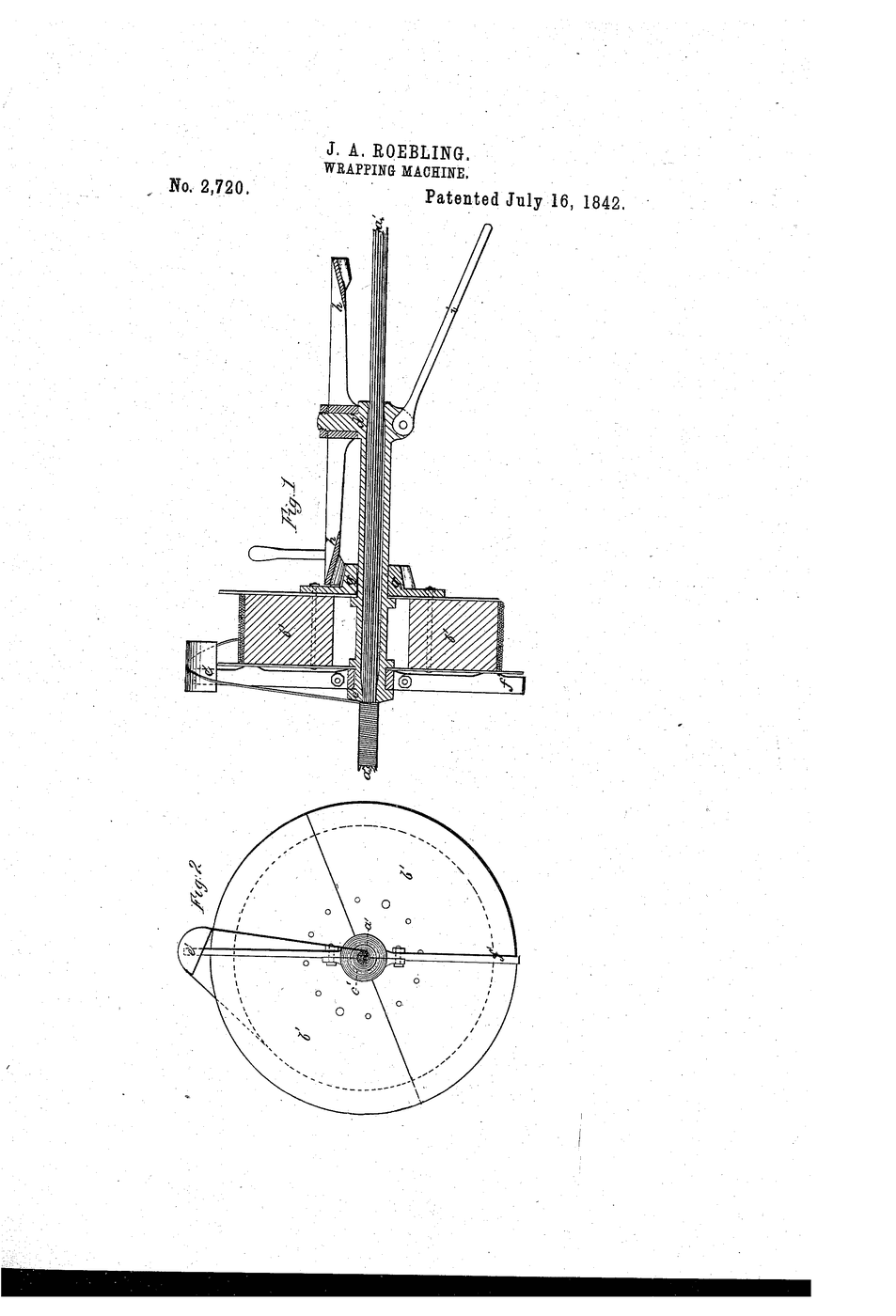
The wire rope came first. Hallidie manufactured wire rope in California, building on his father's British wire-rope patent, and the ropeway was a way to sell it. Wire rope itself had been patented decades earlier — John A. Roebling's US 2,720 of 1842 — and everything here depends on it: a rope of many thin wires bends round a wheel again and again without breaking, where a solid bar would fatigue and a natural-fibre rope would chafe through.
Where it sits. Aerial ropeways still move ore, timber and skiers, on exactly this arrangement: a loop, two terminal wheels, hangers offset to clear the towers. The cable car did borrow the principle — a continuously running rope under the street, with each car gripping and releasing it rather than being fixed to it. That grip is the genuine cable-car invention, and it is not in this patent.
Matériaux
8- 2 piècesEspace réservé
- 1 feuilleEspace réservé
- 1 jeuEspace réservé
- 2 mètresEspace réservé
- 1 mètreEspace réservé
- 4 feuillesEspace réservé
- Espace réservé
- 2 piècesEspace réservé
Matériaux des Blueprints connectés

Blueprints liés
Ces blueprints partagent des connaissances — techniques, matériaux ou principes


CC0 Domaine public
Ce blueprint est publié sous CC0. Vous êtes libre de copier, modifier, distribuer et utiliser ce travail pour tout usage, sans demander la permission.
Soutenez le Maker en achetant des produits via son Blueprint où il perçoit une Commission Maker définie par les Vendeurs, ou créez une nouvelle itération de ce Blueprint et incluez-le comme connexion dans votre propre Blueprint pour partager les revenus.