Collaboration
ART
BEAUTÉ ET BIEN-ÊTRE
ARTISANAT
CULTURE ET HISTOIRE
DIVERTISSEMENT
ENVIRONNEMENT
NOURRITURE ET BOISSONS
INGÉNIERIE INVERSE
SCIENCES
SPORTS
TECHNOLOGIE
TECHNOLOGIE PORTABLE
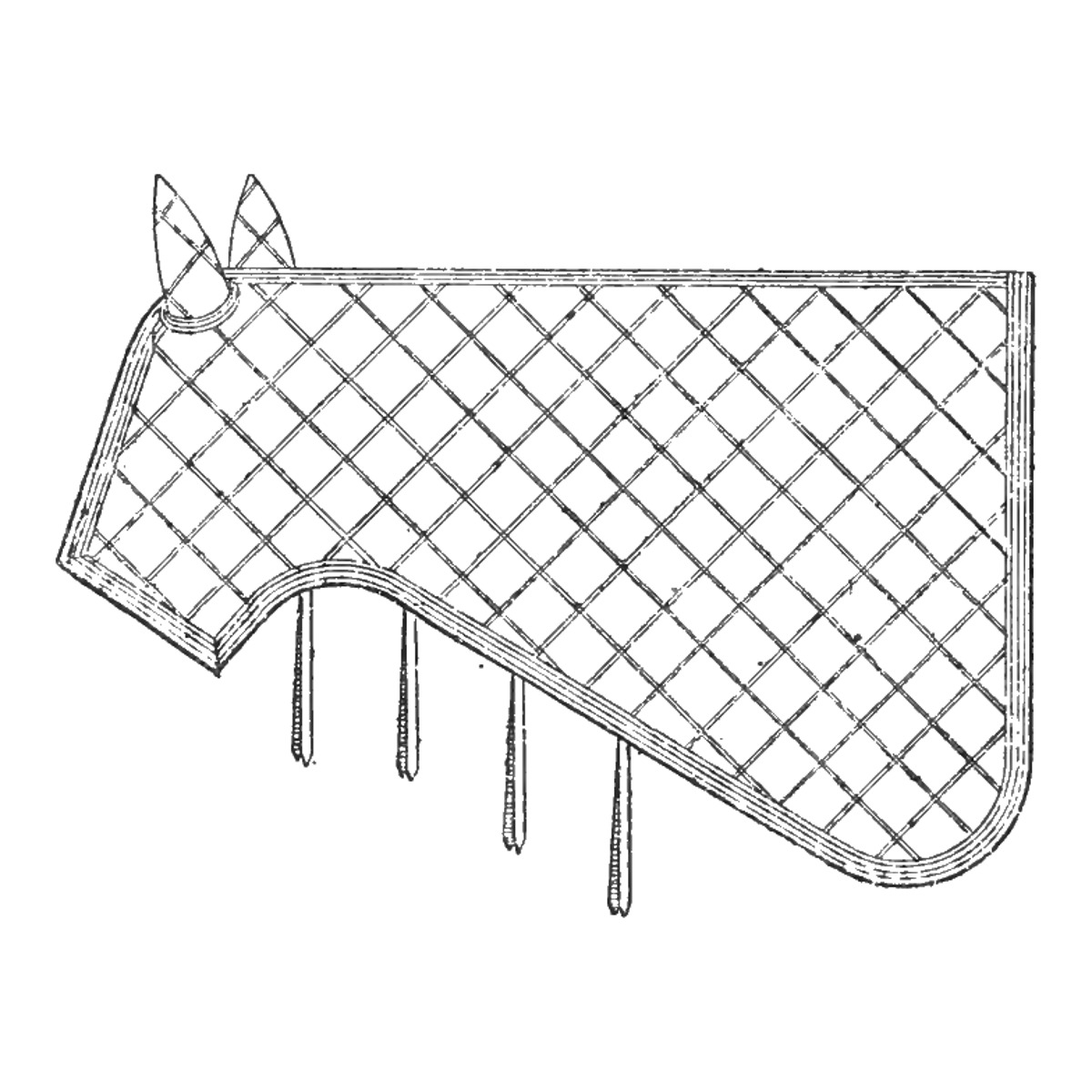


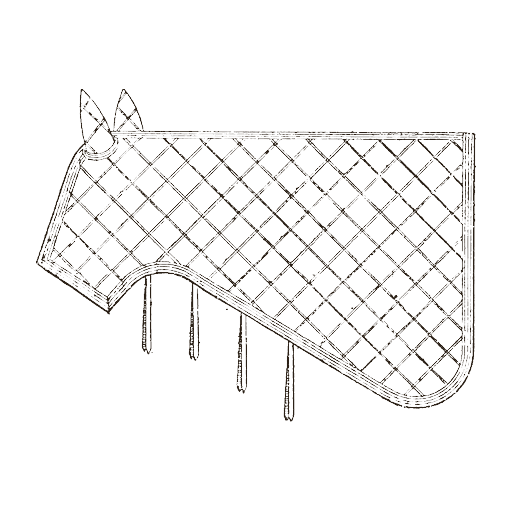
Horse Hood: Two-Piece Cloth Hood With Ear Covers, Bound Edges and Jaw Strap (Hasluck, Saddlery, 1904)
The hood completes a horse's stable suit of sheet, breast cloth and pad cloth, covering the head and neck. This is the hood from Paul N. Hasluck's Saddlery (1904): two pieces of cloth cut to the horse from about 5-1/4 in below the eye back to the shoulder, with ear covers and eye holes, bound all round and fastened under the jaw. It is cut to fit each horse, so he gives few sizes.
Intermédiaire
About 1 day
Consignes
1
1
His sizes in centimetres
His sizes in centimetres
Chargement du notebook Jupyter…
2
2
Read Saddlery, ch. IX
Read Saddlery, ch. IX
"A hood is needed to complete the suit. A suitable shape is shown by Fig. 29. The hood must be cut to the shape of the horse's neck and head, from a point about 5-1/4 in. below the eye on the nose, then along the ridge of the head and neck to the shoulder, where it should cover the front of the sheet well."
3
3
Cut the two sides
Cut the two sides
Cut the hood in two pieces, one for each side (he says sometimes four, with pieces added to the side flaps for size), shaped to the horse from about 5-1/4 in below the eye on the nose, along the ridge of the head and neck to the shoulder, covering the front of the sheet well. Under the neck, cut all round the throat and down under the head so the two sides meet exactly in the centre. Making a paper pattern on the horse first is our suggestion.
Matériaux pour cette étape :
 Drap de laine écru1 pièce
Outils nécessaires :
 Papier kraft
 Crayon
 Ciseaux
 Mètre ruban
4
4
Cut the ear and eye holes
Cut the ear and eye holes
Cut the holes for the ears, and two holes right opposite the eyes. Put the front cut of the cloth opposite the front of the ear.
Outils nécessaires :
CiseauxCrayon5
5
Make the ear covers
Make the ear covers
Make a cover for each ear: the front part about 1 in larger than the face of the ear all round, the back part large enough to pass round the back of the ear and let it go in easily. Whip the edges together and stitch round the hole at the bottom, all the stitches on the outside.
Matériaux pour cette étape :
Drap de laine écru1 pièce Fil de lin1 pièce
 Cire d'abeille1 pièce
Outils nécessaires :
Ciseaux Deux aiguilles de sellier
6
6
Join the sides
Join the sides
Whip the edges together level along the top of the neck and over the head, down the front of the face. Join any other piece the same way, and always bind the joint, stitching on both sides.
Matériaux pour cette étape :
Fil de lin1 pièceCire d'abeille1 pièceOutils nécessaires :
Deux aiguilles de sellier7
7
Bind the edges
Bind the edges
Cut the binding cloth 1-1/4 in wide (cloth, patent or Newmarket binding) and turn it round the edges just enough to catch the first row of stitching, about 1/4 in from the edge. Draw it as flat as possible and stitch another row along the inner edge. Where it puckers too much at a sharp turn, as at the throat, cut the puckers out and stitch edge to edge. Put a strip along the joint on the top of the neck, its ends under the binding, then flat strips 1/2 in wide along the side joints and the points of the ear pieces, and round the bottom to cover the ends and the joint. He notes this work can be done by machine.
Matériaux pour cette étape :
Drap de laine écru1 pièceFil de lin1 pièceCire d'abeille1 pièceOutils nécessaires :
CiseauxDeux aiguilles de sellierMètre ruban8
8
Fit the jaw strap and strings
Fit the jaw strap and strings
Fasten the hood under the jaw with a small strap and buckle. Run cadez strings (ties) from this point to about half-way down the neck on each side, to tie together.
Matériaux pour cette étape :
 Cuir de harnais1 pièce
 Boucle en fer à ardillon1 pièce
 Ficelle de cuisine en coton1 pièceFil de lin1 pièceCire d'abeille1 pièce
Outils nécessaires :
 Couteau à cuir
 AlêneDeux aiguilles de sellier
9
9
Troubleshooting
Troubleshooting
Horse hood troubleshooting.
Flow
Loading...
10
10
History and honest limits
History and honest limits
From **Saddlery**, edited by Paul N. Hasluck, David McKay, 1904 (archive.org saddlery00hasl), chapter IX, "Horse Clothing", hood, pp. 70-74, Fig. 29; every fraction was read on the scan. He gives no overall sizes: the hood is cut to the horse. He does not say what cadez strings are made of; cotton string is our choice. The sheets and breast cloth of the suit are not made here. Kersey, the paper pattern, tools and metric figures are ours.
Matériaux
6- 3 piècesEspace réservé
- 4 piècesEspace réservé
- 4 piècesEspace réservé
- 1 pièceEspace réservé
- 1 pièceEspace réservé
- 1 pièceEspace réservé
Outils requis
7- Espace réservé
- 1 vendor sell this, none ship to you yetEspace réservé
- Espace réservé
- 1 vendor sell this, none ship to you yetEspace réservé
- Espace réservé
- Espace réservé
- Espace réservé
Ce plan fabrique
Blueprints liés
Ces blueprints partagent des connaissances — techniques, matériaux ou principes
CC0 Domaine public
Ce blueprint est publié sous CC0. Vous êtes libre de copier, modifier, distribuer et utiliser ce travail pour tout usage, sans demander la permission.
Soutenez le Maker en achetant des produits via son Blueprint où il perçoit une Commission Maker définie par les Vendeurs, ou créez une nouvelle itération de ce Blueprint et incluez-le comme connexion dans votre propre Blueprint pour partager les revenus.