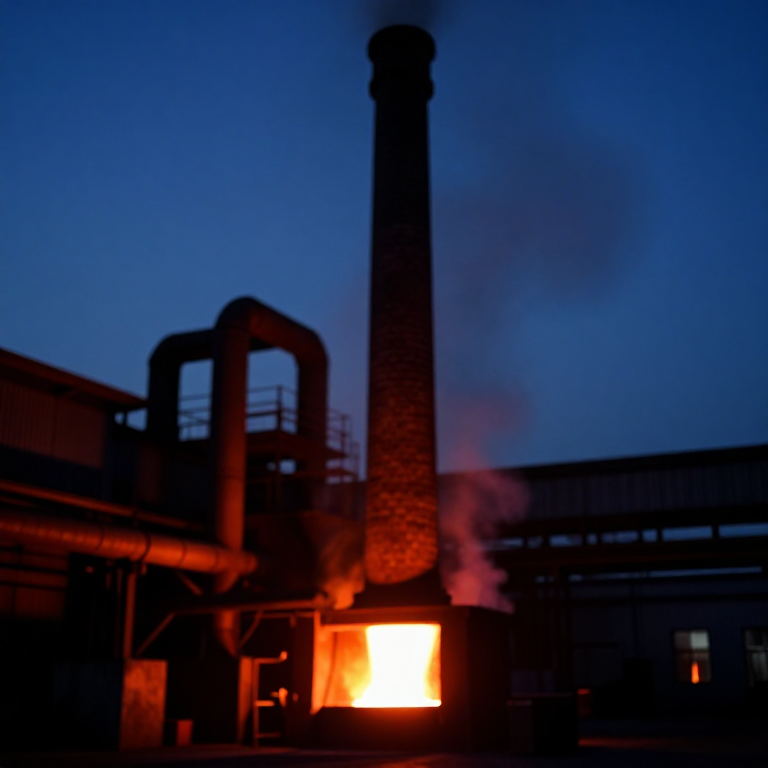


Building a Hot Blast Stove — Preheating the Air That Tripled the Blast Furnace
For centuries ironmasters believed a blast furnace ran best on cold winter air, and blew their furnaces with air at whatever temperature the weather gave. In 1828 the Scottish engineer James Neilson proved the opposite: heating the blast before it entered the furnace slashed the fuel needed and raised the output enormously. The hot blast was one of the great efficiency leaps of the iron age.
The idea seems backwards but the physics is sound. Cold air entering the furnace has to be heated by burning precious fuel before it can do its work; preheating the air outside the furnace, using waste heat that would otherwise escape up the chimney, means far less coke is wasted just warming the blast. Neilson's first stoves cut coke use by a third, and later regenerative stoves did far better still.
A hot blast stove is a chamber of brick or pipe that the blast passes through on its way to the tuyeres, heated by the furnace's own escaping gases. Bolted onto the pig-iron blast furnace, it made iron dramatically cheaper — and cheap iron was the lifeblood of the Industrial Revolution.
Consignes
Understand the hot blast
Understand the hot blast
Tap the furnace waste gas
Tap the furnace waste gas
Outils nécessaires :
 Gaines de ventilation
Build the stove chamber
Build the stove chamber
Matériaux pour cette étape :
 Briques réfractaires200 pièces
Outils nécessaires :
 Transplantoir
Heat the stove
Heat the stove
Matériaux pour cette étape :
 Coke métallurgique20 kg
Pass the blast through
Pass the blast through
Outils nécessaires :
 Soufflerie
Alternate the regenerator stoves
Alternate the regenerator stoves
Insulate the hot main
Insulate the hot main
Matériaux pour cette étape :
 Ciment réfractaire15 kg
Deliver the hot blast
Deliver the hot blast
Outils nécessaires :
 Barre de coulée
Control the temperature
Control the temperature
Outils nécessaires :
 Pyromètre
Measure the saving
Measure the saving
Mind the hazards
Mind the hazards
See the impact
See the impact
Matériaux
3- 200 piècesEspace réservé
- 20 kgEspace réservé
- 15 kgEspace réservé
Outils requis
5- Espace réservé
- Espace réservé
- Espace réservé
- Espace réservé
- Espace réservé
Matériaux des Blueprints connectés

Blueprints liés
Ces blueprints partagent des connaissances — techniques, matériaux ou principes
CC0 Domaine public
Ce blueprint est publié sous CC0. Vous êtes libre de copier, modifier, distribuer et utiliser ce travail pour tout usage, sans demander la permission.
Soutenez le Maker en achetant des produits via son Blueprint où il perçoit une Commission Maker définie par les Vendeurs, ou créez une nouvelle itération de ce Blueprint et incluez-le comme connexion dans votre propre Blueprint pour partager les revenus.