ART
BEAUTÉ ET BIEN-ÊTRE
ARTISANAT
CULTURE ET HISTOIRE
DIVERTISSEMENT
ENVIRONNEMENT
NOURRITURE ET BOISSONS
INGÉNIERIE INVERSE
SCIENCES
SPORTS
TECHNOLOGIE
TECHNOLOGIE PORTABLE
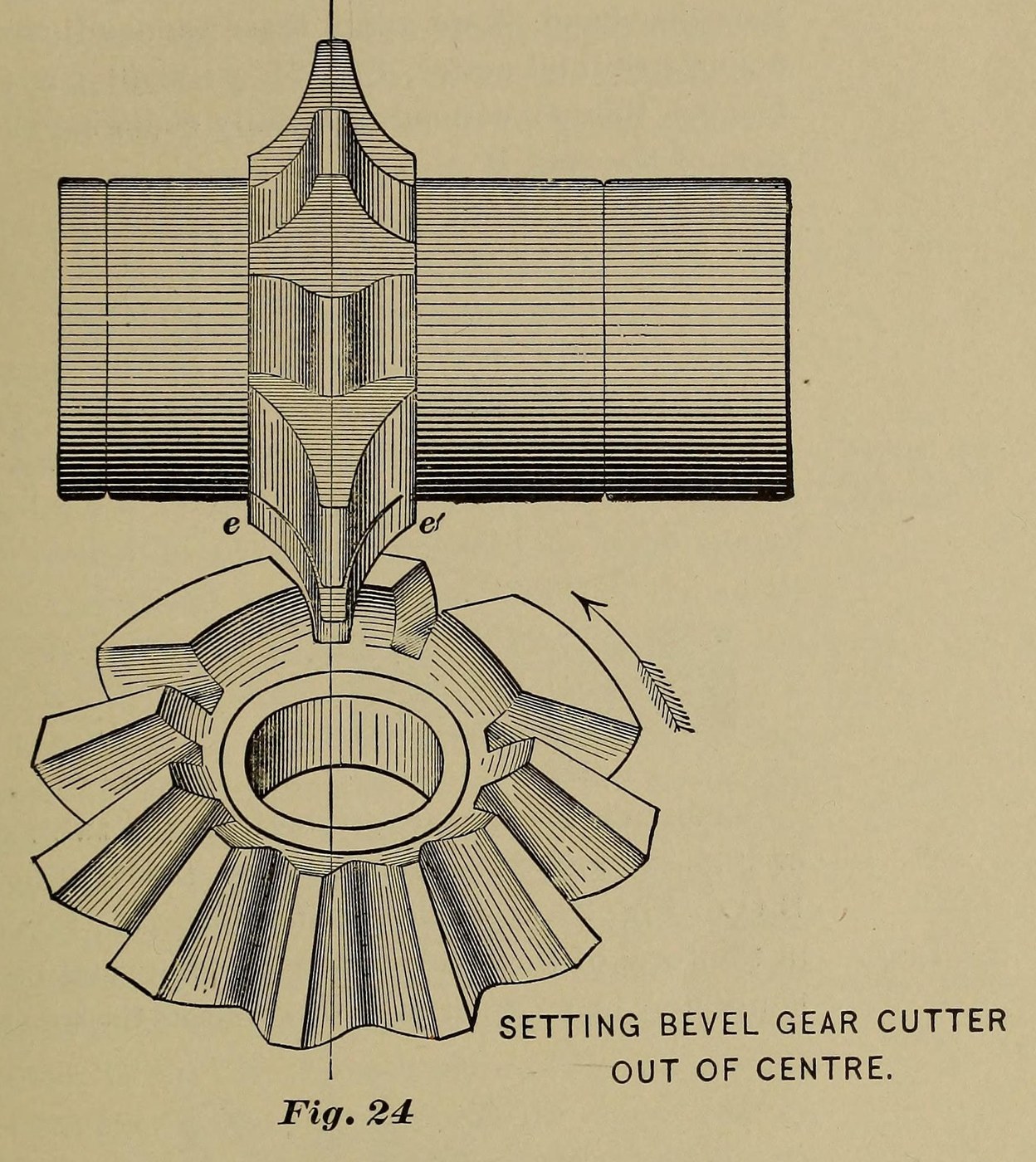


Mitre Gears: a 1:1 Bevel Pair Cut on the Milling Machine (Brown & Sharpe 1911)
Two equal bevel gears on shafts at right angles are mitre gears, and one cutter cuts both. A rotary cutter can only be right for one end of a bevel tooth, so Brown & Sharpe cut each space twice, set off centre to each side, then file the small ends round. Every figure here comes from their rules, worked out for a pair of 16 teeth, 8 pitch.
Source: Brown & Sharpe, Practical Treatise on Gearing (1911), Part I ch. IX–X and Part II ch. III; set-over table p. 58. The tooth count, pitch, face width, steel and bore are ours, and so is the arithmetic. Picture: Brown & Sharpe's Fig. 24.
Avancé
2 days
Consignes
1
1
Work out and turn two blanks
Work out and turn two blanks
Ours: 16 teeth, 8 pitch, so pitch diameter 2.000 in. Mitre gears have a 45° centre angle (tangent 16/16). Diameter increment = cos 45° × working depth 0.250 = 0.177 in. Apex distance 1.414 in. Angle increment: tan = sin 45° ÷ 8, giving 5° 03′; cutting and face angle 45° − 5° 03′ = 39° 57′. Turn two blanks from steel to 2.18 in outside diameter, with the angle of edge 45° and the angle of face 39° 57′, tried with a protractor against the end of the hub. Face length ⅜ in (ours; no more than a third of the 1.414 in apex distance). Bore and hub are ours.
Matériaux pour cette étape :
 Barre d'acier doux1 length for two blanks
Outils nécessaires :
 Tour à métaux
 Outil de coupe pour tour
 Rapporteur
 Micromètre
2
2
Choose the cutter
Choose the cutter
Back cone radius 1.414 in: twice that × 8 pitch = 22.6 teeth, so a No. 5, 8-pitch bevel gear cutter (21 to 25 teeth). One cutter does both gears. Measure its thickness Tc at the pitch line, 0.145 in (1.157 ÷ 8) from its tip.
Outils nécessaires :
 Fraise pour engrenages coniques
 Pied à coulisse pour dents d’engrenage
3
3
Set the head and the depth
Set the head and the depth
Mount the blank on the dividing head, set to the cutting angle of 39° 57′, to index 16 spaces. Set the depth at the large end to the working depth plus clearance, 0.270 in. Clearance stays the same at the small end.
Outils nécessaires :
 Fraiseuse
 Tête diviseuseFraise pour engrenages coniques
4
4
Set over and cut one side of every tooth
Set over and cut one side of every tooth
Set-over: apex distance ÷ face = 1.414 ÷ 0.375 = 3.77, so use the 3¾ column, where a No. 5 cutter has the factor .293. Set-over = Tc ÷ 2 − .293 ÷ 8 = Tc ÷ 2 − 0.037 in. Set the work off centre by that amount to one side, taking up backlash. Run the cutter through, indexing round all 16 spaces.
Outils nécessaires :
FraiseuseTête diviseuseFraise pour engrenages coniques5
5
Set over the other way and trim to thickness
Set over the other way and trim to thickness
Set over by the same amount on the other side of centre and rotate the blank to line the cutter up with the space at the small end. Take a trial cut, then rotate the blank toward the cutter until the tooth is right: 0.196 in thick at the large end and 0.144 in at the small end. Check both ends with the gear tooth vernier. Right at the large end but thick at the small end means too much set-over; the other way round, too little.
Outils nécessaires :
FraiseuseTête diviseuseFraise pour engrenages coniquesPied à coulisse pour dents d’engrenage6
6
Cut round, then make the second gear
Cut round, then make the second gear
Cut the second side of every tooth with that setting. Cut the second blank the same way with the same cutter.
Outils nécessaires :
FraiseuseTête diviseuseFraise pour engrenages coniques7
7
File the small ends
File the small ends
Round the teeth over at the small ends with a file, where the cutter could not. Do not file them thinner at the pitch line.
Outils nécessaires :
 Lime fine
Matériaux
1- 1 length for two blanksEspace réservé
Outils requis
9- Espace réservé
- Espace réservé
- Espace réservé
- Espace réservé
- Espace réservé
- Espace réservé
- Espace réservé
- Espace réservé
- Espace réservé
Ce plan fabrique

CC0 Domaine public
Ce blueprint est publié sous CC0. Vous êtes libre de copier, modifier, distribuer et utiliser ce travail pour tout usage, sans demander la permission.
Soutenez le Maker en achetant des produits via son Blueprint où il perçoit une Commission Maker définie par les Vendeurs, ou créez une nouvelle itération de ce Blueprint et incluez-le comme connexion dans votre propre Blueprint pour partager les revenus.