Collaboration
ART
BEAUTÉ ET BIEN-ÊTRE
ARTISANAT
CULTURE ET HISTOIRE
DIVERTISSEMENT
ENVIRONNEMENT
NOURRITURE ET BOISSONS
INGÉNIERIE INVERSE
SCIENCES
SPORTS
TECHNOLOGIE
TECHNOLOGIE PORTABLE
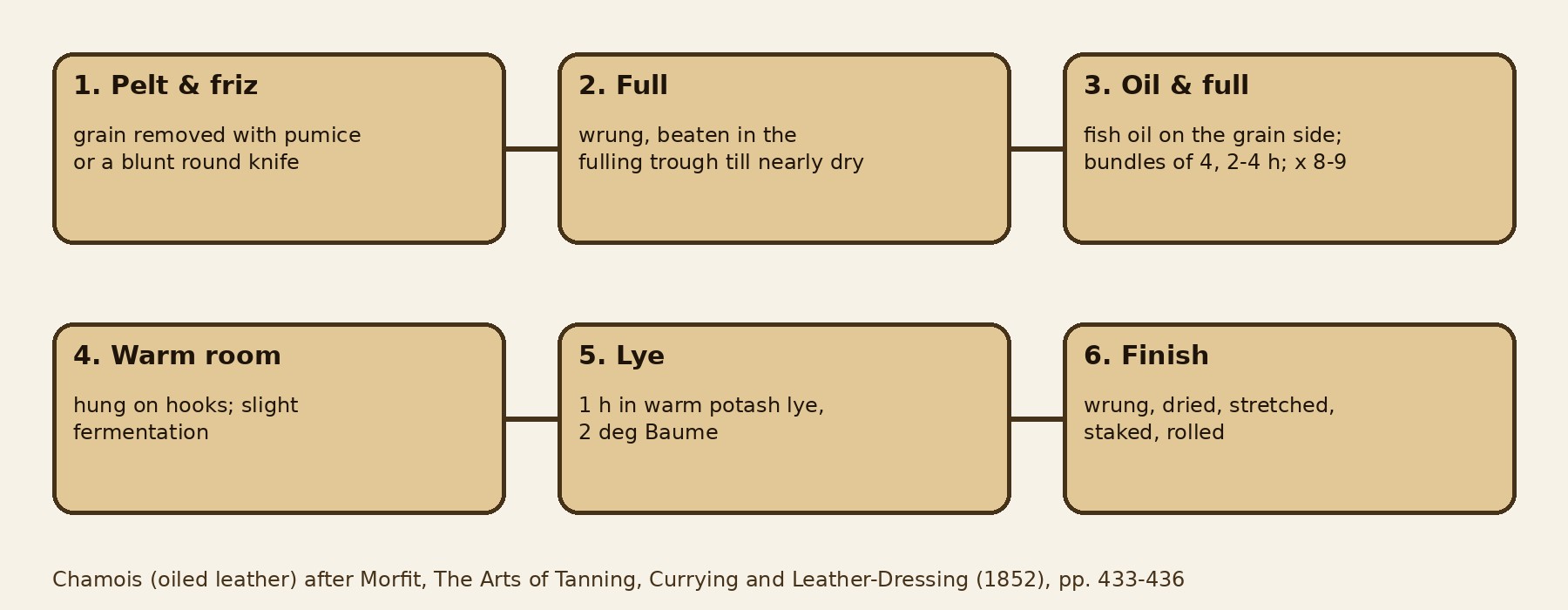


Chamois Wash Leather: Frized Pelts Fulled With Fish Oil Eight or Nine Times (Morfit, 1852)
Oil-tawed chamois or wash leather, from Campbell Morfit's Arts of Tanning, Currying and Leather-Dressing (1852): sheep, goat or deer pelts with the grain rubbed off, beaten again and again with fish oil until it is worked right in, warmed so the oil sets in the fibre, then washed of excess oil in weak potash lye and finished soft. No tannin, no alum.
Avancé
About 2 weeks
Consignes
1
1
Oil budget
Oil budget
Chargement du notebook Jupyter…
2
2
Read The Arts of Tanning
Read The Arts of Tanning
"Oiled leather is commonly known as chamois, or wash-leather ... from its property of bearing wetting and washing."
3
3
Make pelts and friz
Make pelts and friz
Choose the finest goat, sheep, lamb or deer skins (or thin split sides). Bring them to pelt as for kid leather: wash, lime, fleece, beam and bran. Then friz them: rub with a pumice stone, or work under the round edge of a blunt knife, to remove the grain, even the thickness and soften the skin.
Matériaux pour cette étape :
 Peau de mouton12 pièces
 Chaux éteinte1 pièce
 Son de blé1 pièce
Outils nécessaires :
 Cuve de tannage
 Chevalet d'écharnage
 Couteau à écharner
 Pierre ponce
4
4
Oil and full
Oil and full
Wring the skins and beat them in the fulling trough until nearly dry. Spread each on the table and sprinkle the grain side with cod or other fish oil, fold them in bundles of four, and beat again 2 to 4 hours. Open and air them briefly, grease again, and full again. Repeat eight or nine times until thoroughly imbued, with no greasy look. 3 to 5 gallons of oil serve a gross of skins. (By hand: beat them in a tub with a heavy wooden mallet, our method.)
Matériaux pour cette étape :
 Huile de poisson1 pièce
Outils nécessaires :
Cuve de tannage Maillet en bois
5
5
Warm and set
Warm and set
Hang the skins on hooks from wooden hangers in a warm drying room (his is about 6 ft high and 12 ft square, heated by steam-pipes or a stove). A slight fermentation sets the oil into the fibre.
6
6
Wash out the excess
Wash out the excess
Handle the skins for an hour in slightly warm potash lye of 2 deg Baume, which turns the excess oil to soap. Wring them at the peg, dry, finish on the stretcher and the stake (horse), and smooth with rollers. For a buff colour dip them in an oak-bark infusion (a dye here, not a tan).
Matériaux pour cette étape :
 Hydroxyde de potassium1 pièce
 Écorce de chêne (concassée)1 pièce
Outils nécessaires :
Cuve de tannage Seau de 20 litres
7
7
Troubleshooting
Troubleshooting
Chamois troubleshooting.
Flow
Loading...
8
8
History and honest limits
History and honest limits
From Campbell Morfit, **The Arts of Tanning, Currying, and Leather-Dressing** (1852), "Oiled Leather" (checked on the archive.org scan artsoftanningcur00morf, pp. 433-436). He refers back to kid leather for the pelt stage. Hand fulling, the tools and the diagram are ours.
Matériaux
6- 12 piècesEspace réservé
- 1 pièceEspace réservé
- 1 pièceEspace réservé
- 1 pièceEspace réservé
- 1 pièceEspace réservé
- 1 pièceEspace réservé
Outils requis
6- Espace réservé
- Espace réservé
- Espace réservé
- Espace réservé
- Espace réservé
- Espace réservé
Ce plan fabrique
Blueprints liés
Ces blueprints partagent des connaissances — techniques, matériaux ou principes
CC0 Domaine public
Ce blueprint est publié sous CC0. Vous êtes libre de copier, modifier, distribuer et utiliser ce travail pour tout usage, sans demander la permission.
Soutenez le Maker en achetant des produits via son Blueprint où il perçoit une Commission Maker définie par les Vendeurs, ou créez une nouvelle itération de ce Blueprint et incluez-le comme connexion dans votre propre Blueprint pour partager les revenus.