Collaboration
ART
BEAUTÉ ET BIEN-ÊTRE
ARTISANAT
CULTURE ET HISTOIRE
DIVERTISSEMENT
ENVIRONNEMENT
NOURRITURE ET BOISSONS
INGÉNIERIE INVERSE
SCIENCES
SPORTS
TECHNOLOGIE
TECHNOLOGIE PORTABLE
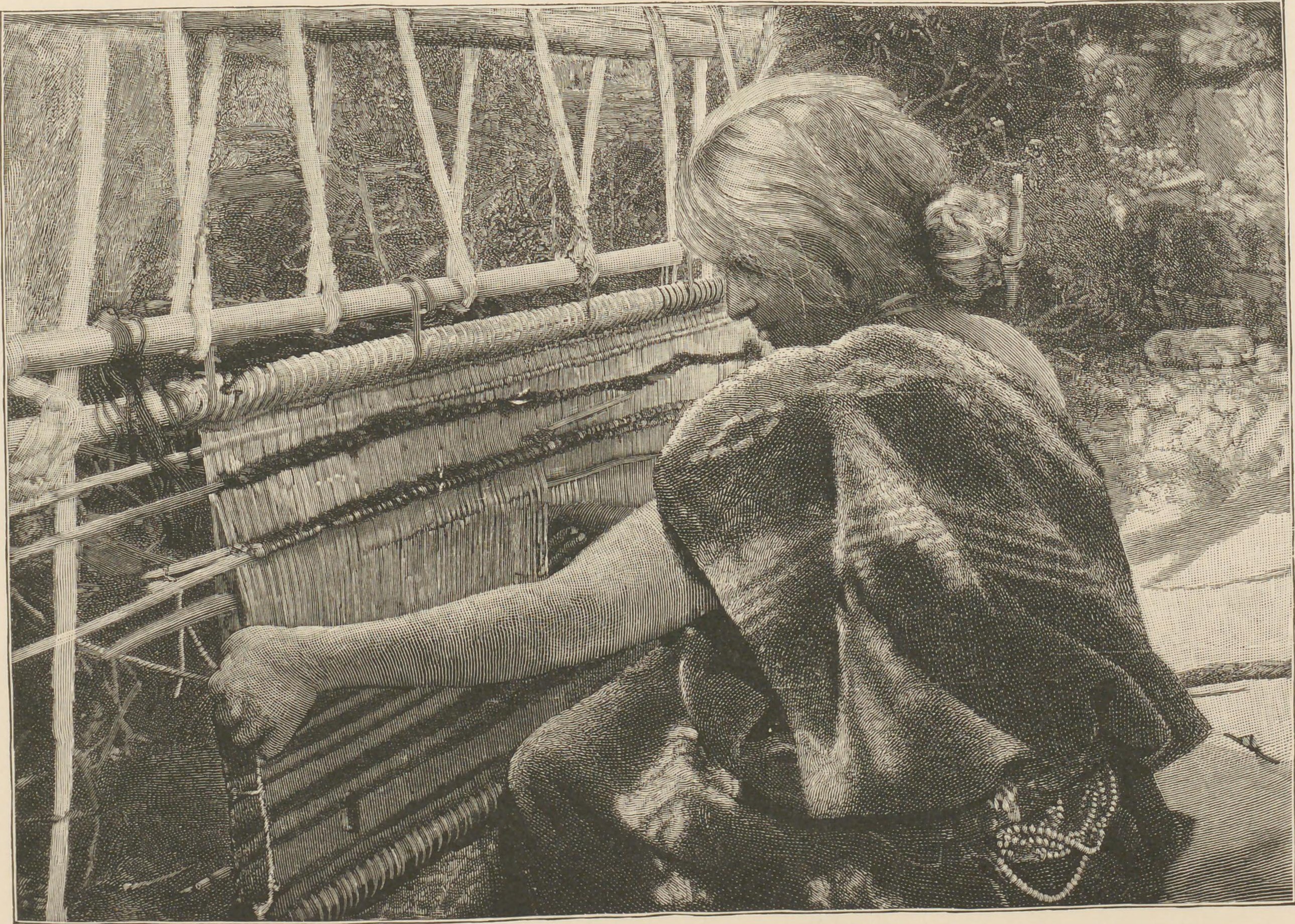


Navajo Blanket Weaving: Figure-8 Warp on Two Poles, String Healds, Batten Turned Flat to Open the Shed (Matthews, 1884)
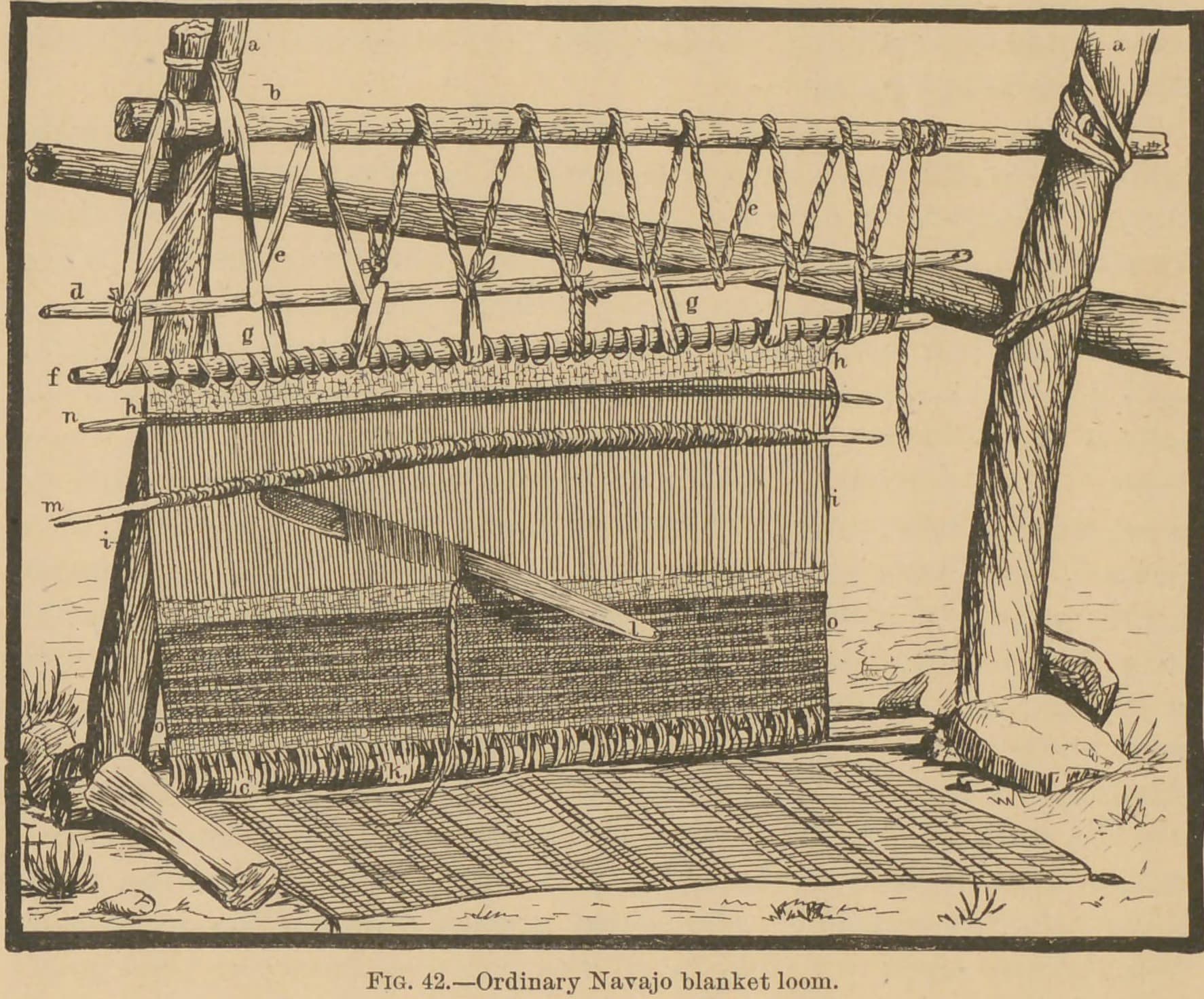
How a Navajo (Diné) weaver made a blanket, as Washington Matthews recorded it: the warp wound in figures of eight between two poles so both sheds exist from the start, three-strand cords twined across each end, a string heald made loop by loop on a rod, and every pick beaten down with a broad oak batten that is first turned flat to open the shed.
Avancé
Weeks for a blanket
Consignes
1
1
His measures
His measures
Chargement du notebook Jupyter…
2
2
Read Matthews
Read Matthews
"It is by the vigorous use of the batten that the Navajo serapes are rendered water-proof."
3
3
Lay the warp
Lay the warp
On the ground make a frame of four sticks: rough saplings at the sides, smooth round poles top and bottom, as far apart as the blanket is long. Tie the warp string to pole 1, take it over pole 2, back under 2 and over 1, and on: the turns cross in the middle in figures of eight, which makes both sheds. Tie off on pole 2 and put a rod in each shed, the rods tied together at their ends.
Matériaux pour cette étape :
 Fil de laine écru1 pièce
 Perches de bois vert1 pièce
Outils nécessaires :
 Couteau
4
4
Twine the end cords
Twine the end cords
Tie three strings together. Sitting outside one pole, fix them left of the warp; take one strand under the first turn of warp, twist a second strand with the others and take in the second bend, the third the third bend, and so along. Pull the cord tight to space the threads, and do the same at the other pole. These become the stout end edges.
Matériaux pour cette étape :
 Cordage1 pièce
Outils nécessaires :
Couteau5
5
Mount and make the healds
Mount and make the healds
Bind the end cords to the loom beams (see the loom blueprint). Keep the upper-shed rod. For the lower shed: pass the end of a ball of string left through the shed, tie a loop on a slender rod, then with a finger draw a fold of string between each pair of front threads, give it one twist into a loop and push the rod through, left to right, until every front thread is in a loop; tie the string to the rod.
Matériaux pour cette étape :
Cordage1 pièceOutils nécessaires :
 Métier à tisser à cadre simpleCouteau
6
6
Weave
Weave
Sit on the ground facing the loom and weave upward. Lower shed: pull the healds toward you (about 1 in. opening), slide the batten in edgewise and turn it flat to open the shed about 3 in. (8 cm), pass the weft, push it down with the reed-fork, turn the batten edgewise and beat hard. Upper shed: let the healds go, push the shed-rod down to them, and weft, fork and batten again. Pass weft only as far as the batten reaches, rarely over 3 ft (90 cm). Two stout yarn cords, tied at the cloth-beam just outside the warp and up to the yarn-beam, make the side edges.
Matériaux pour cette étape :
 Fil de laine teint1 pièce
Outils nécessaires :
Métier à tisser à cadre simple7
7
Lower the web
Lower the web
When the work gets too high, loosen the spiral rope, lower the yarn-beam, fold the woven part and sew the fold's upper edge tightly to the cloth-beam (needle ours). Most weavers weave a little at the top before finishing the middle, so both ends match.
Matériaux pour cette étape :
Cordage1 pièceOutils nécessaires :
 Aiguille à coudreMétier à tisser à cadre simple
8
8
Troubleshooting
Troubleshooting
Weaving troubleshooting.
Flow
Loading...
9
9
History and honest limits
History and honest limits
From Washington Matthews, "Navajo Weavers", **3rd Annual Report of the Bureau of Ethnology** (1884), pp. 378-381, Fig. 43 and Plate XXXV (checked on the archive.org scan 101714660.nlm.nih.gov; p. 380 taken from the scan's text layer). In coarser blankets the end cords were taken out and the warp tied in pairs as a fringe. Yarn amounts, frame size and the needle are ours.
Matériaux
4- 1 pièceEspace réservé
- 1 pièceEspace réservé
- 3 piècesEspace réservé
- 1 pièceEspace réservé
Ce plan fabrique
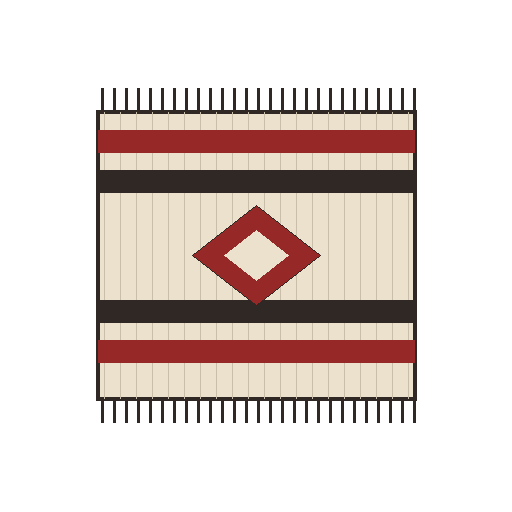
Blueprints liés
Ces blueprints partagent des connaissances — techniques, matériaux ou principes


CC0 Domaine public
Ce blueprint est publié sous CC0. Vous êtes libre de copier, modifier, distribuer et utiliser ce travail pour tout usage, sans demander la permission.
Soutenez le Maker en achetant des produits via son Blueprint où il perçoit une Commission Maker définie par les Vendeurs, ou créez une nouvelle itération de ce Blueprint et incluez-le comme connexion dans votre propre Blueprint pour partager les revenus.