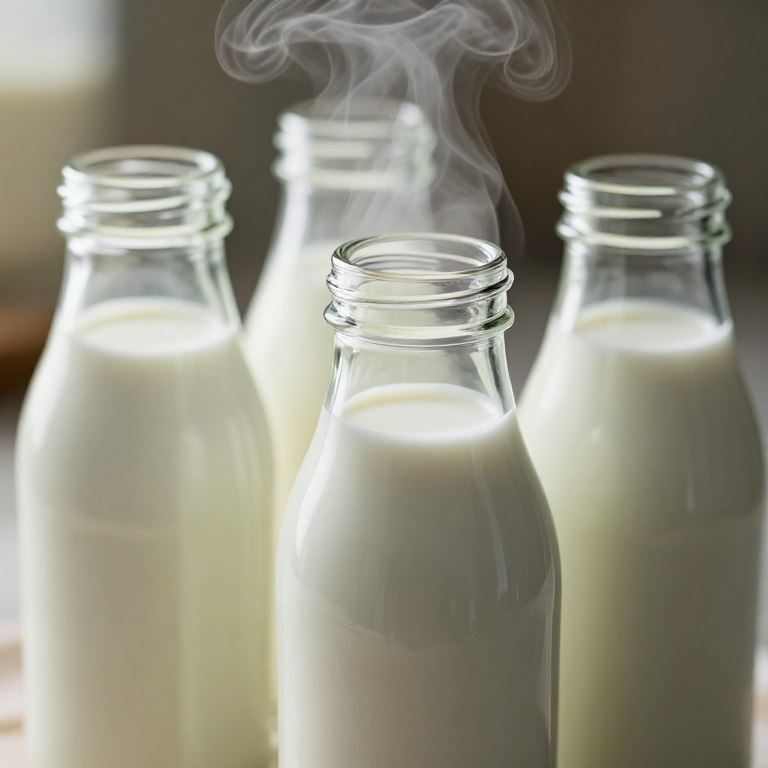


Pasteurising Milk and Wine — Gentle Heat That Kills the Germs Without Cooking
In the 1860s Louis Pasteur proved that the spoiling of wine, the souring of milk, and many diseases were all caused by the same thing: living micro-organisms too small to see. From that insight came a simple, world-changing technique that bears his name — pasteurisation. Heat a perishable liquid just enough to kill most of the microbes in it, but not enough to cook it, and it keeps far longer and becomes safe to drink.
The trick is restraint. Boiling would sterilise milk but ruin its taste; pasteurisation instead holds it at a modest temperature — around 63 degrees for half an hour, or 72 degrees for a few seconds — which destroys the dangerous bacteria while leaving the flavour and most of the nutrition intact. Cool it quickly and seal it clean, and you have a product that is both safe and good.
Pasteurisation does not make food immortal — some spores survive, so pasteurised milk still needs to be kept cold. But it made milk safe for children, ending much of the tuberculosis and infant death that raw milk carried, and it let wine and beer travel the world without turning to vinegar. It is one of the quiet triumphs of public health.
Consignes
Understand germ theory
Understand germ theory
Choose the liquid
Choose the liquid
Matériaux pour cette étape :
 Lait frais2 litres
Set up a gentle heat bath
Set up a gentle heat bath
Outils nécessaires :
 Stérilisateur au bain-marie
Heat to the target temperature
Heat to the target temperature
Outils nécessaires :
 Thermomètre d'ambiance
Hold for the set time
Hold for the set time
Watch the thermometer
Watch the thermometer
Outils nécessaires :
Thermomètre d'ambianceCool quickly
Cool quickly
Matériaux pour cette étape :
 Extracteur de jus2 kg
Seal in clean containers
Seal in clean containers
Matériaux pour cette étape :
 Bouteilles en verre avec couvercle4 pièces
Know its limits
Know its limits
Compare with sterilisation
Compare with sterilisation
Verify it worked
Verify it worked
Outils nécessaires :
 Kit d'analyse de sol
Appreciate the impact
Appreciate the impact
Matériaux
3- 2 litresEspace réservé
- Espace réservé
- Espace réservé
Outils requis
3- Espace réservé
- Espace réservé
- Espace réservé
Blueprints liés
Ces blueprints partagent des connaissances — techniques, matériaux ou principes


CC0 Domaine public
Ce blueprint est publié sous CC0. Vous êtes libre de copier, modifier, distribuer et utiliser ce travail pour tout usage, sans demander la permission.
Soutenez le Maker en achetant des produits via son Blueprint où il perçoit une Commission Maker définie par les Vendeurs, ou créez une nouvelle itération de ce Blueprint et incluez-le comme connexion dans votre propre Blueprint pour partager les revenus.