ART
BEAUTÉ ET BIEN-ÊTRE
ARTISANAT
CULTURE ET HISTOIRE
DIVERTISSEMENT
ENVIRONNEMENT
NOURRITURE ET BOISSONS
INGÉNIERIE INVERSE
SCIENCES
SPORTS
TECHNOLOGIE
TECHNOLOGIE PORTABLE
Youblob · CC0


Precipitated Silica: Hot Water Glass Carbonated, Then Acidified to pH 6.75 (Allen 1957)
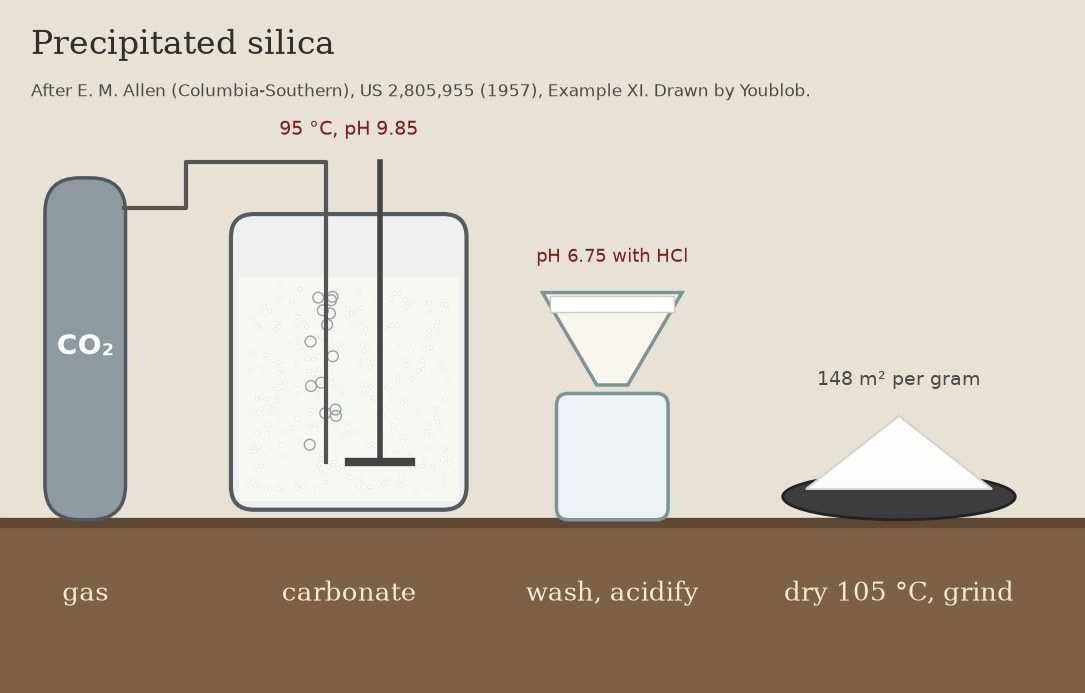
Bubble carbon dioxide through hot dilute water glass and the silica comes down as an extremely fine white powder rather than a gel. Edward Allen of Columbia-Southern made it this way as a white reinforcing filler for rubber; this follows his Example XI, which gave a powder of 148 m² per gram.
Source: E. M. Allen (Columbia-Southern), US 2,805,955 (1957), Example XI. The percentages are our arithmetic; the filter, mill and indicator are ours. Picture drawn by Youblob.
Intermédiaire
2 days
Consignes
1
1
Dilute the water glass
Dilute the water glass
Take 12,850 g of sodium silicate solution holding 976 g Na2O and 3115 g SiO2 (7.6 % and 24.2 %, a silica to soda ratio of 3.19 by weight; our arithmetic). Dilute it with water to 48 litres in a stirred kettle with a heating coil and thermometer, and heat to 95 °C.
Matériaux pour cette étape :
 Verre soluble (solution de silicate de sodium)12850 g
 Eau1 as required
Outils nécessaires :
 Réacteur sous pression
 Agitateur
 Thermomètre
 Balance à fléau
2
2
Carbonate for an hour
Carbonate for an hour
Bubble in pure carbon dioxide fast enough to add the theoretical amount in about 30 minutes, and keep going at that rate for about 1 hour. The slurry ends at pH 9.85.
Outils nécessaires :
 Dioxyde de carbone gazeuxRéacteur sous pressionAgitateurThermomètre
 Papier indicateur de pH
3
3
Filter and wash
Filter and wash
Filter the slurry and wash the cake twice with hot water.
Matériaux pour cette étape :
Eau1 as requiredOutils nécessaires :
 Entonnoir de Büchner (en porcelaine)
 Papier filtre
4
4
Acidify to pH 6.75
Acidify to pH 6.75
Stir the cake back into water and bring it to pH 6.75 with 400 ml of 3.5 N hydrochloric acid.
Matériaux pour cette étape :
Eau1 as requiredOutils nécessaires :
 Acide chlorhydrique
 Récipient en verreAgitateurPapier indicateur de pH
5
5
Wash out the chloride
Wash out the chloride
Filter again and wash the cake with hot water until it is nearly free of chloride.
Matériaux pour cette étape :
Eau1 as requiredOutils nécessaires :
Entonnoir de Büchner (en porcelaine)Papier filtre6
6
Dry at 105 °C and grind
Dry at 105 °C and grind
Dry it at 105 °C in a fan oven and grind it to a fine powder. Allen's had a pH of 8.2, 0.61 % sodium and a surface area of 148 m² per gram.
Outils nécessaires :
 Étuve de séchage
 Mortier et pilon
 Bocaux en verre avec couvercle
Matériaux
2- Espace réservé
- 4 as requiredEspace réservé
Outils requis
13- Espace réservé
- Espace réservé
- Espace réservé
- Espace réservé
- Espace réservé
- Espace réservé
- Espace réservé
- Espace réservé
- Espace réservé
- Espace réservé
- Espace réservé
- Espace réservé
- Espace réservé
Ce plan fabrique
Blueprints liés
Ces blueprints partagent des connaissances — techniques, matériaux ou principes
CC0 Domaine public
Ce blueprint est publié sous CC0. Vous êtes libre de copier, modifier, distribuer et utiliser ce travail pour tout usage, sans demander la permission.
Soutenez le Maker en achetant des produits via son Blueprint où il perçoit une Commission Maker définie par les Vendeurs, ou créez une nouvelle itération de ce Blueprint et incluez-le comme connexion dans votre propre Blueprint pour partager les revenus.