ART
BEAUTÉ ET BIEN-ÊTRE
ARTISANAT
CULTURE ET HISTOIRE
DIVERTISSEMENT
ENVIRONNEMENT
NOURRITURE ET BOISSONS
INGÉNIERIE INVERSE
SCIENCES
SPORTS
TECHNOLOGIE
TECHNOLOGIE PORTABLE


PTFE Fine Powder: a Dispersion Stirred Until It Curdles (Lontz 1952)
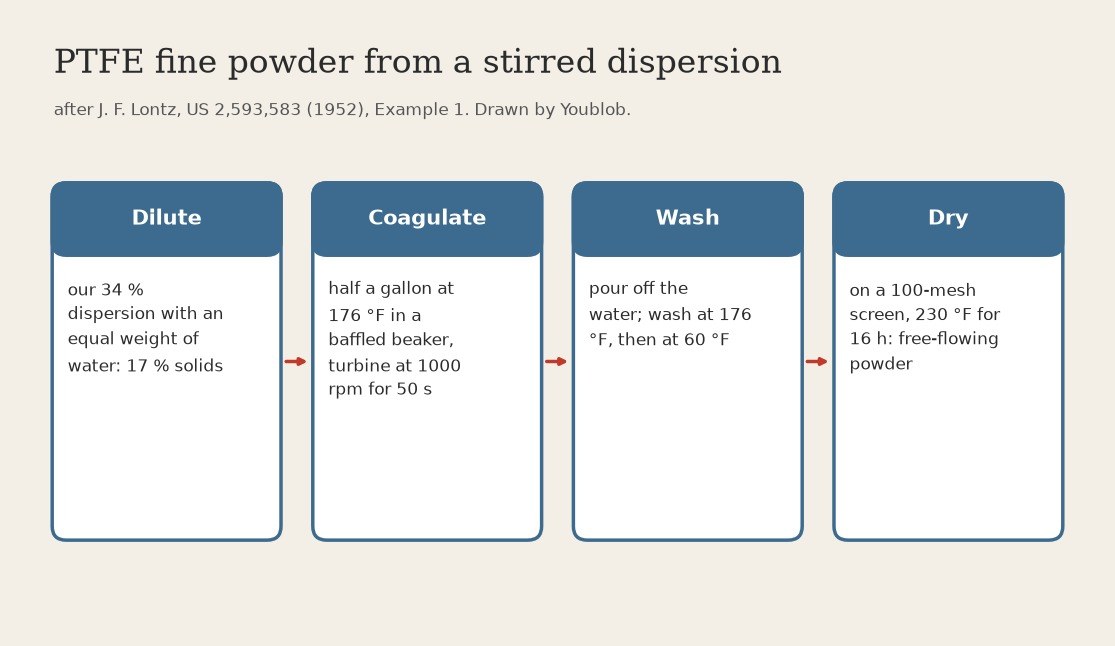
A PTFE dispersion is stable on the shelf, but stirred hard enough it curdles. Fifty seconds at 1000 rpm in a baffled beaker and the polymer floats up as a dry-looking, unwettable crumb. Washed and dried, it is a free-flowing powder for rolling into tape, or for cold lubricated extrusion.
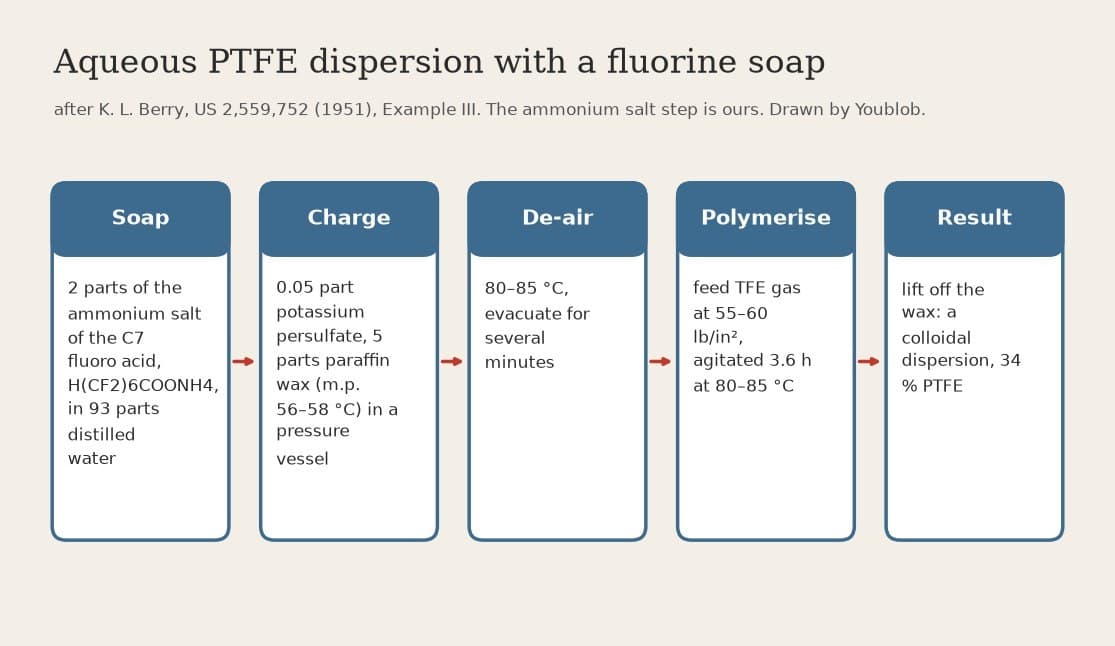
Source: J. F. Lontz (du Pont), US 2,593,583 (1952), Example 1. Lontz started from a dispersion made with disuccinic acid peroxide; ours is Berry's persulfate dispersion, diluted to his 17 %. Picture drawn by Youblob.
Intermédiaire
1 day
Consignes
1
1
Dilute the dispersion to 17 %
Dilute the dispersion to 17 %
Ours: stir the 34 % dispersion with an equal weight of distilled water to get 17 % solids, the strength Lontz used.
Matériaux pour cette étape :
 Dispersion aqueuse de PTFE1 part
 Eau distillée1 part
Outils nécessaires :
 Balance à fléau
 Bocaux en verre avec couvercle
2
2
Set up the baffled beaker
Set up the baffled beaker
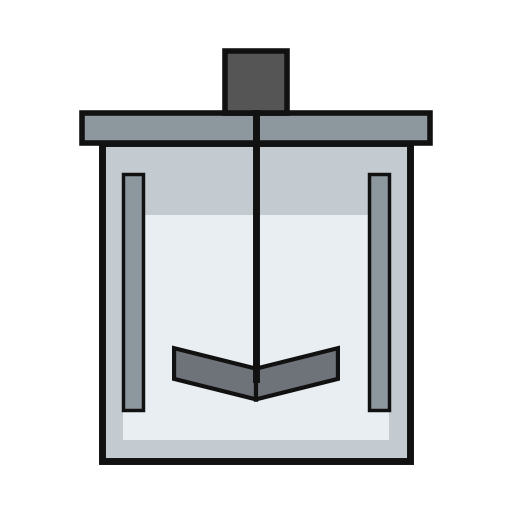
A 1-gallon stainless beaker, 6.5 in across and 7.5 in deep, with four baffles about ⅜ × 1 in hanging from the cover to within 3 in of the bottom. Stirrer: open turbine, 4 blades 1½ in high, 5 in across, reaching to within 1 in of the bottom.
Outils nécessaires :
 Cuve agitée à chicanes
 Agitateur
3
3
Stir hard at 176 °F for 50 seconds
Stir hard at 176 °F for 50 seconds
Put in half a gallon of the 17 % dispersion and heat it to 176 °F (80 °C). Run the stirrer at 1000 rpm for 50 seconds (Lontz measured 0.72 hp per gallon). The polymer coagulates and floats, unwetted, on top.
Outils nécessaires :
Cuve agitée à chicanesAgitateur Plaque chauffante
 Thermomètre
4
4
Wash hot, then cold
Wash hot, then cold
Pour off the water. Wash the polymer with hot water at 176 °F, then with cold water at 60 °F (16 °C), and drain.
Outils nécessaires :
Cuve agitée à chicanesThermomètre5
5
Dry at 230 °F for 16 hours
Dry at 230 °F for 16 hours
Spread the wet polymer on a 100-mesh screen and dry it in an oven at 230 °F (110 °C) for 16 hours. It comes out a free-flowing granular powder that passes 6–8 mesh.
Outils nécessaires :
 Tamis à toile métallique fine
 Étuve de séchageBocaux en verre avec couvercle
Matériaux
2- Espace réservé
- 1 partEspace réservé
Outils requis
8- Espace réservé
- Espace réservé
- Espace réservé
- Espace réservé
- Espace réservé
- Espace réservé
- Espace réservé
- Espace réservé
Ce plan fabrique
Blueprints liés
Ces blueprints partagent des connaissances — techniques, matériaux ou principes
CC0 Domaine public
Ce blueprint est publié sous CC0. Vous êtes libre de copier, modifier, distribuer et utiliser ce travail pour tout usage, sans demander la permission.
Soutenez le Maker en achetant des produits via son Blueprint où il perçoit une Commission Maker définie par les Vendeurs, ou créez une nouvelle itération de ce Blueprint et incluez-le comme connexion dans votre propre Blueprint pour partager les revenus.