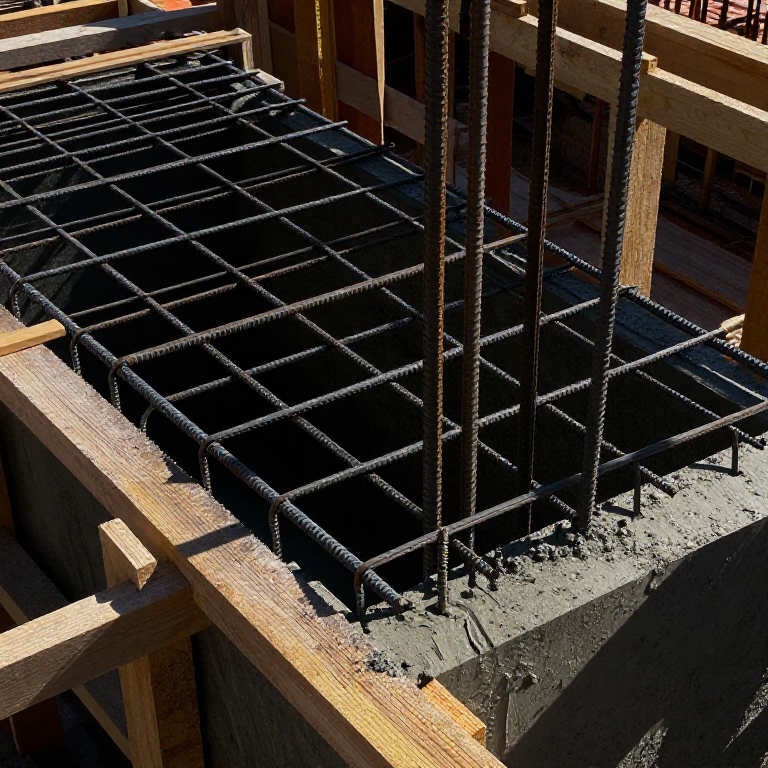


Casting Reinforced Concrete — Marrying Steel and Stone into the Modern Structure
Concrete is wonderful stuff in compression — squeeze it and it holds — but pull on it and it cracks like a biscuit. Steel is the opposite: superb in tension, useless if you try to build a wall of it. In the late 1800s builders like Joseph Monier and François Hennebique realised that embedding steel inside concrete combines the best of both, and reinforced concrete became the material that built the modern world.
The idea works because of three lucky properties. Concrete and steel expand and contract at almost exactly the same rate, so temperature changes do not tear them apart. Wet concrete is strongly alkaline, which coats the steel in a protective film that stops it rusting. And the two grip each other firmly, so a load shared between them is truly shared. Put steel where the structure is stretched and concrete where it is squeezed, and you get a member strong in every direction.
From this came bridges, dams, tunnels, and the skeletons of skyscrapers — shapes impossible in stone or iron alone. The skill is in knowing where the steel must go and in surrounding it completely with sound, well-cured concrete.
Consignes
Understand the partnership
Understand the partnership
Know where the steel goes
Know where the steel goes
Build the formwork
Build the formwork
Matériaux pour cette étape :
 Planche de bois10 pièces
Outils nécessaires :
 Marteau
Cut and bend the rebar
Cut and bend the rebar
Matériaux pour cette étape :
 Barre d'armature en acier doux n° 415 mètres
Outils nécessaires :
 Cintreuse à barres
Place and tie the cage
Place and tie the cage
Matériaux pour cette étape :
 Fil à ligaturer1 rouleau
Mix the concrete
Mix the concrete
Matériaux pour cette étape :
 Ciment Portland50 kg
 Sable fin100 kg
 Gravier200 kg
Outils nécessaires :
 Bétonnière
Pour around the steel
Pour around the steel
Matériaux pour cette étape :
 Eau30 litres
Compact out the air
Compact out the air
Outils nécessaires :
 Barre à damer
Cure it slowly
Cure it slowly
Strip the formwork
Strip the formwork
Outils nécessaires :
 Pied-de-biche
Understand why it lasts
Understand why it lasts
See what it built
See what it built
Matériaux
7- 10 piècesEspace réservé
- 15 mètresEspace réservé
- 1 rouleauEspace réservé
- 50 kgEspace réservé
- 100 kgEspace réservé
- 200 kgEspace réservé
- 30 litresEspace réservé
Outils requis
5- Espace réservé
- Espace réservé
- Espace réservé
- Espace réservé
- Espace réservé
Matériaux des Blueprints connectés



Blueprints liés
Ces blueprints partagent des connaissances — techniques, matériaux ou principes


CC0 Domaine public
Ce blueprint est publié sous CC0. Vous êtes libre de copier, modifier, distribuer et utiliser ce travail pour tout usage, sans demander la permission.
Soutenez le Maker en achetant des produits via son Blueprint où il perçoit une Commission Maker définie par les Vendeurs, ou créez une nouvelle itération de ce Blueprint et incluez-le comme connexion dans votre propre Blueprint pour partager les revenus.