ART
BEAUTÉ ET BIEN-ÊTRE
ARTISANAT
CULTURE ET HISTOIRE
DIVERTISSEMENT
ENVIRONNEMENT
NOURRITURE ET BOISSONS
INGÉNIERIE INVERSE
SCIENCES
SPORTS
TECHNOLOGIE
TECHNOLOGIE PORTABLE
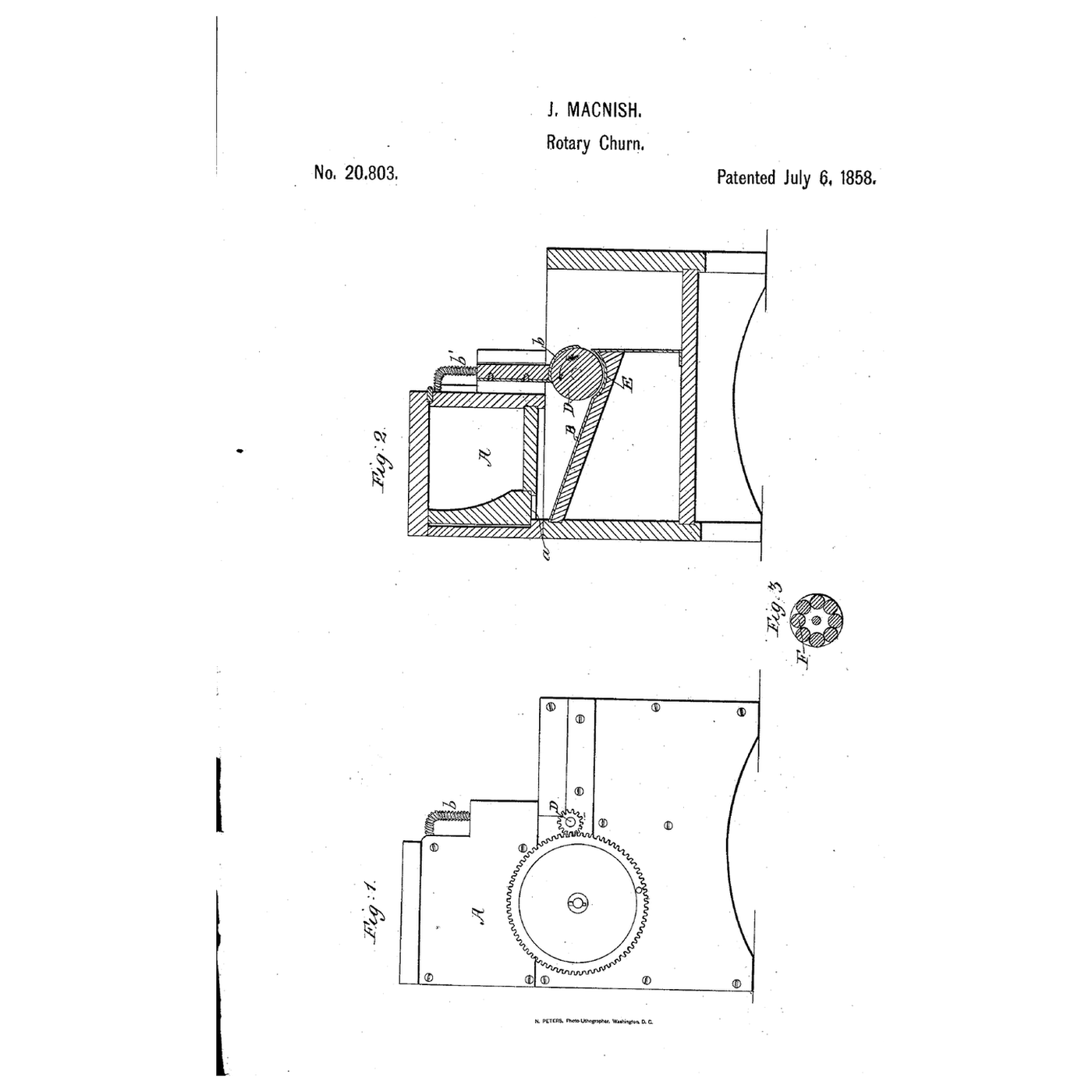


Roller-and-Concave Friction Churn: Cream Runs Once Between a Sprung Roller and a Fixed Concave
James MacNish of Berlin, Wisconsin, received US 20,803, dated 6 July 1858, for a churn that breaks the cream's fat globules by compression and friction: the cream runs down an apron into a fixed concave, where a roller held down by a sprung plate presses it through, and the plate scrapes the butter off the roller.
This rung prints the hopper, apron, concave, roller and gearing at tabletop scale, over a storage container.
Avancé
About 5 hours, plus printing
Consignes
1
1
Gearing and the roller's surface
Gearing and the roller's surface
Chargement du notebook Jupyter…
2
2
Churns with turning rollers, before it
Churns with turning rollers, before it
Those rollers worked inside a churn of cream; MacNish passes the cream once between a roller and a fixed concave.
3
3
Read US 20,803
Read US 20,803
"The cream only requires to pass between the roller and the concave once in order to produce butter."
4
4
Print the parts
Print the parts
Print the frame (/uploads/blueprints/roller-and-concave-friction-churn-frame.stl) lying on its cheek, the front cheek (/uploads/blueprints/roller-and-concave-friction-churn-cheek.stl), the roller (/uploads/blueprints/roller-and-concave-friction-churn-roller.stl), the shoe (/uploads/blueprints/roller-and-concave-friction-churn-shoe.stl), the pinion (/uploads/blueprints/roller-and-concave-friction-churn-pinion.stl), the wheel with its crank (/uploads/blueprints/roller-and-concave-friction-churn-wheel.stl) and the base (/uploads/blueprints/roller-and-concave-friction-churn-base.stl). The frame, cheek and base need a 240 mm print bed. Print in PETG at 0.2 mm layers, 30 % infill, 4 walls; wash before first use.
Matériaux pour cette étape :
 Filament PETG1 pièce
Outils nécessaires :
 Imprimante 3D à filament (FDM)
5
5
Roller, shoe and cheek
Roller, shoe and cheek
Cut a 10 mm dowel 148 mm long as the axle and push it through the roller. Lay the roller in the concave with the axle in the back cheek's slot, and screw the front cheek on with five M4 screws. Lay the shoe over the roller, put a spring on each of two M4 screws, and screw them down through the bridge into the shoe until the springs press the roller into the concave.
Matériaux pour cette étape :
 Goujons de bois dur1 pièce
 Vis à métaux1 pièce
 Jeu de ressorts de compression1 pièce
Outils nécessaires :
 Scie égoïne
 Papier abrasif
 Jeu de tournevis
6
6
Gears and base
Gears and base
Fix the pinion on the axle behind the back cheek with an M3 screw drilled through the dowel. Glue a 10 mm dowel 19 mm long into the back cheek's stud hole, put the wheel on it meshing the pinion, and hold it with an M3 screw and washer through its crank arm into the stud's end. Screw the frame onto the base with four M4 screws and set the base on the container, its opening over the container.
Matériaux pour cette étape :
Goujons de bois dur1 pièce Colle à bois1 pièceVis à métaux1 pièce
 Rondelle plate1 pièce
 Contenant de stockage de qualité alimentaire1 pièce
Outils nécessaires :
Scie égoïne Chignole à mainJeu de tournevis
7
7
The build in 3D
The build in 3D
FreeCAD model of this build: the base on the container, the frame with hopper A, the gap a, apron B and concave E, the roller with the sprung shoe over it, the bridge, and the wheel and pinion behind the back cheek. The front cheek is left off to show the inside.
8
8
Churn
Churn
Pour 0.5 litre of heavy cream at about 15 °C, checked with the thermometer, into the hopper and turn the crank steadily, timing it with the stopwatch. The cream runs out under the hopper's front wall, down the apron and between the roller and the concave, and falls with the scraped butter into the container. Gather the butter into a lump with the spatula, pour off the buttermilk, wash the butter in cold water until it runs clear, work in a pinch of salt and weigh it.
Matériaux pour cette étape :
 Crème liquide entière0.5 l
 Gros sel marin1 pièce
 Eau1 pièce
Outils nécessaires :
 Thermomètre à sonde à demeure
 Chronomètre
 Spatule
 Balance de cuisine numérique
 Grand cul-de-poule en acier inoxydable
9
9
Troubleshooting
Troubleshooting
Roller-and-concave churn troubleshooting.
Flow
Loading...
10
10
History and honest limits
History and honest limits
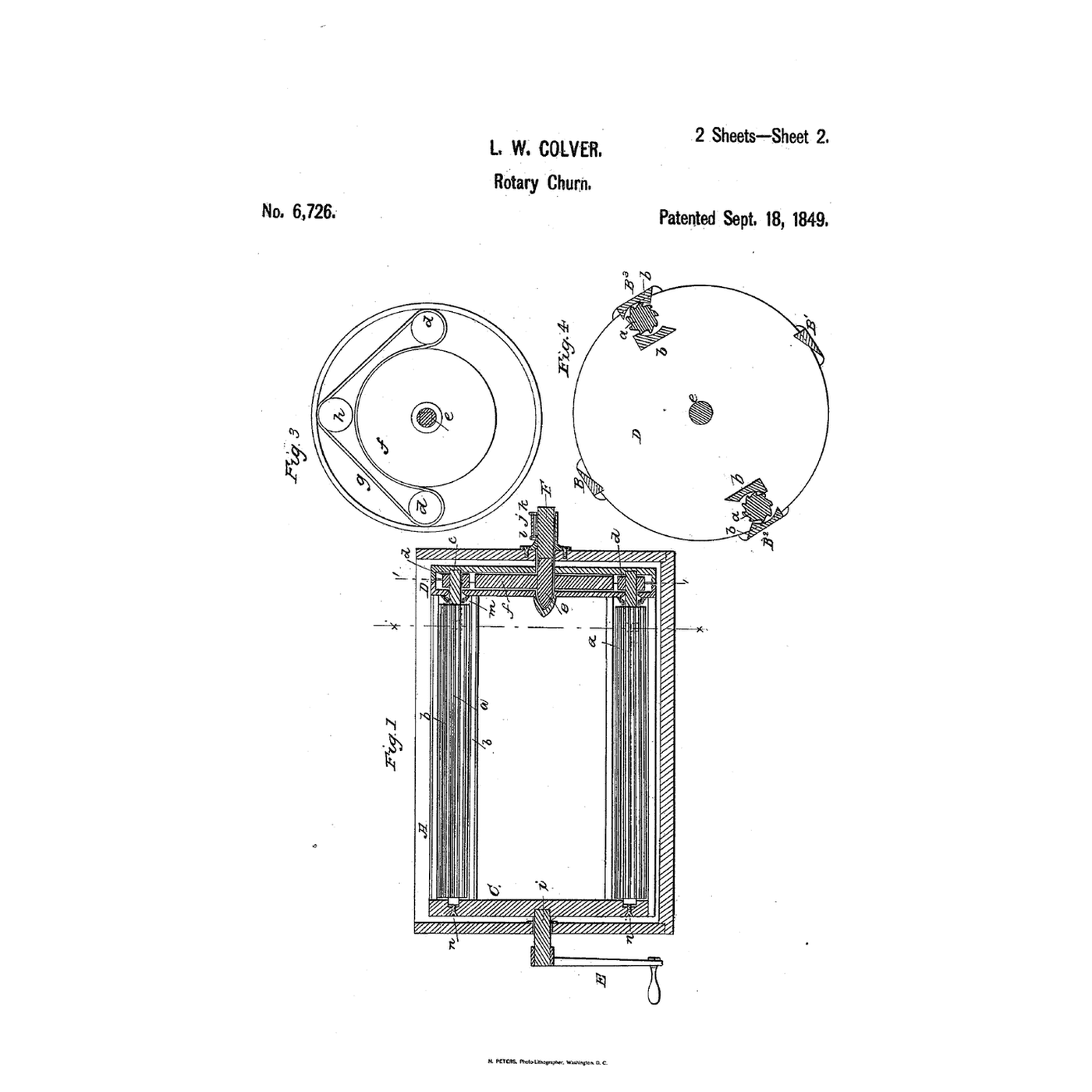
**James MacNish** of Berlin, Marquette County, Wisconsin, US 20,803, 6 July 1858. His spring plate ran from end to end of the roller, partly encircling it, made yielding by spiral springs, and also scraped the butter off it. He showed a second roller (Fig. 3) and suggested placing it in an ordinary churn box with a concave bottom. His receptacle C had a faucet to let off the buttermilk. He claimed breaking the globules by compression and friction with a roller revolving in, and touching, a stationary concave. Our printed shoe, sizes, gearing and container are ours. FDM prints hold food in their layer lines, so wash well and replace when worn.
Matériaux
10- 1 pièceEspace réservé
- 1 pièceEspace réservé
- 2 piècesEspace réservé
- Espace réservé
- 1 pièceEspace réservé
- 1 pièceEspace réservé
- Espace réservé
- Espace réservé
- 1 pièceEspace réservé
- 1 pièceEspace réservé
Outils requis
10- Espace réservé
- Espace réservé
- Espace réservé
- Espace réservé
- Espace réservé
- Espace réservé
- Espace réservé
- Espace réservé
- Espace réservé
- Espace réservé
Fichiers de conception
1Blueprints liés
Ces blueprints partagent des connaissances — techniques, matériaux ou principes


CC0 Domaine public
Ce blueprint est publié sous CC0. Vous êtes libre de copier, modifier, distribuer et utiliser ce travail pour tout usage, sans demander la permission.
Soutenez le Maker en achetant des produits via son Blueprint où il perçoit une Commission Maker définie par les Vendeurs, ou créez une nouvelle itération de ce Blueprint et incluez-le comme connexion dans votre propre Blueprint pour partager les revenus.