ART
BEAUTÉ ET BIEN-ÊTRE
ARTISANAT
CULTURE ET HISTOIRE
DIVERTISSEMENT
ENVIRONNEMENT
NOURRITURE ET BOISSONS
INGÉNIERIE INVERSE
SCIENCES
SPORTS
TECHNOLOGIE
TECHNOLOGIE PORTABLE

The Ruby Laser
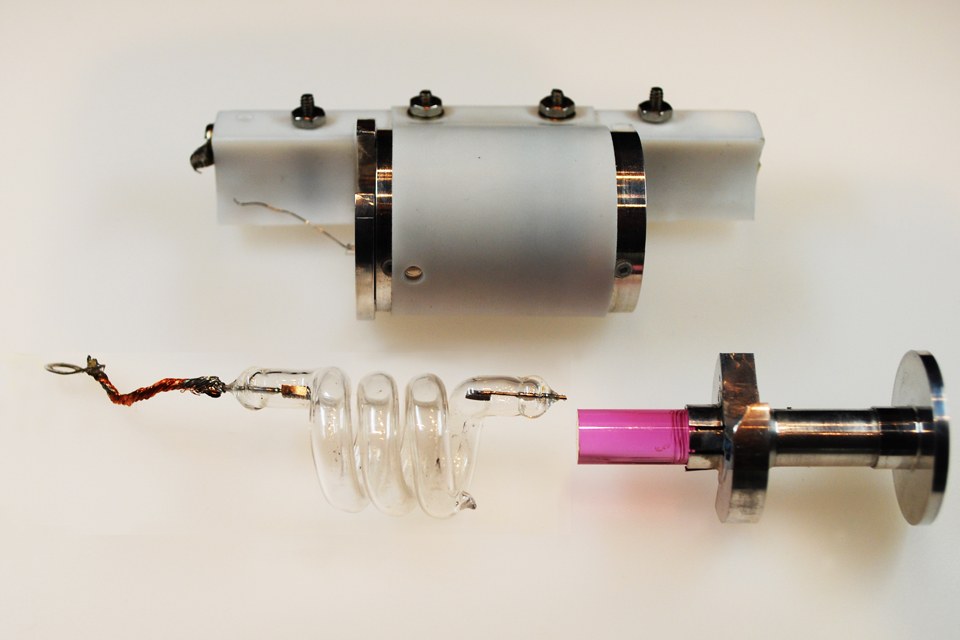
On 16 May 1960 Theodore Maiman, at Hughes Research Laboratories in Malibu, fired a helical xenon photographic flashlamp around a small rod of synthetic pink ruby and got a pulse of deep red light at 694.3 nm. It was the first laser.
Almost everyone thought ruby could not work. Ruby is a THREE-LEVEL medium: the laser transition ends on the ground state, so before there is any gain at all you must lift more than half of the chromium ions out of it. The consensus was that this needed more pump power than any lamp could deliver. Maiman's answer was not more power, it was less time — a millisecond flash, and a medium whose upper level survives about three milliseconds, long enough to accumulate the inversion before it decays.
MEASURED, NOT FABRICATED. Building the 1960 machine means a kilojoule capacitor bank at over a kilovolt driving a xenon flashtube, and that is a genuinely dangerous piece of equipment that belongs in a supervised lab. What you can do on a bench, cheaply and safely, is measure the two properties the whole invention rests on: the sharp 694.3 nm R-line, and the three-millisecond lifetime that makes energy storage possible. Both are visible in a synthetic ruby rod that costs less than a set of drill bits.
The historical machine is given as a specification, with what the patent and the 1960 Nature paper actually state kept separate from the modern equivalents.
Avancé
4 hours
Consignes
1
1
Pump the rod and see the R-line
Pump the rod and see the R-line
Work in a darkened room. Mount the synthetic ruby rod on an optical bench carrier and aim a 405 nm violet module at its side, not its end. Wear the safety glasses: 405 nm is poorly visible and the eye's blink reflex does not protect against it.
The rod will glow deep red. That is not scattered violet light — it is Cr3+ ions absorbing in the violet and blue-green bands, dropping non-radiatively into the metastable level, and emitting at 694.3 nm.
Move the pump around the rod and note that the red glow follows the illuminated volume. In a laser this volume is the whole rod, which is why Maiman's flashlamp was a helix wrapped around it rather than a lamp pointed at it.
Matériaux pour cette étape :
 Barreau de rubis synthétique1 pièce
Outils nécessaires :
 Jeu de modules à diode laser
 Lunettes de protection laser
 Kit de banc optique
2
2
Read the wavelength with a spectroscope
Read the wavelength with a spectroscope
Build or set up the spectroscope and point it at the glowing rod. Ruby's emission is not a broad band — it is a pair of very narrow lines, R1 at 694.3 nm and R2 at 692.9 nm, and the 1.4 nm gap between them is at the edge of what a grating spectroscope resolves.
Compare against a red LED in the same instrument. The LED's band is tens of nanometres wide; the ruby line is a fraction of a nanometre. A narrow emission line means the ions all emit at the same frequency, which is exactly the condition for one photon to stimulate the next.
If you have the USB spectrometer, record the spectrum and measure the linewidth directly.
Matériaux pour cette étape :
Barreau de rubis synthétique1 pièceOutils nécessaires :
 Spectromètre (USB)
 Feuille de réseau de diffraction (1000 traits/mm)Jeu de modules à diode laser
 Ordinateur de bureau
3
3
Measure the three-millisecond lifetime
Measure the three-millisecond lifetime
Drive the 405 nm module from the function generator with a 20 Hz square wave so it switches hard off. Put the photodiode against the rod behind a piece of red filter or exposed film that blocks the violet, and watch the decay on the oscilloscope.
Set the timebase to 2 ms per division. The fluorescence does not vanish when the pump stops — it decays over roughly ten milliseconds. Capture the trace and read off values every 0.2 ms for the fit in the next step.
This decay IS the invention. A dye that fluoresces for nanoseconds cannot store anything; the pump energy is gone before the next ion is excited. Three milliseconds lets a millisecond flash accumulate.
Matériaux pour cette étape :
Barreau de rubis synthétique1 pièceOutils nécessaires :
 Photodiode (BPW34)
 Oscilloscope numérique
 Générateur de fonctionsJeu de modules à diode laserLunettes de protection laser
4
4
The three-level penalty, in numbers
The three-level penalty, in numbers
Chargement du notebook Jupyter…
Outils nécessaires :
Ordinateur de bureau5
5
Compendium: the 1960 machine, and what a maker should not build
Compendium: the 1960 machine, and what a maker should not build
WHAT MAIMAN ACTUALLY USED. A synthetic ruby rod roughly 1 cm across and 2 cm long, both ends ground flat and parallel and silvered — the cavity was evaporated onto the rod itself, with one end left partly transmitting. Around it a General Electric FT-506 helical xenon photographic flashlamp. Behind that a polished aluminium cylinder to send stray light back in. The output was a burst of 694.3 nm light lasting under a millisecond.
MODERN EQUIVALENTS, CLEARLY LABELLED AS DERIVED. Verneuil-grown boules and Czochralski pulling both produce laser-grade ruby today; the growth blueprint this one links to is the same process family. Dielectric mirror coatings replaced evaporated silver and cut the round-trip loss by more than an order of magnitude. The flashlamp would now be driven by a pulse-forming network rather than a bare capacitor.
THE HIGH-VOLTAGE REALITY, STATED PLAINLY. A ruby laser flash needs of the order of a kilojoule at over a kilovolt. A charged bank of that size stays lethal after the supply is switched off and must be shorted through a bleeder before anyone touches it. This is not a scale-it-down-and-try-it project; it is supervised-laboratory equipment. The measurements in steps 1 to 4 give you the physics honestly and safely.
WHY IT MATTERED ANYWAY. Ruby is a bad continuous laser and a superb energy store. That same three-level structure that makes it hard to start makes it hold a large inversion, and holding an inversion is precisely what the next-but-one blueprint, Q-switching, exists to exploit.
Outils requis
9- Espace réservé
- Espace réservé
- Espace réservé
- Espace réservé
- Espace réservé
- Espace réservé
- Espace réservé
- Oscilloscope numérique10 % de commissionMagento Legacy Storeships internationallyEspace réservé
- Espace réservé
Blueprints liés
Ces blueprints partagent des connaissances — techniques, matériaux ou principes


CC0 Domaine public
Ce blueprint est publié sous CC0. Vous êtes libre de copier, modifier, distribuer et utiliser ce travail pour tout usage, sans demander la permission.
Soutenez le Maker en achetant des produits via son Blueprint où il perçoit une Commission Maker définie par les Vendeurs, ou créez une nouvelle itération de ce Blueprint et incluez-le comme connexion dans votre propre Blueprint pour partager les revenus.