ART
BEAUTÉ ET BIEN-ÊTRE
ARTISANAT
CULTURE ET HISTOIRE
DIVERTISSEMENT
ENVIRONNEMENT
NOURRITURE ET BOISSONS
INGÉNIERIE INVERSE
SCIENCES
SPORTS
TECHNOLOGIE
TECHNOLOGIE PORTABLE
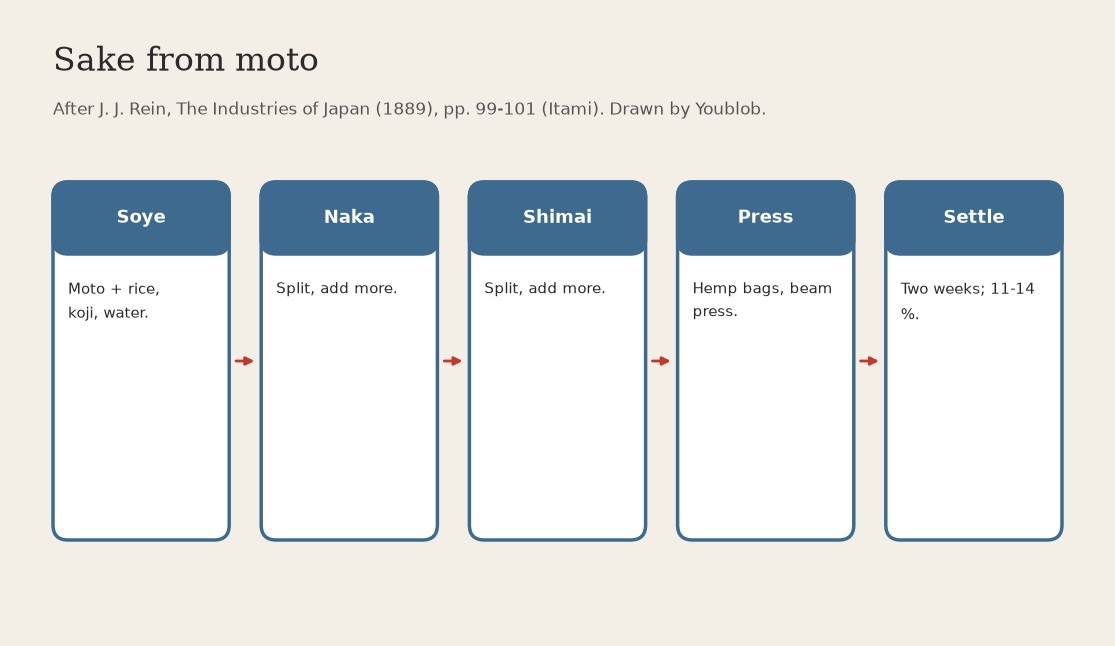


Sake from Moto: the Mash Built Up in Three Additions, Soye, Naka and Shimai, Pressed and Settled (Itami, after Rein 1889)
The brewers of Itami never put all the rice in at once. They fed the moto in three steps, roughly doubling the mash each time, so the yeast always stayed ahead of the sugar the koji made. Then they pressed the mash in a beam press and let the sake settle clear.
Result: sake of 11 to 14 % alcohol.
Source: J. J. Rein, The Industries of Japan (1889), pp. 99-101. The beam press is replaced by any press. Picture drawn by Youblob.
Avancé
4 weeks
Consignes
1
1
Soye: first addition
Soye: first addition
In a three-foot tub mix 1.30 koku steamed rice, 1.30 koku moto, 0.35 koku koji and 1.30 koku water (4.25 koku). Stir thoroughly every two hours for two or three days; it warms to about 20 C and smells pleasant and pungent. Ours: steam the rice over a pot.
Matériaux pour cette étape :
 Riz japonais à grain court1.3 koku
 Moto (levain de saké)1.3 koku
 Riz koji (Aspergillus oryzae)0.35 koku
 Eau1.3 koku
Outils nécessaires :
 Baquet en bois
 Longue pagaie de brassage en bois
 Grande marmite
 Thermomètre
2
2
Naka: second addition
Naka: second addition
Split the soye between two tubs and add 2.00 koku steamed rice, 0.65 koku koji and 2.90 koku water (9.80 koku, 4.90 per tub). Stir vigorously every other hour for one day.
Matériaux pour cette étape :
Riz japonais à grain court2 kokuRiz koji (Aspergillus oryzae)0.65 kokuEau2.9 kokuOutils nécessaires :
Baquet en boisLongue pagaie de brassage en boisGrande marmite3
3
Shimai: last addition
Shimai: last addition
Split again into four tubs and add 3.30 koku steamed rice, 1.00 koku koji and 4.20 koku water (Rein prints the naka here as 9.90; total 18.40 koku). Treat as before; keep tubs no more than half full.
Matériaux pour cette étape :
Riz japonais à grain court3.3 kokuRiz koji (Aspergillus oryzae)1 kokuEau4.2 kokuOutils nécessaires :
Baquet en boisLongue pagaie de brassage en boisGrande marmite4
4
Main fermentation
Main fermentation
After three days pour all four tubs into one big six-foot tub. A brisk fermentation follows and eases in two or three days; the scum settles and the liquor is strongly alcoholic.
Outils nécessaires :
Baquet en bois5
5
Press
Press
Fill close-woven hemp bags with the mash, lay them crosswise in a strong box and press. Rein's press is a beam lever weighted with 600-900 kg; ours: any wine press. Collect the turbid sake.
Outils nécessaires :
 Sac en lin
 Pressoir à vin
6
6
Settle and draw off
Settle and draw off
Let the sake stand quiet two weeks in a standing cask with two taps near the bottom, then draw it off clear by the upper tap. Store in barrels or closed tubs; heat it when warm weather comes to keep it.
Outils nécessaires :
 Tonneau en bois
Matériaux
4- 3.3 kokuEspace réservé
- 1.3 kokuEspace réservé
- Espace réservé
- 8.4 kokuEspace réservé
Outils requis
7- Espace réservé
- Espace réservé
- Espace réservé
- Espace réservé
- Espace réservé
- Espace réservé
- Espace réservé
Ce plan fabrique

Blueprints liés
Ces blueprints partagent des connaissances — techniques, matériaux ou principes

CC0 Domaine public
Ce blueprint est publié sous CC0. Vous êtes libre de copier, modifier, distribuer et utiliser ce travail pour tout usage, sans demander la permission.
Soutenez le Maker en achetant des produits via son Blueprint où il perçoit une Commission Maker définie par les Vendeurs, ou créez une nouvelle itération de ce Blueprint et incluez-le comme connexion dans votre propre Blueprint pour partager les revenus.