ART
BEAUTÉ ET BIEN-ÊTRE
ARTISANAT
CULTURE ET HISTOIRE
DIVERTISSEMENT
ENVIRONNEMENT
NOURRITURE ET BOISSONS
INGÉNIERIE INVERSE
SCIENCES
SPORTS
TECHNOLOGIE
TECHNOLOGIE PORTABLE
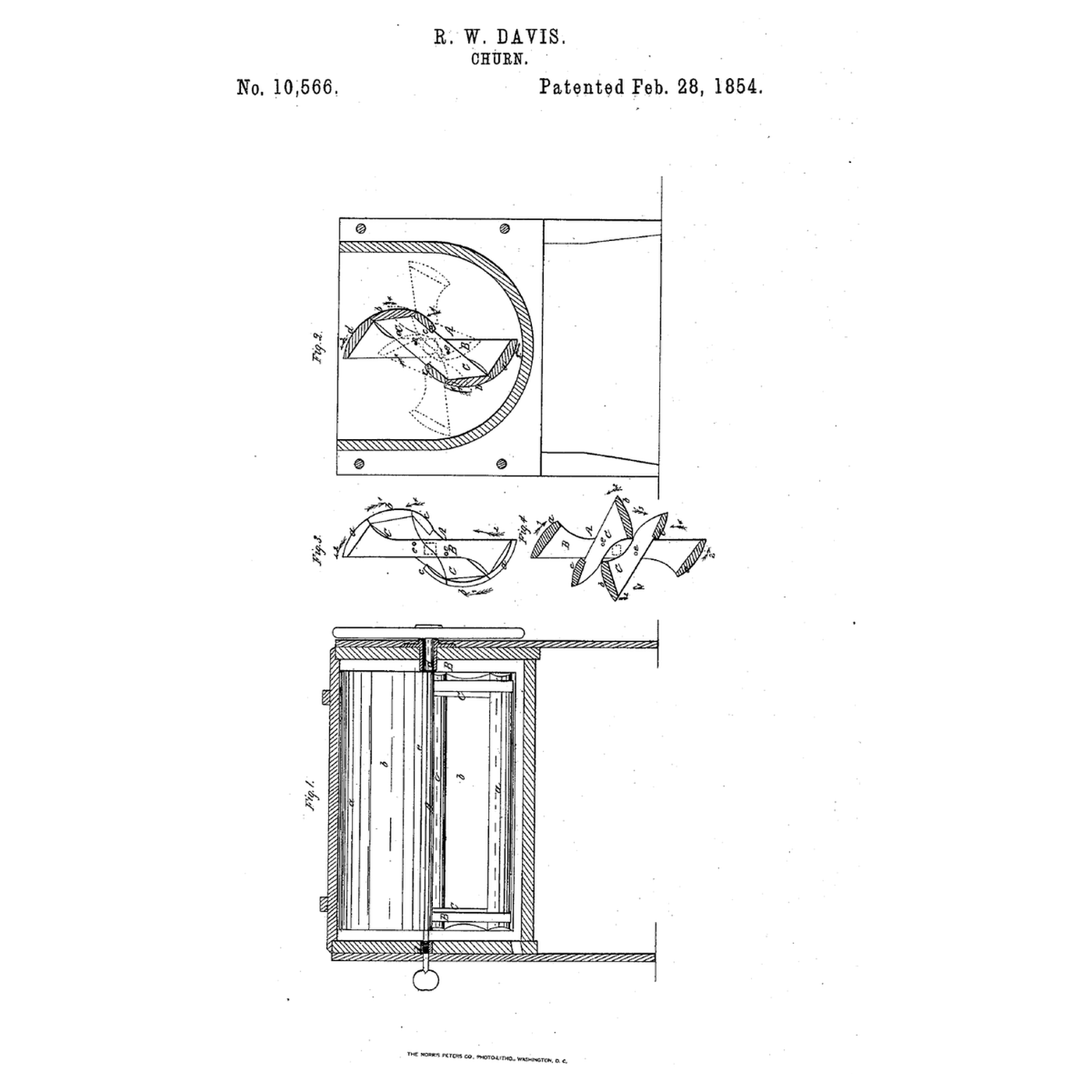

Self-Folding Blade Dasher Churn: Six Blades to Churn, Reverse and They Fold to Two That Gather
Robert W. Davis let the cream set the dasher and the butter fold it.
Robert W. Davis of Rodgersville, Steuben County, New York, received US 10,566, dated 28 February 1854, for "Churns for Making and Working Butter": a dasher of two end pieces B carrying blades a, and divided end pieces C hung loosely on pins "set eccentric to the axis of the dasher," carrying blades b and scroll-curved blades c. Turned one way, the cream's resistance opens it "so as to present six centripetal cutting or agitating blades"; reversed after the butter comes, the butter's resistance closes it "so as to present but two centrifugal gathering blades," which gather the butter, work it into rolls and expel the buttermilk.
This rung works out the strokes and the turning moment, then prints the end pieces, sections and blades, builds the round-bottomed churn, and makes and works butter.
Avancé
About 5 hours, plus printing
Consignes
1
1
Six blades or two
Six blades or two
Chargement du notebook Jupyter…
2
2
A dasher that changes when reversed, before it
A dasher that changes when reversed, before it
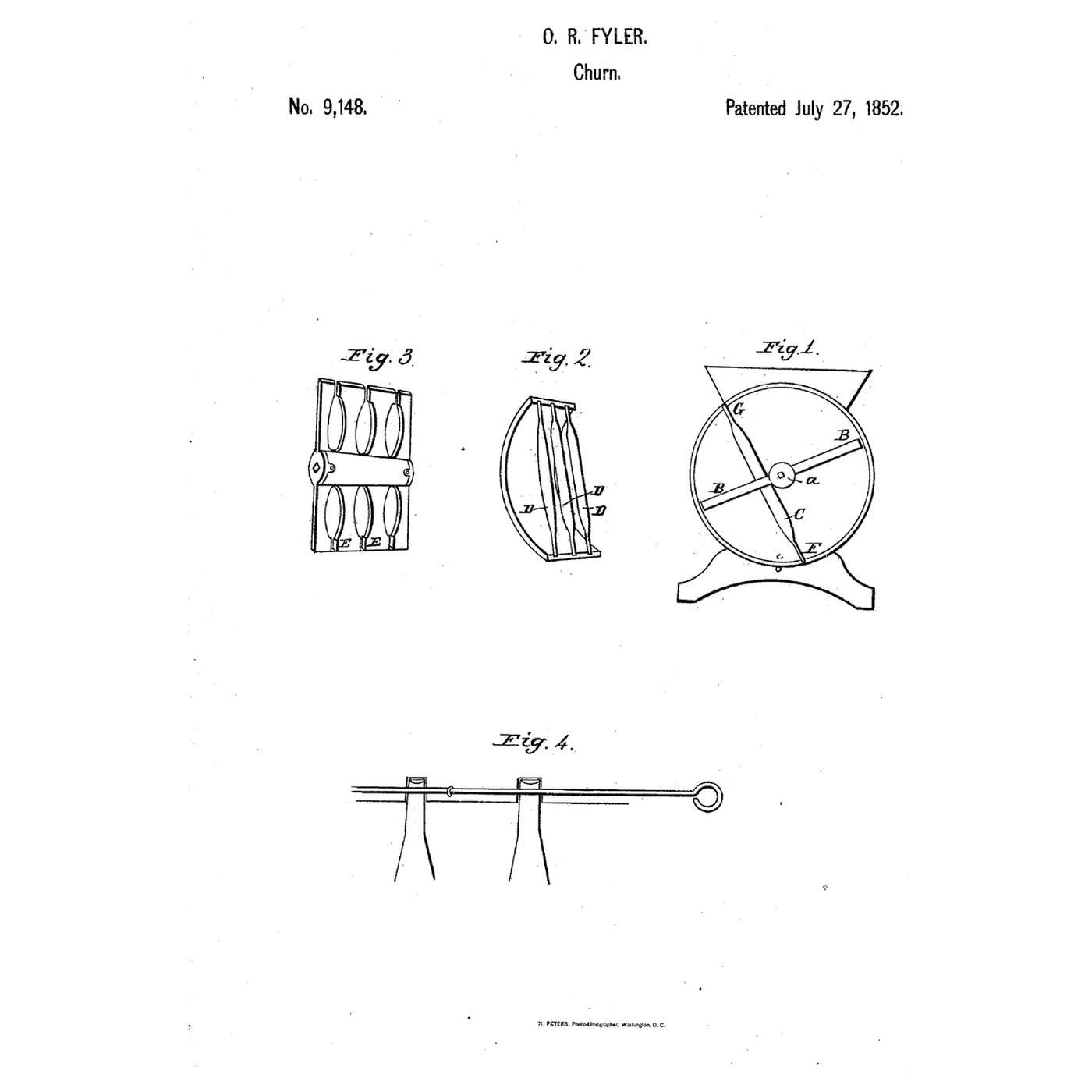
The embedded blueprint's floats fall back onto rollers when the crank is reversed. Davis's sections fold six blades into two S-shaped gatherers.
3
3
Read US 10,566
Read US 10,566
"The blades, c, c, have a greater curvature given them in line of a scroll, than those, b, b, as seen in the drawing. This increased curvature commences from the termination of the curve of the blades, b, b, as seen in the drawing. This increased curvature prevents the dasher throwing the butter toward the center of the churn, while gathering and working it."
4
4
Print the parts
Print the parts
Print two end pieces B (/uploads/blueprints/self-folding-blade-dasher-churn-end-piece.stl), four sections C (/uploads/blueprints/self-folding-blade-dasher-churn-section.stl), four outer blades for a and b (/uploads/blueprints/self-folding-blade-dasher-churn-outer-blade.stl) and two scroll blades c (/uploads/blueprints/self-folding-blade-dasher-churn-scroll-blade.stl). Print the blades on their lug ends. Print in PETG at 0.2 mm layers, 30 % infill, 4 walls; wash before first use.
Matériaux pour cette étape :
 Filament PETG1 pièce
Outils nécessaires :
 Imprimante 3D à filament (FDM)
5
5
The round-bottomed churn
The round-bottomed churn
Lay a round food-grade container about 180 mm across and 180 mm long on its side in a pine cradle and cut a lid opening in its top. Drill both ends on the axis for a 10 mm square hardwood shaft and fit a crank arm and dowel handle outside.
Matériaux pour cette étape :
 Contenant de stockage de qualité alimentaire1 pièce
 Planche de pin1 pièce
 Goujons de bois dur1 pièce
 Vis à bois #8 x 1"1 pièce
 Colle à bois1 pièce
Outils nécessaires :
 Scie à chantourner
 Perceuse sans fil
 Jeu de forets
 Scie égoïne
6
6
Assemble the folding dasher
Assemble the folding dasher
Slide the two end pieces onto the shaft inside the churn and screw an outer blade a across each pair of ends. On each side, hang a section on each end piece's pin hole with a 4 mm stainless pin, then screw an outer blade b across the sections' outer ends and a scroll blade c across their inner ends. Fit a short pin in each end piece as a stop so the sections open about square to B and fold back flat against it.
Matériaux pour cette étape :
 Rond en acier doux1 pièce
 Vis à métaux1 pièce
Outils nécessaires :
 Scie à métaux
 Jeu de tournevisPerceuse sans fil
7
7
The build in 3D
The build in 3D
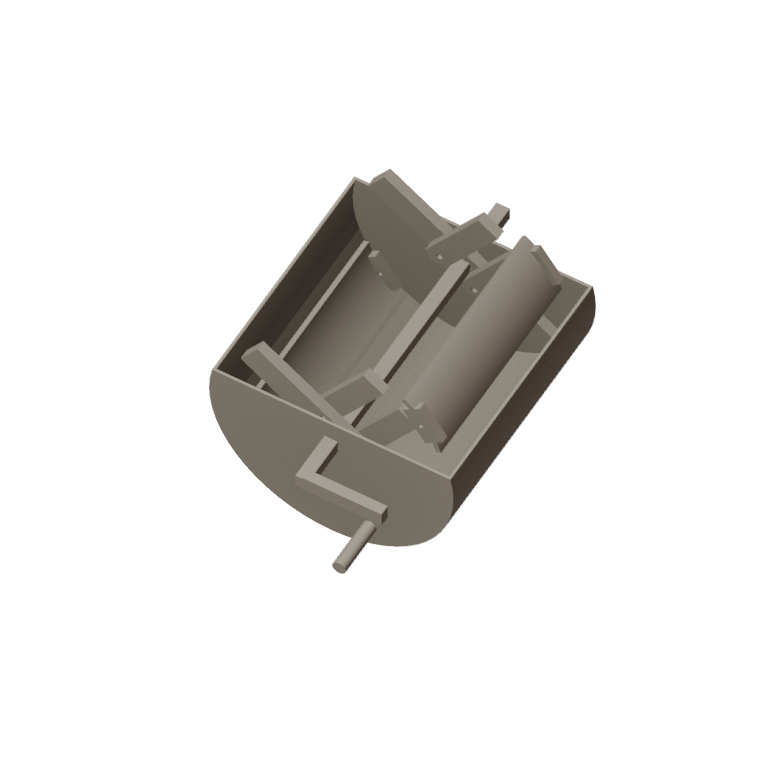
FreeCAD model of this build, not of the patent: the round-bottomed churn cut open, the end pieces with blades a on the square shaft, and the sections swung open across them on their pins, as for churning.
8
8
Churn one way, gather the other
Churn one way, gather the other
Let the heavy cream stand until it reaches about 15 °C, checked with the thermometer. Pour in 1.5 litres. Turn the crank the way that opens the sections and time until the butter comes. Draw off the buttermilk, then reverse the crank so the sections fold and the two S-blades gather and roll the butter. Pour off the buttermilk, add cold water, churn a little and pour off again until it runs clear; work in a pinch of salt and weigh the butter.
Matériaux pour cette étape :
 Crème liquide entière1500 ml
 Gros sel marin1 pièce
 Eau1 pièce
Outils nécessaires :
 Thermomètre à sonde à demeure
 Chronomètre
 Balance de cuisine numérique
 Grand cul-de-poule en acier inoxydable
9
9
Sections that will not swing
Sections that will not swing
Self-folding blade dasher troubleshooting.
Flow
Loading...
10
10
History and honest limits
History and honest limits
**Robert W. Davis** of Rodgersville, Steuben County, New York, received US 10,566, dated 28 February 1854. He divided the end pieces C diagonally "in the line of a cima reversa" so the blades' edges always meet them as they open and close; his Fig. 2 showed the open position in red lines, which do not survive in the black-and-white scan. He claimed dividing the end pieces C, eccentric to the dasher's axis, combined with the blades a, b, c, so the dasher adjusts itself by the resistance of the cream and then, reversed, of the butter.
**Honest limits.** A container, printed parts and stop pins stand in for his churn and diagonal joints; he gave no sizes, and our blade curves are read from his figures. The notebook's force is illustrative. FDM prints hold food in their layer lines, so wash well and replace when worn. Your times and weights are the result.
Matériaux
11- 1 pièceEspace réservé
- Espace réservé
- 1 pièceEspace réservé
- 1 pièceEspace réservé
- 1 pièceEspace réservé
- 1 pièceEspace réservé
- 1 pièceEspace réservé
- 1 pièceEspace réservé
- 1500 mlEspace réservé
- 1 pièceEspace réservé
- 1 pièceEspace réservé
Outils requis
11- Espace réservé
- Espace réservé
- 1 vendor sell this, none ship to you yetEspace réservé
- Espace réservé
- Espace réservé
- Espace réservé
- Espace réservé
- Espace réservé
- Espace réservé
- Espace réservé
- Espace réservé
Fichiers de conception
1Blueprints liés
Ces blueprints partagent des connaissances — techniques, matériaux ou principes
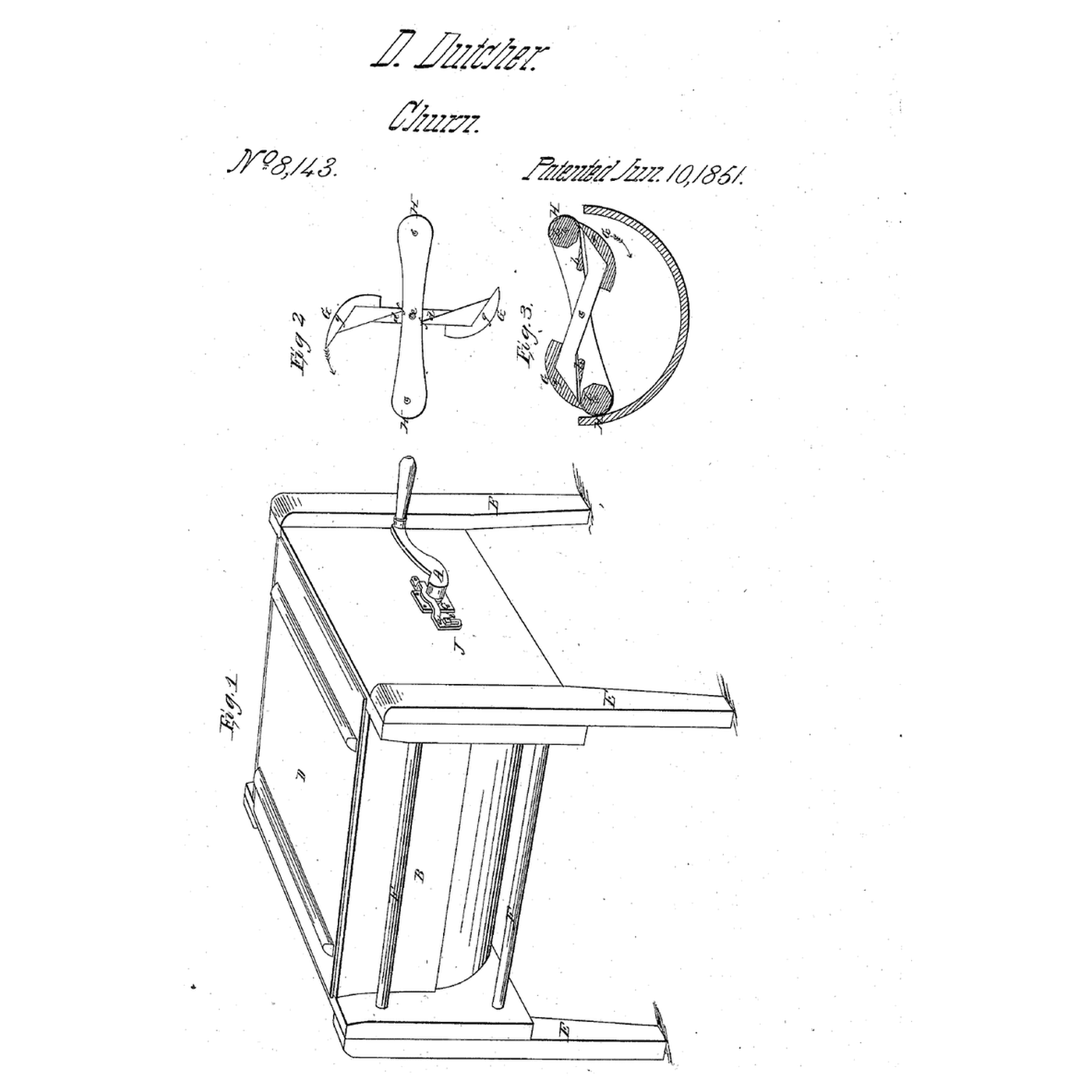
Roller-and-Float Gathering Churn: Floats That Fold Onto Rollers to Press the Butter
par Woody
Menuiserie
8
0
0
0
0
0
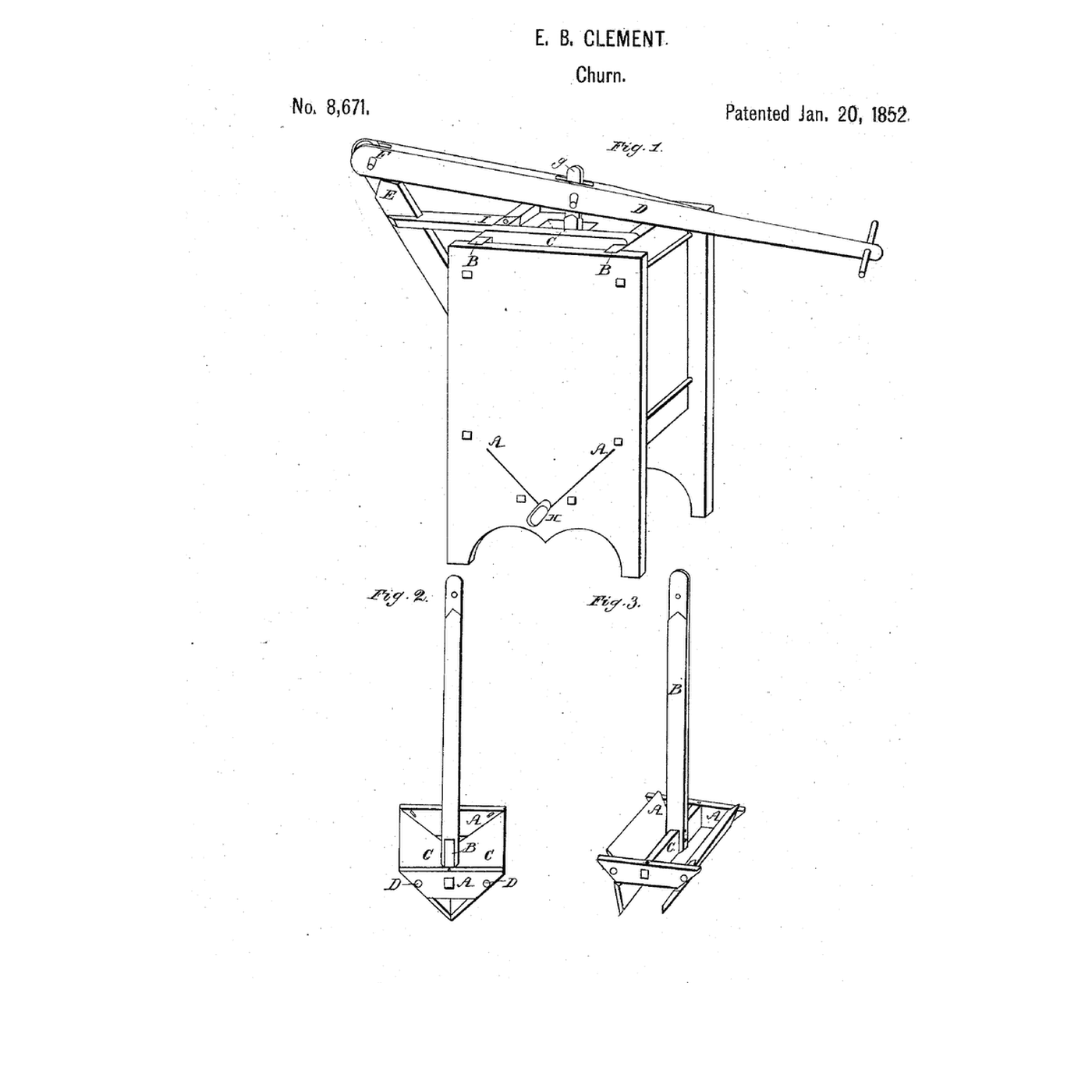
Folding-Float V-Bottom Churn: Floats That Close Into a V on the Down-Stroke
par Woody
Menuiserie
8
0
0
0
0
0
Post-and-Float Butter-Working Churn: Floats Revolving Astride Fixed Posts
par Woody
Menuiserie
4
0
0
0
0
0
CC0 Domaine public
Ce blueprint est publié sous CC0. Vous êtes libre de copier, modifier, distribuer et utiliser ce travail pour tout usage, sans demander la permission.
Soutenez le Maker en achetant des produits via son Blueprint où il perçoit une Commission Maker définie par les Vendeurs, ou créez une nouvelle itération de ce Blueprint et incluez-le comme connexion dans votre propre Blueprint pour partager les revenus.