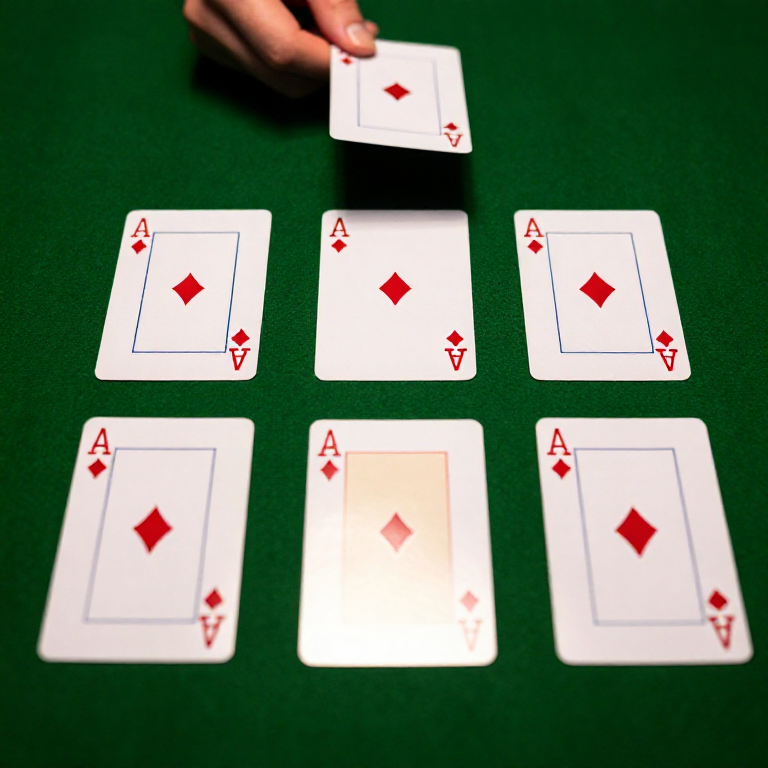


Self-Working Card Trick
Most card tricks need sleight of hand. This one needs none at all — it works because of arithmetic, and it works every single time no matter who shuffles or which card they pick. Magicians call these self-working, and they are the honest end of the craft: the deception is a theorem.
The principle here is the twenty-one card trick, and the mathematics is a ternary search. Twenty-one cards dealt into three piles; the spectator says which pile holds their card; that pile goes in the middle and you deal again. Each round divides the possibilities by three, so after three rounds 21 becomes 7 becomes 3 becomes 1. The card ends up in a fixed position — always the eleventh.
Build the cards, run it, then work out on paper why the middle position is the one that does it. That second part is the real project.
Consignes
Cut 21 blank cards
Cut 21 blank cards
Cut 21 rectangles of card, 88 x 63 mm. Cut them in a stack so they are identical — cards of slightly different sizes can be tracked by touch, and that would spoil a trick that needs no skill.
Matériaux pour cette étape :
 Papier cartonné2 feuilles
Outils nécessaires :
 Cutter de précision
 Règle
RègleRound the corners
Round the corners
Round all four corners of each card. Square corners catch on each other and make dealing uneven, and they wear into a giveaway pattern.
Mark the faces distinctly
Mark the faces distinctly
Draw a different simple symbol on each face. They must be easy for a spectator to remember and easy for you to see at a glance across a table.
Matériaux pour cette étape :
 Coffret de pigments de terre en poudre1 jeu
Keep the backs identical
Keep the backs identical
Leave the backs completely plain, or mark them all the same. Any variation between backs would let you cheat, and the point of this trick is that you cannot.
Let the spectator shuffle
Let the spectator shuffle
Hand over all 21 cards and let them shuffle as much as they like. The starting order does not matter at all — say so out loud, because it is true and it is the most convincing thing about the trick.
Deal three piles of seven, across not down
Deal three piles of seven, across not down
Deal one card to pile one, one to pile two, one to pile three, and repeat. Deal across, never seven at a time into one pile — dealing across is what interleaves the positions and makes the arithmetic work.
Ask which pile holds their card
Ask which pile holds their card
Have them note their card and tell you only which pile it is in. That single answer eliminates fourteen of the twenty-one possibilities.
Gather with their pile in the middle
Gather with their pile in the middle
Stack the three piles with the named pile between the other two. The middle is not arbitrary — it is the position that centres their seven candidates in the deck.
Repeat exactly twice more
Repeat exactly twice more
Deal across into three piles again, ask again, gather with their pile in the middle again. Do it a third time. Change nothing — the procedure is the mechanism.
Count to the eleventh card
Count to the eleventh card
Deal off ten cards and turn over the eleventh. It is theirs. The eleventh is the exact middle of twenty-one, which is where three rounds of centring must leave it.
Track the possibilities on paper
Track the possibilities on paper
Write down how many cards could still be theirs after each round: 21, then 7, then 3, then 1. Each round divides by three because you offered three piles and got one answer.
Prove the middle is necessary
Prove the middle is necessary
Now run it putting their pile on top instead of in the middle, and see where the card ends up. It no longer lands in a fixed place. That failure is the proof that centring is doing the work.
History & Context
History & Context
Self-working means what it says. A self-working trick has no sleight of hand, no palming, no forced card. The performer follows a procedure and the mathematics guarantees the outcome. Anyone can perform one immediately, which is why they are the standard entry point into card magic — and why some magicians are slightly sniffy about them.
It is a ternary search. Each round you pose one question with three possible answers and the candidate set shrinks by a factor of three: 21 → 7 → 3 → 1. Three questions therefore suffice for up to 27 cards, and 21 is chosen because it divides evenly into three piles of seven. This is the same logic as binary search, with three branches instead of two, and it is the reason the trick needs exactly three deals and not four.
Why the middle. Placing the chosen pile between the other two puts the seven candidates in positions 8 to 14 of the 21. Deal across again and those seven distribute so that the next round narrows to positions clustering on the centre. Repeat and the candidate set converges on position 11 — the median. Put the pile on top instead and the candidates converge somewhere that depends on which pile was named, so there is no fixed reveal. Step 12 is worth doing, because seeing it fail is more convincing than being told.
Information, counted. Each answer carries log₂3 ≈ 1.58 bits, and identifying one card in 21 needs log₂21 ≈ 4.39 bits. Three answers give about 4.75 bits — just enough. The trick is not merely correct, it is close to information-theoretically efficient, which is a rather elegant thing for a parlour amusement to be.
Old, and widely reinvented. Pile-dealing location principles appear in recreational mathematics collections for centuries and turn up in many variants — different pile counts, different deck sizes, different reveal positions. Like the buzzer and the spinning top, this is a thing people keep rediscovering, because the underlying arithmetic is available to anyone who plays with three heaps of cards for long enough.
Matériaux
2- 2 feuillesEspace réservé
- Espace réservé
CC0 Domaine public
Ce blueprint est publié sous CC0. Vous êtes libre de copier, modifier, distribuer et utiliser ce travail pour tout usage, sans demander la permission.
Soutenez le Maker en achetant des produits via son Blueprint où il perçoit une Commission Maker définie par les Vendeurs, ou créez une nouvelle itération de ce Blueprint et incluez-le comme connexion dans votre propre Blueprint pour partager les revenus.