
ART
BEAUTÉ ET BIEN-ÊTRE
ARTISANAT
CULTURE ET HISTOIRE
DIVERTISSEMENT
ENVIRONNEMENT
NOURRITURE ET BOISSONS
INGÉNIERIE INVERSE
SCIENCES
SPORTS
TECHNOLOGIE
TECHNOLOGIE PORTABLE
The Separating Funnel and the Partition Coefficient
Charlie

Créé par

Charlie

23. septembre 2026DE
33
0
0
0
0

The Separating Funnel and the Partition Coefficient

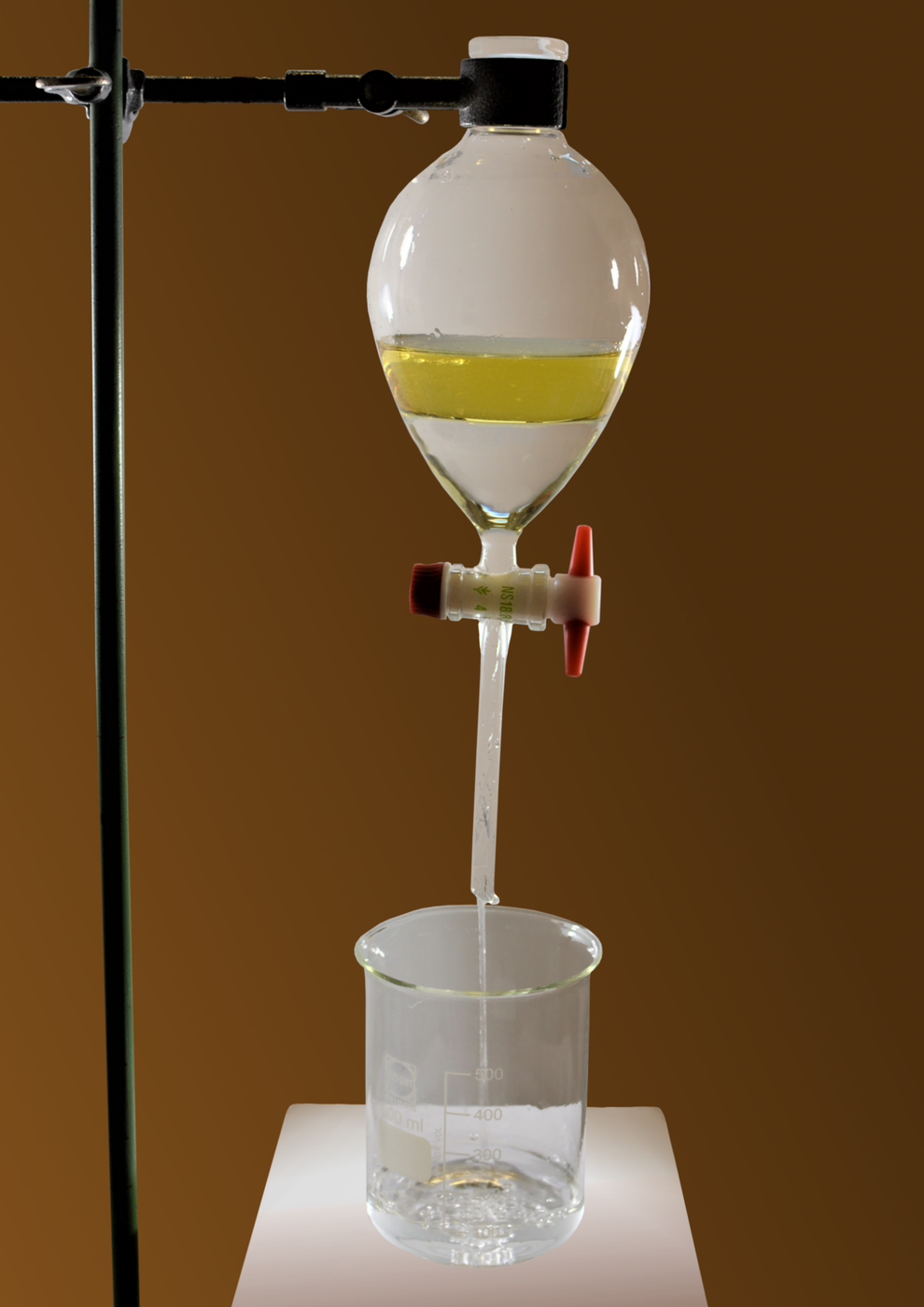
Distillation separates by boiling point, and pays the latent heat to do it. This rung separates by something cheaper: by what a substance PREFERS. Shake a mixture with two liquids that will not mix, let them settle, and every dissolved substance distributes itself between the two layers in a fixed ratio — its partition coefficient. Nernst wrote the law down in 1891. It sounds modest, and it is the single idea underneath every rung that follows in this batch: a chromatography column is nothing but this same partition repeated a few thousand times in a row, with one of the two phases held still and the other flowing past. Build it first with your hands and a funnel, where you can watch the colour move from one layer to the other, and every later rung stops being magic.
Débutant
3 hours

Consignes

1

Find two liquids that refuse to mix

Pour water into a jar, add an equal depth of cooking oil, shake, and set it down. Within a minute you have two clean layers with a sharp line between them. They separate because water molecules attract each other far more strongly than they attract oil, so mixing costs energy the system will not pay. That line is the interface, and everything in this blueprint happens across it. Note which layer sits on top: here the oil, because it is less dense. You will need to know which tap-end to drain, and getting it wrong is how a first attempt is lost.

Outils nécessaires :

Bocal en verreBocal en verre
2

Charge the funnel — and never fill it more than two-thirds

Close the tap. Pour in your water layer, then your solvent layer, filling no more than two-thirds. Stopper it. The empty third is not caution, it is what lets you shake. A full funnel cannot mix and will spit past the stopper the moment you invert it. Check the tap is actually shut before anything goes in — this is the mistake everyone makes once, and the floor tells you immediately.

Matériaux pour cette étape :

Éthanol de laboratoire, 95 %Éthanol de laboratoire, 95 %50 ml

Outils nécessaires :

Ampoule à décanterAmpoule à décanter

Bécher en borosilicateBécher en borosilicate
3

Shake, and VENT

Hold the stopper down with one hand and the tap with the other. Invert, shake gently once, then — still inverted, tap pointing away from you and everyone else — OPEN THE TAP to vent. You will often hear it hiss. Volatile solvents build pressure the instant they are shaken, and a funnel that is not vented fires its stopper across the room. Vent after every few shakes, never point the tap at a face, and shake gently: a violent shake makes an emulsion, a milky layer that refuses to settle and can cost you the whole run.

Outils nécessaires :

Ampoule à décanterAmpoule à décanter
Lunettes-masque de sécuritéLunettes-masque de sécurité
Gants en nitrileGants en nitrile
4

Let it settle, then drain the bottom layer only

Stand the funnel in a ring, remove the stopper — it will not drain with the stopper in — and let the interface sharpen. Open the tap and run the LOWER layer out into a beaker, closing it the instant the interface reaches the tap. Then pour the upper layer out of the TOP, not through the tap. Draining it past the residue in the stem is how the two layers get remixed at the last moment, and it is the commonest way a clean separation is thrown away.

Outils nécessaires :

Ampoule à décanterAmpoule à décanter
Bécher en borosilicateBécher en borosilicate
5

Watch a dye choose a side

Now make it visible. Add a drop of a water-soluble food colour to a water/solvent pair and shake: the colour stays in the water. Repeat with a plant dye extracted in alcohol and it will move the other way. Nothing has reacted. The molecule has simply found the phase it is more comfortable in, and the ratio it settles at is a property of that molecule, not of how hard you shook. That reproducible ratio is what makes separation a measurement rather than a knack.

Matériaux pour cette étape :

Colorant alimentaireColorant alimentaire1 bouteille

Outils nécessaires :

Ampoule à décanterAmpoule à décanter
Pipette graduée (de Mohr)Pipette graduée (de Mohr)
6

Extract three times with a third of the solvent

Split your solvent into three equal portions and extract three times in a row, combining the three extracts, rather than extracting once with all of it. This is the whole trick, and the notebook proves why. Every extraction leaves a fraction behind; doing it three times leaves a fraction of a fraction of a fraction. The difference is not small, and it is the reason a chromatography column — which is thousands of tiny extractions in series — separates things a single shake never could.

Matériaux pour cette étape :

Éthanol de laboratoire, 95 %Éthanol de laboratoire, 95 %60 ml

Outils nécessaires :

Ampoule à décanterAmpoule à décanter
Bécher en borosilicateBécher en borosilicate
Pipette graduée (de Mohr)Pipette graduée (de Mohr)
7

How much is left behind

Chargement du notebook Jupyter…

Outils nécessaires :

Balance numériqueBalance numérique
8

Break an emulsion when you make one

Sooner or later a shake gives you a milky middle layer that will not clear. Do not shake it more. Three things work, in order of how little they cost you: wait, because many emulsions settle in twenty minutes; add a spoonful of salt to the water layer, which raises its ionic strength and squeezes the organic phase out; or swirl gently rather than shaking on the next attempt. An emulsion is not a mistake in your technique so much as a sign the two phases are closer in character than you assumed — which is itself information about your solvent choice.

Outils nécessaires :

Ampoule à décanterAmpoule à décanter

Matériaux

2

Outils requis

7

CC0 Domaine public

Ce blueprint est publié sous CC0. Vous êtes libre de copier, modifier, distribuer et utiliser ce travail pour tout usage, sans demander la permission.

Soutenez le Maker en achetant des produits via son Blueprint où il perçoit une Commission Maker définie par les Vendeurs, ou créez une nouvelle itération de ce Blueprint et incluez-le comme connexion dans votre propre Blueprint pour partager les revenus.

Commentaires

(0)

Se connecter pour participer à la discussion

Chargement des commentaires...