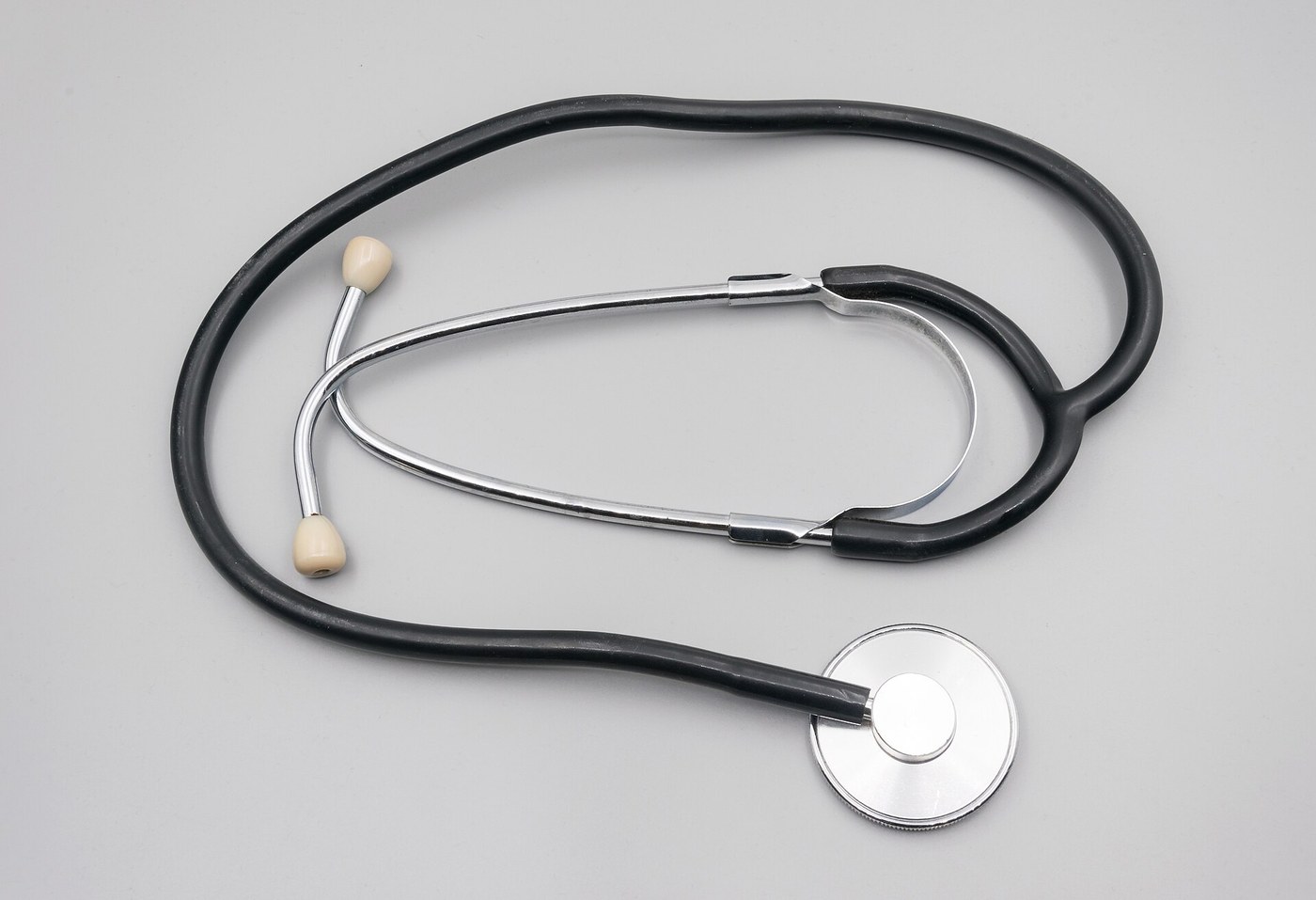


The Stethoscope
A working heart and a breathing lung are loud. The problem is that the sound has to cross from soft wet tissue into air, and almost none of it survives the journey — most is reflected back at the boundary. By the time it reaches a listener standing beside the bed, there is effectively nothing left.
Pressing an ear directly to the chest works, and was the standard method. It is also awkward, unhygienic, and in the early nineteenth century socially impossible with many patients — which is exactly the constraint that produced the instrument.
A stethoscope solves the physics by confining the sound instead of amplifying it. Nothing in it adds energy. A tube stops the sound spreading out in all directions and losing intensity with distance, and delivers what the chest wall gives up straight to the ear.
The modern chestpiece adds a second idea: two surfaces for two jobs. The stiff diaphragm only responds to faster vibrations, so it favours high-pitched sounds — breath, normal heart sounds. The open bell, pressed lightly, lets the skin itself act as a slack membrane and passes low-pitched sounds a stiff diaphragm would reject.
Press the bell hard and you stretch the skin tight, turning it into a diaphragm. The same instrument becomes a different filter depending on how hard you push it — which is a mechanical high-pass control with no parts.
Consignes
Find out how much sound the air steals
Find out how much sound the air steals
Have a partner hold a ticking watch or tap a finger steadily against their own forearm. Listen from 30 cm away, then press your ear directly against the arm.
Record the difference.
Expect direct contact to be dramatically louder.
Two things are happening. Sound spreads out and weakens with distance, and most of it never leaves the body at all — it reflects at the tissue-air boundary because tissue and air carry sound so differently. Contact bypasses that boundary.
Build the simplest possible instrument
Build the simplest possible instrument
Roll a tube of stiff paper or take a length of hose. Put one end on a partner's chest, the other to your ear.
Listen for the heart.
Expect it to be clearly audible — this is Laennec's original instrument, which was a rolled paper cylinder and then a turned wooden tube.
Note what you have not done: nothing amplifies. You have only stopped the sound escaping sideways, and confining it was enough.
Matériaux pour cette étape :
 Tube en silicone1 m
Test what the tube itself does to the sound
Test what the tube itself does to the sound
Compare tubes: long against short, wide against narrow, floppy against stiff-walled.
Listen to the same heartbeat through each and rank them.
Expect short, fairly narrow and stiff-walled to win.
A long tube loses sound to friction and to flexing walls; a very wide one lets it spread again; a floppy wall absorbs energy into itself instead of passing it along.
This is why clinical stethoscope tubing is thick-walled and surprisingly short — every extra centimetre costs signal, and there is none to spare.
Add a diaphragm and hear the balance shift
Add a diaphragm and hear the balance shift
Stretch a taut membrane — balloon rubber or thin plastic — over a small funnel and fit it to your tube. Compare against the same funnel with no membrane.
Listen to breath sounds and to the heart with both.
Expect the taut diaphragm to make breath sounds crisper and to make low rumbles fainter.
A stretched membrane is stiff, and a stiff thing follows fast vibrations and ignores slow ones. You have built a mechanical high-pass filter out of a piece of rubber.
Matériaux pour cette étape :
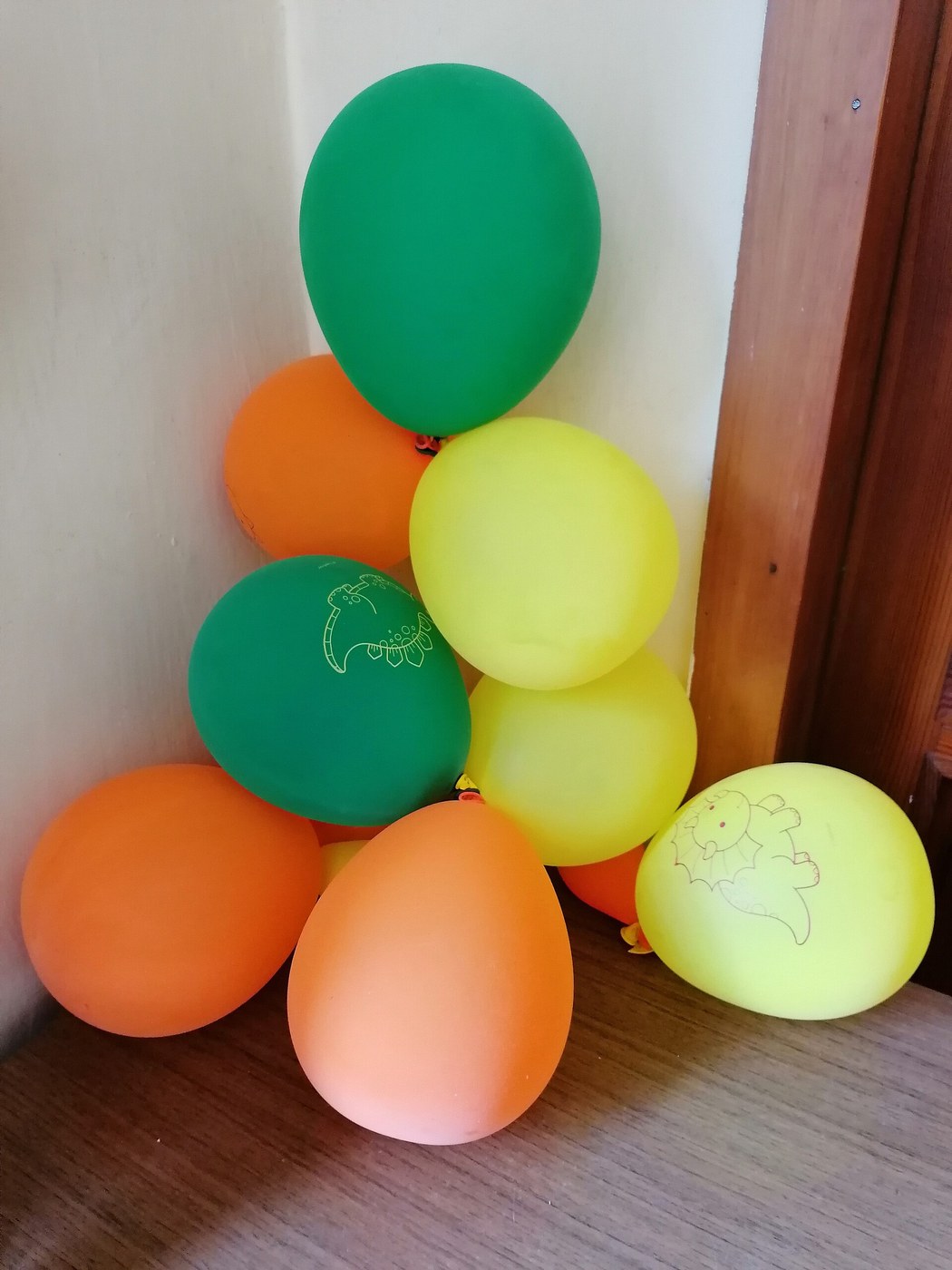 Ballons de baudruche1 paquet
Use pressure as the tuning control
Use pressure as the tuning control
Use the open funnel with no membrane. Rest it on the chest with the lightest possible contact and listen, then press it firmly and listen again.
Expect light contact to pass more low-frequency sound, and firm pressure to thin it out.
Pressing stretches the skin under the rim, and taut skin behaves exactly like the diaphragm from step 4.
So the bell is not simply "the other side". It is a continuously adjustable filter, and the adjustment is your hand. Clinicians use this deliberately, and it is invisible in any photograph of the instrument.
History & Context
History & Context
It was invented out of embarrassment. René Laennec, in Paris, faced a young woman whose heart he needed to examine and for whom direct ear-to-chest listening was not acceptable. He recalled that a solid beam carries a scratch from one end to the other, rolled a sheaf of paper into a cylinder, and found the heart sounds clearer than he had ever heard them. He then spent years learning what the sounds meant and wrote the book that founded the discipline.
The instrument was the easy half. A tube is trivial; knowing that this crackle means fluid and that murmur means a leaking valve required correlating what he heard in life with what he found afterwards at autopsy. He built the vocabulary — rales, rhonchi, egophony — that is still in use. A sensor is worthless without a trained interpretation, and the interpretation took far longer to make than the object.
It changed the relationship as much as the diagnosis. Before it, diagnosis rested largely on what the patient reported. Afterwards, the physician had access to something the patient could not perceive at all. That is the beginning of instrumental medicine — and of the modern imbalance in which the machine knows something about you that you cannot check.
Same physics, different fields. Confining sound to preserve it is the speaking tube on a ship, the engineer's screwdriver held to a bearing housing to hear a fault, the mechanic's stethoscope on an engine block, and the doctor's on a chest. All of them are refusing to let a weak vibration spread out and die.
Honest limits. It adds nothing — a quiet sound stays quiet, and a noisy room defeats it entirely. It samples one small patch at a time, so what you find depends on where you put it. Interpretation varies between listeners in ways that are measurable and uncomfortable. And it tells you about sound only: ultrasound and echocardiography now show the moving valve directly, which is why the stethoscope's role has narrowed to fast, cheap, bedside screening — still the first instrument reached for, two centuries on.
Matériaux
2- Espace réservé
- 1 paquetEspace réservé
CC0 Domaine public
Ce blueprint est publié sous CC0. Vous êtes libre de copier, modifier, distribuer et utiliser ce travail pour tout usage, sans demander la permission.
Soutenez le Maker en achetant des produits via son Blueprint où il perçoit une Commission Maker définie par les Vendeurs, ou créez une nouvelle itération de ce Blueprint et incluez-le comme connexion dans votre propre Blueprint pour partager les revenus.