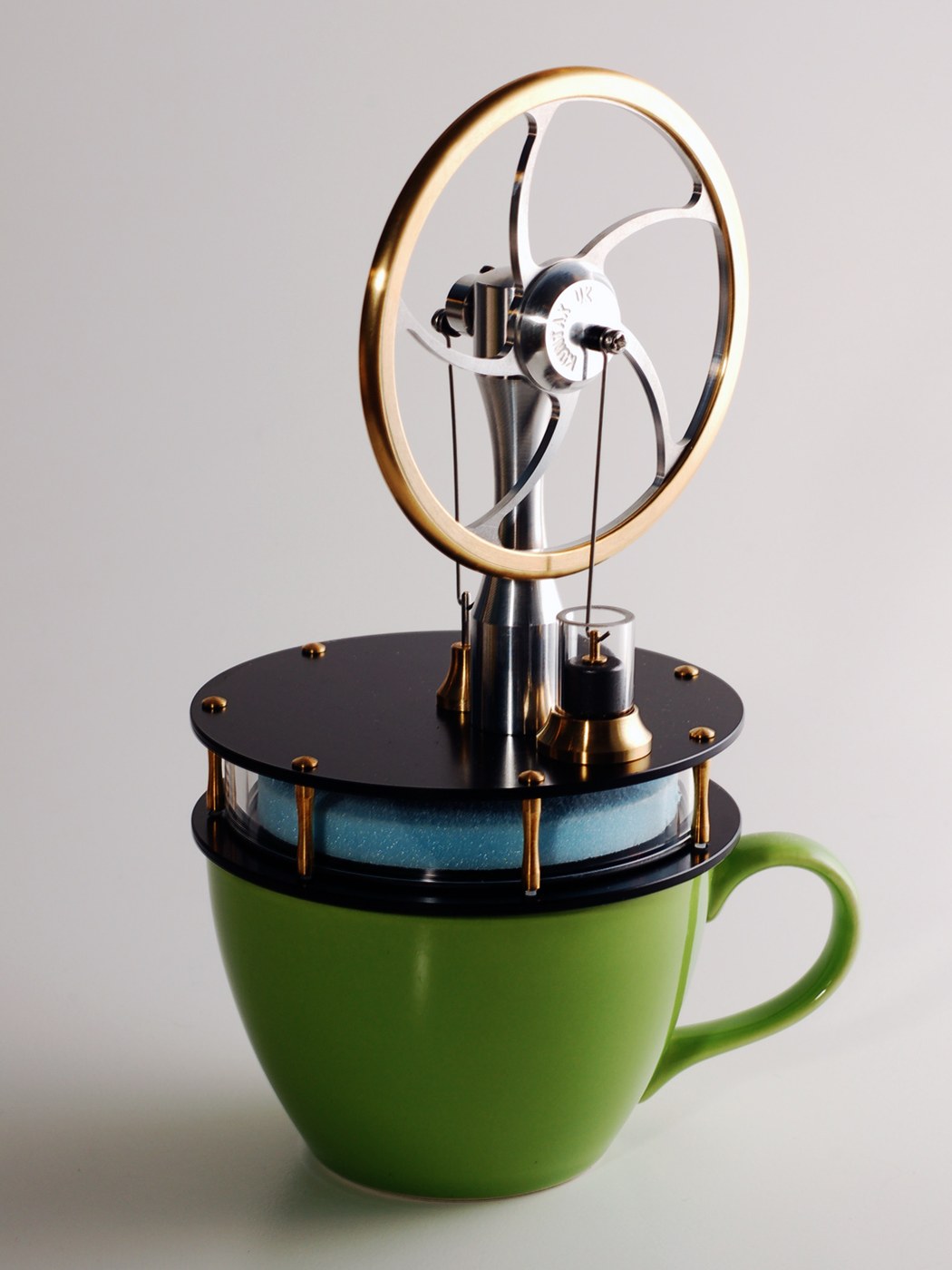


Stirling Engine
Consignes
Show that heating air does work
Show that heating air does work
Start with the whole principle in one crude demonstration.
- Stretch a balloon over the mouth of a rigid container.
- Warm the container gently — the balloon inflates.
- Cool it and the balloon collapses.
Matériaux pour cette étape :
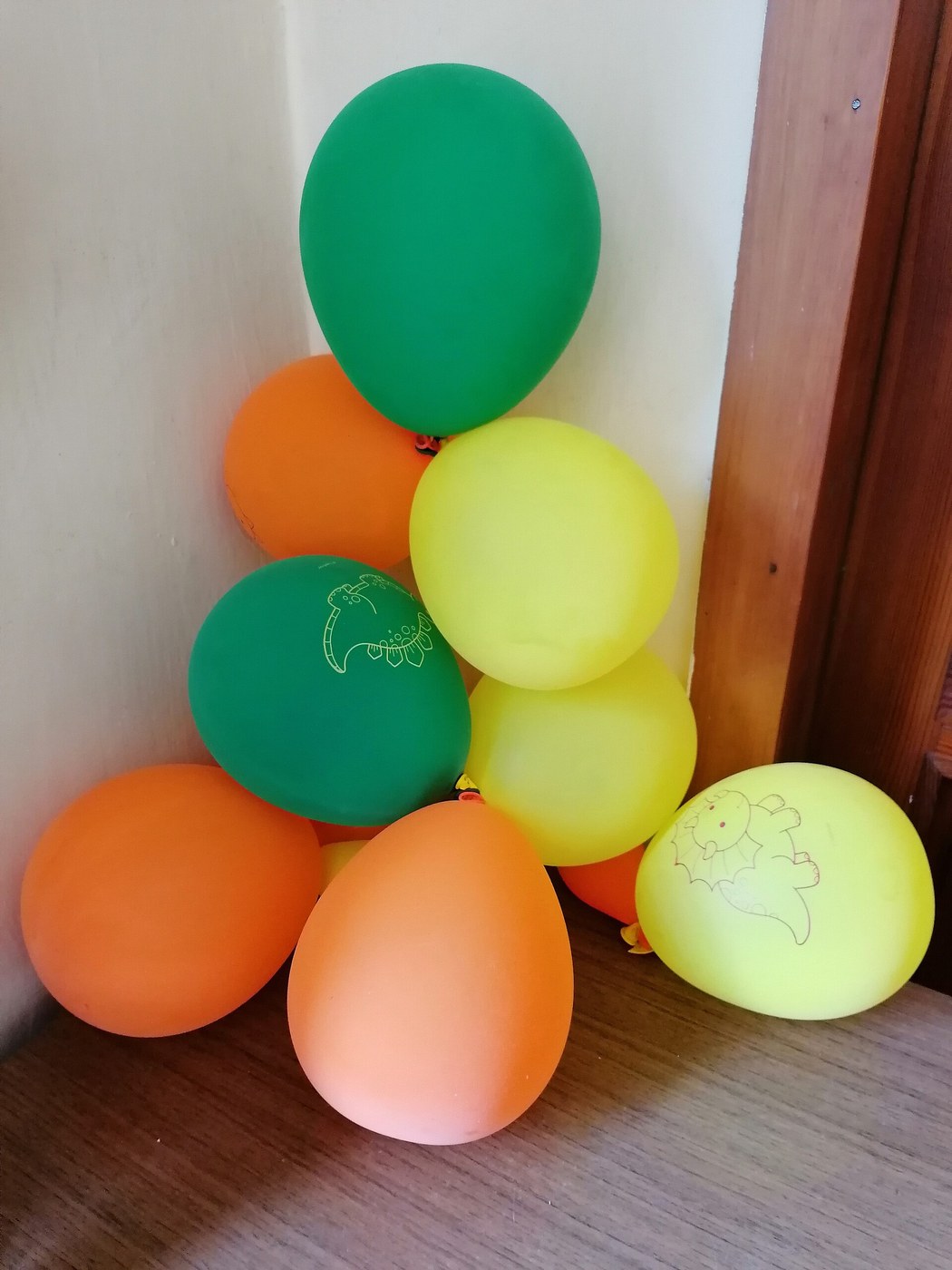 Ballons de baudruche1 paquet
 Thermomètre à lecture instantanée1 pièce
Build the displacer
Build the displacer
The displacer does not seal and does not push anything — it just moves gas about.
- Make a loose plug of steel wool that slides freely inside the body with generous clearance.
- Attach it to a rod that passes out through a sealed but low-friction guide.
- Heat one end of the body and keep the other cool.
Matériaux pour cette étape :
 Laine d'acier1 pad
Add the power piston and the 90-degree phasing
Add the power piston and the 90-degree phasing
A second, sealed piston takes the work out — and its timing is everything.
- Fit a light diaphragm or close-fitting piston connected to the crankshaft.
- Connect the displacer to the same crank, but 90 degrees out of phase.
- Spin the flywheel to start it.
Matériaux pour cette étape :
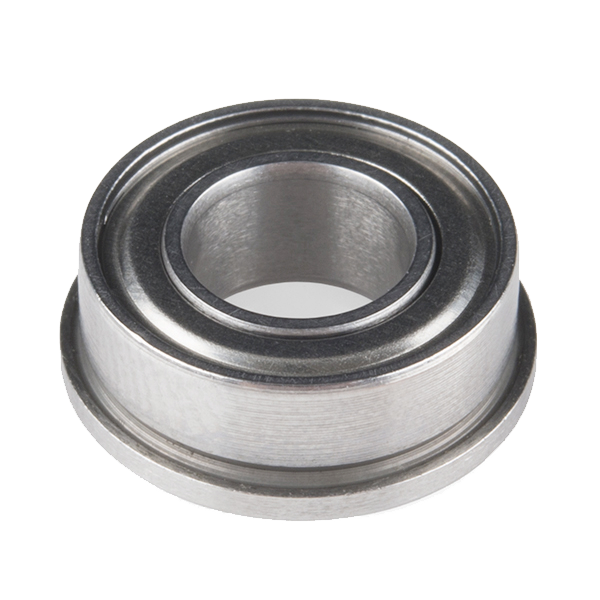 Ball Bearing - Flanged (6,35 mm Bore, 1,27 cm OD)2 pièces
 Barre de laiton1 length
Measure what the temperature difference buys
Measure what the temperature difference buys
The engine's ceiling is set by thermodynamics, not by workmanship.
- Measure hot end and cold end temperatures in kelvin.
- Carnot limit = 1 − (T_cold / T_hot).
- Now increase the cooling — ice on the cold end — and watch the speed rise.
Matériaux pour cette étape :
 Chronomètre1 pièce
History and context
History and context
Robert Stirling (1790-1878) was a minister in the Church of Scotland who patented his Economiser and its engine in 1816, aged 26. Boiler explosions were a genuine and frequent cause of death, and a closed-cycle hot-air engine cannot explode in the same way. He and his brother James built working engines that pumped water at a quarry.
The regenerator is the patented idea and the important one. As gas passes from the hot side to the cold side it gives up heat to a mesh; on the return trip it takes that heat back. Without it, that heat is dumped to the cooler every cycle and must be resupplied by the burner. It is one of the earliest clear engineering uses of heat recovery, and the same concept runs modern regenerative burners and heat exchangers.
Why it lost. Stirlings are quiet, safe, multi-fuel and efficient in principle — and they have poor power-to-weight, respond slowly to load changes, and need good heat exchangers on both ends. Internal combustion beat them on all the properties a vehicle cares about. The engine that was safer lost to the engine that was lighter.
Where it still wins: submarine air-independent propulsion, cryocoolers run in reverse to reach very low temperatures, spacecraft radioisotope generators, and solar dish systems — every case where quiet operation, sealed working gas or arbitrary heat source matters more than power density. Low-temperature-difference models will run on the warmth of a hand, which is the clearest demonstration of what the cycle actually needs.
Matériaux
6- 1 paquetEspace réservé
- Espace réservé
- 1 padEspace réservé
- Ball Bearing - Flanged (6,35 mm Bore, 1,27 cm OD)10 % de commission2 pièces€2.17
- 1 lengthEspace réservé
- 1 pièceEspace réservé
Blueprints liés
Ces blueprints partagent des connaissances — techniques, matériaux ou principes
CC0 Domaine public
Ce blueprint est publié sous CC0. Vous êtes libre de copier, modifier, distribuer et utiliser ce travail pour tout usage, sans demander la permission.
Soutenez le Maker en achetant des produits via son Blueprint où il perçoit une Commission Maker définie par les Vendeurs, ou créez une nouvelle itération de ce Blueprint et incluez-le comme connexion dans votre propre Blueprint pour partager les revenus.