ART
BEAUTÉ ET BIEN-ÊTRE
ARTISANAT
CULTURE ET HISTOIRE
DIVERTISSEMENT
ENVIRONNEMENT
NOURRITURE ET BOISSONS
INGÉNIERIE INVERSE
SCIENCES
SPORTS
TECHNOLOGIE
TECHNOLOGIE PORTABLE
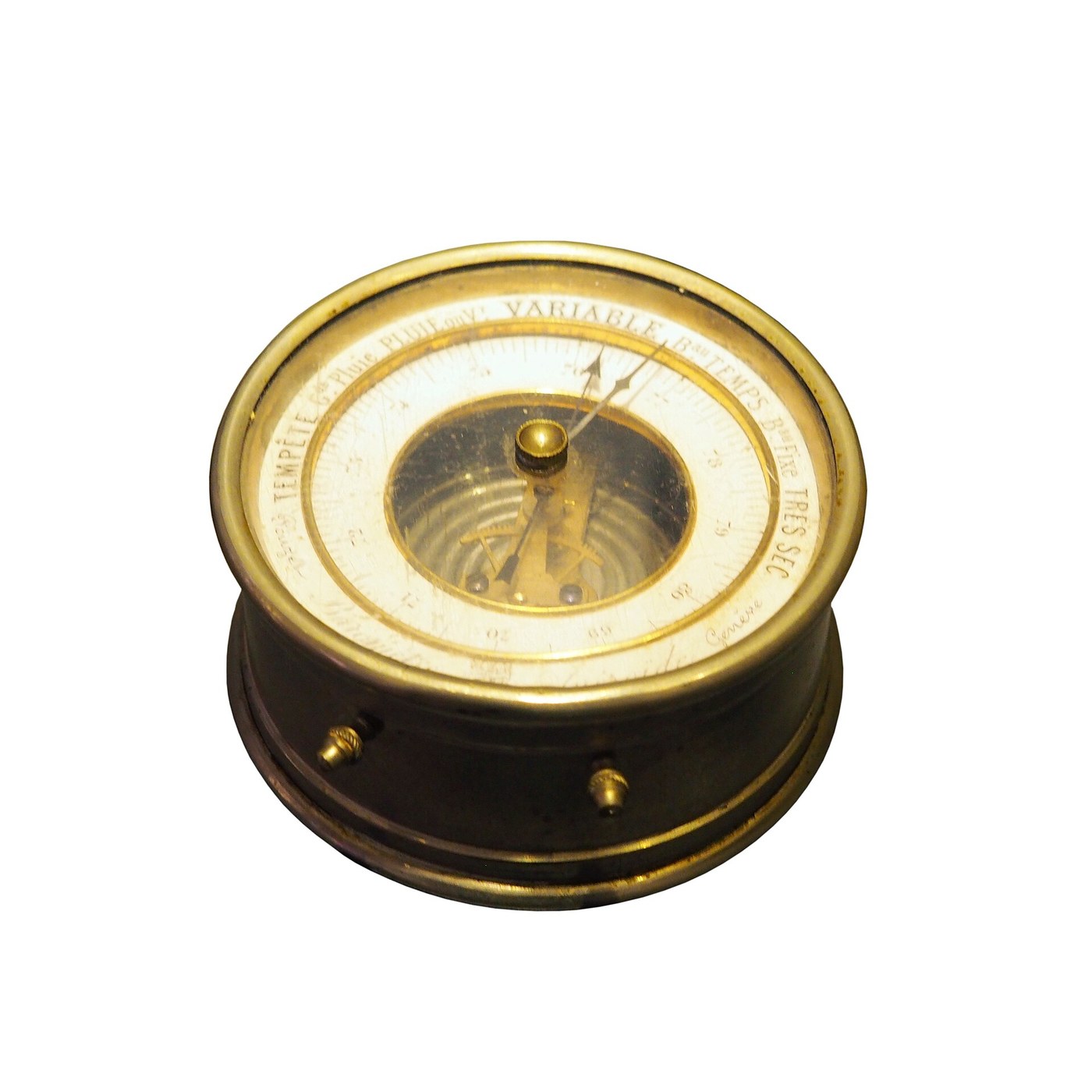


The Aneroid Barometer
Torricelli's barometer, already published here, is a metre of glass and a pool of mercury. It is accurate, it is the standard everything else is calibrated against, and you cannot carry it up a hill or hang it in a hallway.
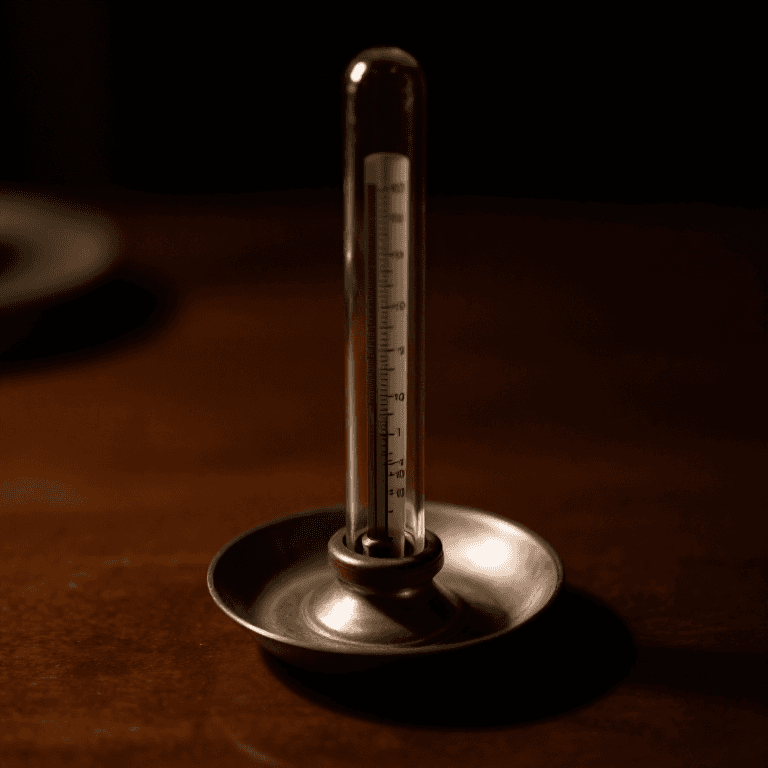
Lucien Vidi's aneroid of 1844 replaced the mercury with a sealed metal capsule from which most of the air has been pumped out. Atmospheric pressure squeezes it; a spring resists; the tiny movement — a few hundredths of a millimetre — is multiplied several hundred times by a train of levers and a chain wrapped round the needle's spindle.
*Aneroid* means 'without liquid', and the whole instrument is a study in amplifying a movement too small to see. The pressure itself is less interesting than its CHANGE, which is the single most useful forecasting signal an amateur station can produce.
Intermédiaire
4 hours
Consignes
1
1
Understand the amplification chain
Understand the amplification chain
Open a scrap instrument and trace the movement: capsule, a stiff leaf spring, a first lever, a second lever, then a fine chain that turns the needle spindle against a hairspring.
Each stage multiplies. It also multiplies FRICTION and backlash, which is why an aneroid is tapped before reading — the tap frees a needle that is sitting wherever friction last left it. That habit is not superstition, it is a compensation for the very design that makes the instrument possible.
Matériaux pour cette étape :
 Baromètre anéroïde1 pièce
2
2
Set it against a known pressure, not against the weather
Set it against a known pressure, not against the weather
Get the current sea-level pressure from an official station nearby, and set your instrument to that with the adjusting screw on the back.
Never set it to what you think the weather 'should' be, and never set it to an average of the dial. If you can, set it against a mercury barometer or a calibrated digital sensor at the same moment. Re-check every few months: the capsule's spring creeps slowly for years after manufacture, so the zero drifts.
3
3
Correct for your altitude, or compare nothing
Correct for your altitude, or compare nothing
Pressure falls about one hectopascal for every 8.5 metres of height. A station 100 metres up reads about 12 hPa lower than the same weather at the coast.
So every published pressure is reduced to sea level, and yours must be too before it can be compared with anything. Measure your altitude once, work out the correction, write it on the instrument and apply it always. A station reporting its own raw pressure is reporting its own hill.
4
4
Record the TENDENCY, not just the reading
Record the TENDENCY, not just the reading
Read at fixed times and write down the change over the last three hours, with its sign. That three-hour tendency is a standard meteorological quantity, and it is worth more than the absolute value.
A steady 1005 hPa is unremarkable weather. A fall from 1015 to 1005 in three hours is a storm arriving. The moving needle is the forecast; the number it points at is mostly a statement about how high your house is.
5
5
Pressure, height and how fast it is falling
Pressure, height and how fast it is falling
Chargement du notebook Jupyter…
6
6
Hang it somewhere the temperature is steady
Hang it somewhere the temperature is steady
Mount it indoors on an interior wall, away from direct sun, draughts, radiators and doors that slam.
The capsule and its spring both change stiffness with temperature, and although good instruments are compensated with a bimetal link, cheap ones are not. It does not need to be outdoors: pressure is the same inside and out, which is the one convenience this instrument offers over every other in the batch.
Matériaux pour cette étape :
 Clous galvanisés4 pièces
Outils nécessaires :
 Marteau à panne fendue
Matériaux
2- 1 pièceEspace réservé
- 4 piècesEspace réservé
Outils requis
1- Espace réservé
Blueprints liés
Ces blueprints partagent des connaissances — techniques, matériaux ou principes

CC0 Domaine public
Ce blueprint est publié sous CC0. Vous êtes libre de copier, modifier, distribuer et utiliser ce travail pour tout usage, sans demander la permission.
Soutenez le Maker en achetant des produits via son Blueprint où il perçoit une Commission Maker définie par les Vendeurs, ou créez une nouvelle itération de ce Blueprint et incluez-le comme connexion dans votre propre Blueprint pour partager les revenus.