ART
BEAUTÉ ET BIEN-ÊTRE
ARTISANAT
CULTURE ET HISTOIRE
DIVERTISSEMENT
ENVIRONNEMENT
NOURRITURE ET BOISSONS
INGÉNIERIE INVERSE
SCIENCES
SPORTS
TECHNOLOGIE
TECHNOLOGIE PORTABLE
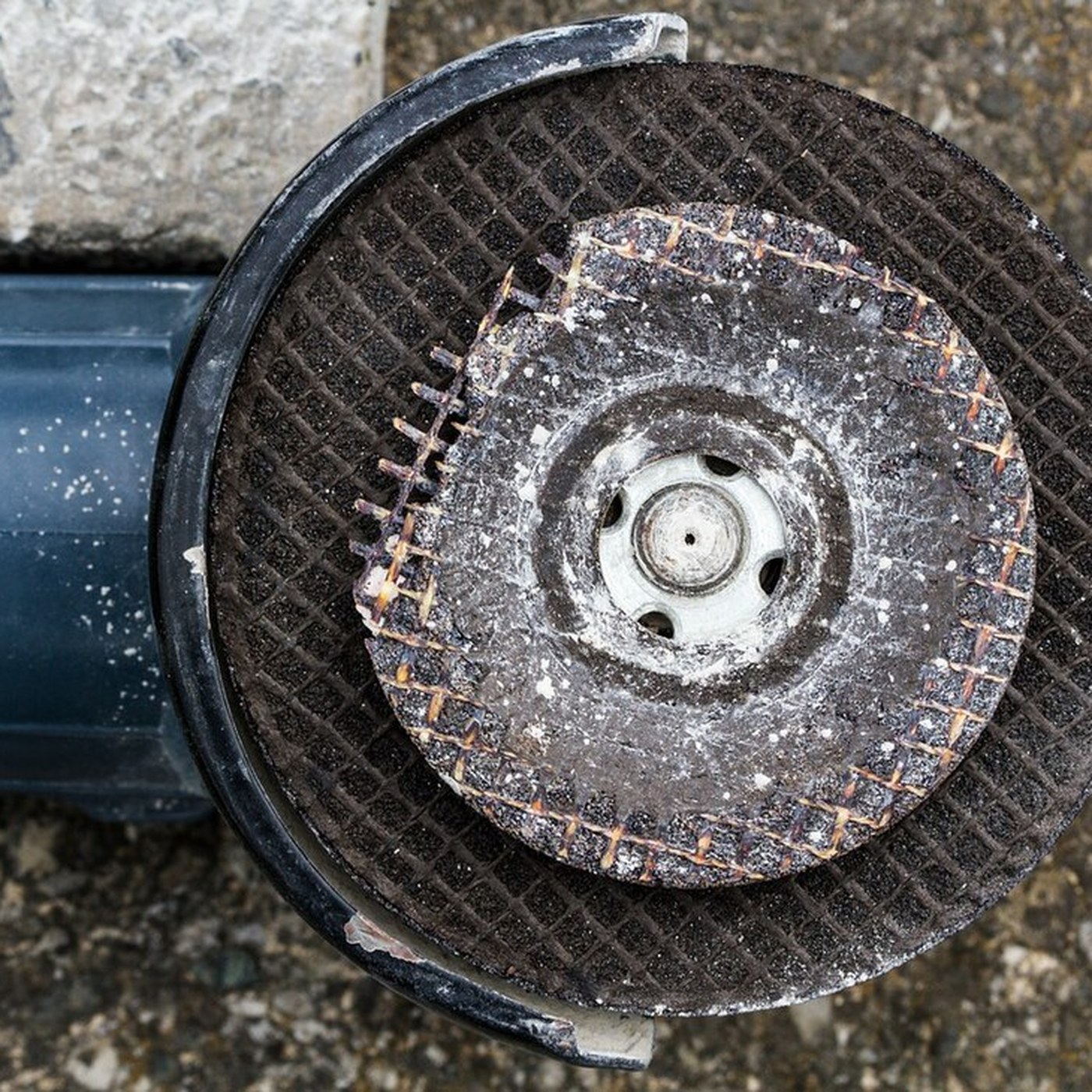


Turning the Corner: The Right-Angle Head
A bench grinder makes you bring the work to the wheel. For anything bolted down, welded up or too heavy to lift, that is the wrong way round.
The angle grinder turns the motor axis through ninety degrees with a pair of bevel gears, so an abrasive wheel can be held flat against work that is not going anywhere. It is the most generally useful metalworking tool a small shop owns, and the one that injures the most people.
Three things make it survivable and all three are geometry: the guard's position, the wheel's rated speed, and which part of the wheel you present to the work. This rung is about those three.
Intermédiaire
About 2 hours
Consignes
1
1
Read the wheel before you fit it
Read the wheel before you fit it
Every bonded abrasive wheel is printed with a maximum operating speed and a diameter. Find both on the wheel and find the no-load speed on the grinder's rating plate. Write the two numbers side by side.
**The wheel's rating must be equal to or higher than the tool's no-load speed.** Not close to it. Step 4 shows why: stress in the disc rises with the square of speed, so a modest overspeed is a large overstress on a part that gives no warning.
Then check the wheel itself. Cutting discs are thin and meant for the EDGE only; grinding discs are thick and meant for the face at a shallow angle; flap discs are layered and meant for the face flat. Using a cutting disc on its face is the classic way to shatter one, because it is not built to take a side load at all.
Ring-test a bonded wheel before fitting: hang it on a finger and tap the side gently with a screwdriver handle. A sound wheel rings. A cracked one thuds. This takes two seconds and it is the only inspection that finds an internal crack.
Check the expiry date. Resin-bonded wheels degrade and are dated for that reason.
Outils nécessaires :
 Meuleuse d'angle
 Meule abrasive
 Jeu de disques à lamelles
 Jeu de tournevis
 Pied à coulisse numérique 6 pouces
2
2
The bevel pair, and why the guard sits where it does
The bevel pair, and why the guard sits where it does
Inside the head is a pair of **bevel gears**. The motor pinion turns about the tool's long axis; the wheel spindle turns about an axis at ninety degrees to it. That is the whole reason the tool exists in this shape — a motor in line with your forearm, driving a wheel you can lay flat on a workpiece.
The pair also gears down. A universal motor runs far too fast to put straight onto a 125 mm wheel, so the bevel ratio brings it into the wheel's rated range. Turn the spindle by hand with the tool unplugged and count how far the motor fan turns for one turn of the spindle — that is your ratio, measured rather than assumed.
**The guard is not a cover, it is a direction.** A bursting wheel throws fragments tangentially, along the line the rim was travelling. The guard is positioned to intercept that line on the operator's side and is deliberately open toward the work. That is why rotating the guard to 'see better' is so dangerous: it does not reduce protection evenly, it removes it from exactly the sector the fragments will take.
Set the guard so the open side faces away from you, fit the side handle, and use it. The side handle is what gives you the leverage to hold the tool when a disc snatches.
Outils nécessaires :
Meuleuse d'angle Jeu de clés plates
 Jeu de clés Allen
3
3
Cut and grind a scrap, and find out which way it pulls
Cut and grind a scrap, and find out which way it pulls
Clamp a piece of steel plate in the vise, well supported, with the cut line clear of the jaws. Full face shield or goggles, gloves, hearing protection, sleeves down, nothing flammable within the spark stream — which is further than you think.
Let the tool reach full speed clear of the work, then bring the disc in. With a cutting disc, use the edge and keep the cut straight: any twist puts a side load on a disc that has no side strength, and that is how they shatter.
Feel which way the tool wants to travel. The wheel's rotation drags the tool along the work in one direction and pushes it away in the other. Work so that the tool is pushed against your grip rather than pulled out of it, and never let the disc climb out of a cut toward you.
Now grind with a flap disc at about 15 degrees to the surface and compare the finish with what a file leaves. The grinder removes metal an order of magnitude faster and leaves a coarser surface — it is a stock-removal tool, and the file rung remains the one that makes a surface true.
Let the disc stop on its own. Setting a running grinder down is how the tool takes off across the bench.
Matériaux pour cette étape :
 Plaque d'acier doux1 pièce
Outils nécessaires :
Meuleuse d'angleMeule abrasiveJeu de disques à lamelles Étau d'établi
 Lunettes de sécurité
 Protection auditive
 Gants de soudeur
 Masque anti-poussière
4
4
Why the speed rating is not advisory
Why the speed rating is not advisory
Chargement du notebook Jupyter…
Outils nécessaires :
Pied à coulisse numérique 6 pouces Tachymètre numérique
5
5
History and context
History and context
**Attribution, stated honestly.** The handheld angle grinder in its modern form is credited to **Ackermann + Schmitt** of Stuttgart — the firm behind the FLEX brand — in **1954**, and in German the tool is still often called a *Flex* after it. Earlier right-angle grinding machines existed; what 1954 is remembered for is the compact one-hand form that became standard. A specific patent number could not be verified from the sources reachable here, so none is asserted. The mechanism — a bevel pair turning the drive through ninety degrees onto a guarded abrasive wheel — is not in doubt.
The tool spread because it is indifferent to what it is cutting. A change of disc turns it from a cut-off saw into a grinder, a sander, a wire brush or a mortar rake, and none of those needs the work to move. For repair, demolition and fabrication that is close to unbeatable.
It also has one of the worst injury records of any hand tool, and the reasons are structural rather than careless: the wheel is brittle, it is fast, it is close to the hand, and it gives no warning before it fails. Nearly every later feature — anti-kickback clutches, no-volt release, brake motors that stop the wheel in seconds — exists because of that record.
**Honest limits.** It removes metal fast and accurately never; anything that must be true gets finished by file, by the bevel-grinding rung, or on a machine. It throws sparks far enough to start fires out of sight. It generates dust that is genuinely hazardous when the work is stone, and silica is not a nuisance dust. And the disc it needs depends entirely on the job, which means the commonest failure is the right tool with the wrong wheel in it.
Matériaux
1- 1 pièceEspace réservé
Outils requis
13- 1 vendor sell this, none ship to you yetEspace réservé
- Espace réservé
- Espace réservé
- Espace réservé
- Espace réservé
- Espace réservé
- Espace réservé
- Espace réservé
- Espace réservé
- Protection auditive10 % de commissionEspace réservé
- Espace réservé
- Espace réservé
- Espace réservé
Blueprints liés
Ces blueprints partagent des connaissances — techniques, matériaux ou principes
CC0 Domaine public
Ce blueprint est publié sous CC0. Vous êtes libre de copier, modifier, distribuer et utiliser ce travail pour tout usage, sans demander la permission.
Soutenez le Maker en achetant des produits via son Blueprint où il perçoit une Commission Maker définie par les Vendeurs, ou créez une nouvelle itération de ce Blueprint et incluez-le comme connexion dans votre propre Blueprint pour partager les revenus.