ART
BEAUTÉ ET BIEN-ÊTRE
ARTISANAT
CULTURE ET HISTOIRE
DIVERTISSEMENT
ENVIRONNEMENT
NOURRITURE ET BOISSONS
INGÉNIERIE INVERSE
SCIENCES
SPORTS
TECHNOLOGIE
TECHNOLOGIE PORTABLE
Youblob (generated from this blueprint's notebook) · CC0

The Betz Limit: Why No Rotor Takes More Than 16/27 of the Wind
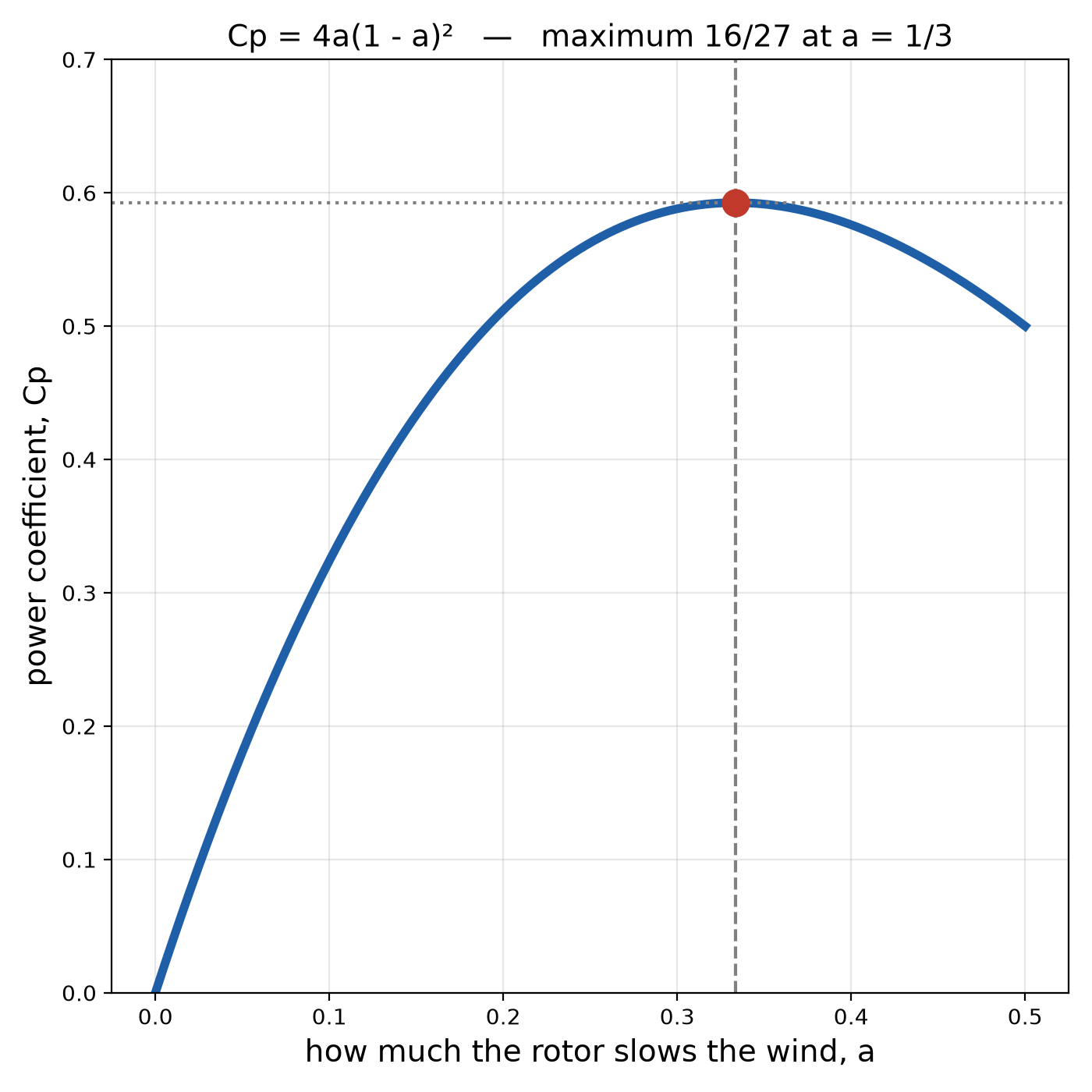
A wind rotor makes power by slowing the wind. Slow it too little and most of the energy blows through; slow it too much and the air piles up and goes round the rotor instead of through it. Between the two lies a best amount, and it caps every rotor that has ever been built at 16/27 — 59.3 % — of the power in the wind.
Albert Betz published the result in 1919–20; Frederick Lanchester and Nikolai Zhukovsky reached it independently, and it is sometimes given all three names.
This practice rung derives the limit in a notebook and uses it to rate the small rotor built in the first rung of this batch.
Débutant
About 2 hours
Consignes
1
1
Derive the limit
Derive the limit
Chargement du notebook Jupyter…
2
2
See the slowed wake
See the slowed wake
Set the rung-1 rotor in front of the box fan and hold a smouldering incense stick just upstream of the rotor disc, then just downstream, and watch the smoke. Measure the wind speed with the anemometer a rotor diameter in front, and a rotor diameter behind — with the rotor loaded, and then with the load disconnected so it free-wheels.
The loaded rotor leaves a slower wake than the free-wheeling one: slowing the air is where the power comes from. The notebook says the best wake is one third of the incoming wind; see how close your rotor's gets.
Matériaux pour cette étape :
 Bâtonnets d'encens pour visualisation de la fumée2 pièces
Outils nécessaires :
 Ventilateur caisson (vitesse variable)
 Anémomètre portatif
 Mètre ruban
3
3
Rate your rotor against Betz
Rate your rotor against Betz
From the first rung's measurements, take the electrical power at one wind speed. Divide it by the wind power through your rotor's disc at that speed (the notebook prints it): that is your Cp. Divide again by 0.593 to see what fraction of the theoretical best you reached.
Expect a small printed rotor on a hobby motor to reach only a fraction of the Betz limit: the motor's own losses, the blade drag at low Reynolds number and the tip losses all take their share. That gap is what a century of blade design has closed.
Outils nécessaires :
 MultimètreAnémomètre portatif
4
4
Context
Context
**Albert Betz**, Göttingen, published the limit in 1919–20. It uses nothing but conservation of mass, momentum and energy through an idealised disc, which is why it applies to every kind of rotor — Savonius, Darrieus and propeller alike (the next two rungs). It is a practice rung: no patent anchors it.
**Honest limits of the model.** It ignores the swirl a rotor leaves behind, blade drag and tip losses — all of which lower the real figure further. It applies to an open rotor in a free stream; a rotor in a duct or a pipe (the Kaplan turbine) is a different problem.
Matériaux
1- Espace réservé
Outils requis
4- Espace réservé
- Espace réservé
- 1 vendor sell this, none ship to you yetEspace réservé
- Espace réservé
Blueprints liés
Ces blueprints partagent des connaissances — techniques, matériaux ou principes


CC0 Domaine public
Ce blueprint est publié sous CC0. Vous êtes libre de copier, modifier, distribuer et utiliser ce travail pour tout usage, sans demander la permission.
Soutenez le Maker en achetant des produits via son Blueprint où il perçoit une Commission Maker définie par les Vendeurs, ou créez une nouvelle itération de ce Blueprint et incluez-le comme connexion dans votre propre Blueprint pour partager les revenus.